
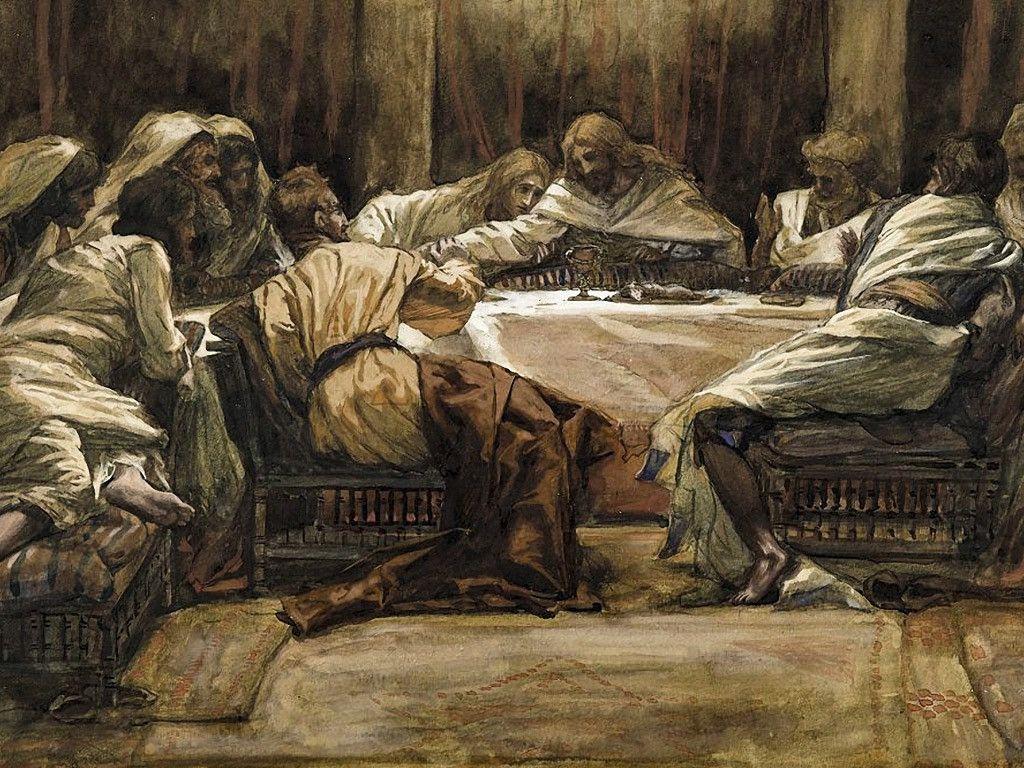
The Last Supper, by James Tissot (c. 1886–1894). Tissot’s historically inspired depiction of Jesus’ final Passover meal with His disciples. Public domain.
For centuries, critics have argued that John’s Gospel presents a different Passover chronology than the Synoptic Gospels.1
The Synoptic Gospels—Matthew, Mark, and Luke—clearly present the Last Supper as a Passover meal. Jesus instructs His disciples to prepare the Passover, gathers with them that evening, and is arrested later that night. Read by themselves, these accounts naturally suggest that Jesus ate the Passover on the proper day—the fourteenth day of the first month (Ex. 12:6, Ex. 12:18, Lev. 23:5)—and was crucified the following day.
John’s Gospel, however—written much later than the Synoptic Gospels—appears to place the Jewish authorities on a different timetable. During Jesus’ trial they refuse to enter Pilate’s residence because they still intended to eat the Passover.
“Then they led Jesus from Caiaphas to the Praetorium, and it was early morning. But they themselves did not go into the Praetorium, lest they should be defiled, but that they might eat the Passover.” —John 18:28
John reinforces this chronology by describing Jesus’ trial as taking place on “the Preparation of the Passover” (John 19:14), suggesting that the Passover sacrifices were still ahead. He also uniquely introduces Jesus as “the Lamb of God” (John 1:29, 36) and later notes that none of His bones were broken (John 19:36), echoing the requirements for the Passover lamb (Ex. 12:46). Taken together, these details suggest that Jesus died on Passover, at the very time the lambs were being sacrificed. Interestingly, this was also the unanimous testimony of the early Church, which consistently associated Jesus’ crucifixion with Nisan 14—the Passover.
Common Reconciliations
At first glance, the chronology appears difficult to reconcile. If Jesus had already celebrated the Passover with His disciples, why were the Jewish leaders still preparing to eat it? And if the Passover meal had not yet occurred, why do the Synoptic Gospels describe the Last Supper as a Passover meal?
Several explanations have been proposed. The most common focuses on the meaning of the word Passover. Some argue that John uses the term more broadly than the Synoptic Gospels, referring to the entire festival week rather than to the Passover meal itself.² While there is evidence that Passover could be used in this broader sense, it does not fully explain why the Jewish authorities had not yet eaten the Passover meal described in John 18.
Others suggest that the Last Supper was not actually a Passover meal, but rather a gathering held the evening before Passover. This explanation also faces difficulties, since the Synoptic Gospels repeatedly identify the meal as the Passover.
These proposals have merit and continue to be discussed by biblical scholars. Yet they share one common feature: they attempt to reconcile the accounts by redefining the term Passover.
But what if the real solution lies elsewhere?
Differing Passover Traditions?
Another possibility is that the apparent discrepancy reflects differing Passover traditions within first-century Judaism, with John’s Gospel focusing on one tradition while the Synoptic Gospels reflect another.
This proposal has historical merit. Judaism during the Second Temple period was not uniform, and disagreements over the calendar and the observance of the biblical feasts are well documented.³
If so, the Synoptic Gospels could naturally reflect the Passover tradition followed by Jesus and His disciples, while John presents the events from the perspective of the Temple authorities, whose calendar governed the official sacrifices. Under such a reconstruction, Jesus could celebrate the Passover with His disciples while still dying during the Passover observed at the Temple.
If correct, this proposal offers an elegant reconciliation without redefining the word Passover or minimizing the significance of the Last Supper.
But this proposal also raises another question: How could such differences persist?
Some point to Israel’s observational calendar, which depended upon witnesses identifying the first visible crescent of the new moon and the ripening of the barley harvest. Under such a system, different groups could occasionally reach different conclusions, causing feast days to differ by a day.
Yet such disagreements would seem relatively easy to resolve. The Jews would sooner die than compromise on a theological conviction—but would they divide over differing moon sightings?
History suggests otherwise. Lasting divisions within Judaism were usually theological rather than observational. Jewish sects frequently disagreed over the interpretation of Scripture, and those disagreements often endured for generations. If two Passover traditions truly existed, the underlying cause was likely interpretive rather than observational.
That brings us to the issue of the reckoning of days.
When Do Days Begin?
Most people are familiar with the Jewish practice of reckoning days from evening to evening—that is, a new calendar day begins at sundown rather than at dawn.
But did all ancient Jews believe this?
More importantly, does Scripture actually teach it?
This question is far more significant than it may first appear. If one group reckoned its days from evening to evening while another reckoned them from morning to morning, both could celebrate the Passover on different evenings while honestly believing they were observing the same biblical date—Nisan 14. Such a difference would naturally produce two Passover traditions without requiring different calendars or conflicting Gospel accounts.
Historical evidence indicates that an evening-to-evening reckoning was the dominant practice during the Second Temple period, as reflected in Josephus and later rabbinic tradition.⁴ This appears to have been the reckoning followed by the Temple authorities in Jesus’ day.
But was it the reckoning taught by Moses? And could the Synoptic Gospels be preserving that earlier understanding?
Let’s examine the biblical evidence, beginning with Genesis.
GENESIS
Genesis 1 concludes each day of creation with the familiar refrain, “There was evening and there was morning.” Because evening is mentioned first, many conclude that the biblical day begins at sunset.
But is that what the text actually says?
Genesis never states, “The day began in the evening.” Rather, it simply records that each day consisted of an evening followed by a morning. The order is there, but what does that order actually tell us?
The first thing to notice is that evening and morning function as boundary markers—dusk and dawn. Evening (dusk) marks the close of the daylight period, while morning (dawn) marks the close of the night. Under this reading, the daylight period comes first.
Think about it. God completes His creative work during the daylight period. Then comes evening—the transition from day to night. Likewise, morning marks the transition from night to day. Under this understanding, the refrain describes the boundaries of the night rather than the beginning of a new day. Viewed this way, the expression, “there was evening and there was morning,” could be understood as saying, “The day ended, and the night ended.”
Whether one accepts that interpretation or not, Genesis alone does not settle the question. Let’s turn to another important passage.
THE DAY OF ATONEMENT
A second passage frequently cited is God’s instruction concerning the Day of Atonement. Israel was commanded to observe the fast “from evening to evening” (Lev. 23:32). Many understand this as evidence that biblical days were reckoned from sunset to sunset.
Yet this conclusion is also an inference rather than an explicit statement. God’s instruction may have applied specifically to the fast itself rather than to the reckoning of days. In fact, there may have been a practical reason for beginning the fast at evening.
Think about it. How would one begin a morning-to-morning fast? To do so, a person would need to eat one final meal before dawn, perhaps rising in the middle of the night to do so. Otherwise, he would simply be continuing the overnight fast that had already begun while he slept.
By contrast, an evening-to-evening fast begins naturally after the evening meal. The night’s sleep occupies the first portion of the fast, making the observance far more practical for an entire nation—including children.
Whether or not one accepts this reasoning, the Day of Atonement instruction still does not explicitly define when a new day begins. It simply commands that this particular fast be observed from evening to evening.
That brings us to another passage—one that may speak even more directly to the question.
THE PASSOVER INSTRUCTIONS
Ironically, the strongest biblical evidence for a morning-to-morning reckoning may come from God’s instructions for the very first Passover.
Israel was commanded to slaughter the Passover lamb and eat the meal on the fourteenth day of the first month, at twilight (Ex. 12:6, 18; Lev. 23:5). The key expression is at twilight—a rendering found in virtually every major modern English translation.
If the ordinary meaning of twilight is intended, it refers to the transition from daylight to darkness immediately following sunset. Here, however, an important question arises.
If a new day begins at sunset, then twilight marks the beginning of the fifteenth day. Yet the Passover is repeatedly associated with the fourteenth day at twilight.
This tension did not go unnoticed. Later rabbinic tradition resolved it by interpreting “between the evenings” (bein ha’arbayim) as the late afternoon, roughly from mid-afternoon until sunset. By the time of Jesus, this appears to have been the practice of the Temple authorities. The Passover lambs were slaughtered during the afternoon of Nisan 14, while the meal itself was eaten after sunset, technically at the beginning of Nisan 15—a practice that continues in Judaism today.
But is that what Moses intended?
Leviticus 23:5 simply states:
“On the fourteenth day of the first month at twilight is the LORD’S Passover.”
The Old Testament never says the Passover begins on the fifteenth day. Rather, it consistently associates the Passover with the fourteenth day at twilight (Ex. 12:6, 18; Lev. 23:5).
If twilight is understood in its ordinary sense, the Mosaic instructions seem to fit naturally within a morning-to-morning reckoning, where the evening following sunset still belongs to the fourteenth day.
If so, it becomes much easier to understand why Jesus and His disciples could have celebrated the Passover one evening before the Temple authorities. Rather than departing from Scripture, they may have been preserving an older interpretation of it.
Differing Perspectives
Under this framework, the apparent discrepancy between John and the Synoptic Gospels becomes remarkably simple.
The Synoptic Gospels describe the Passion from the perspective of a Passover tradition consistent with a morning-to-morning reckoning of the day. Under this understanding, Nisan 14 continued through the evening following sunset, allowing Jesus to celebrate the Passover with His disciples before His arrest later that night.
John, however, draws attention to the Passover observed by the Temple authorities, whose evening-to-evening reckoning placed Jesus’ crucifixion on the very day the Passover lambs were being sacrificed. From that perspective, Jesus truly died as the Passover Lamb.
Both perspectives can therefore be historically accurate. The Synoptic Gospels preserve the chronology of Jesus’ final Passover meal, while John emphasizes the profound theological significance of His death in relation to the Temple’s Passover observance.
Rather than contradicting one another, the Gospel writers may simply be viewing the same events through the lens of two contemporaneous Passover traditions.
This proposal is not new, and there is solid scholarship behind it. One of its best-known modern advocates is New Testament scholar Harold W. Hoehner. In Chronological Aspects of the Life of Christ, Hoehner argued that the apparent discrepancy between John’s Gospel and the Synoptic Gospels can be reconciled if Jesus and His disciples followed a morning-to-morning reckoning of the day, while the Judean religious authorities followed the more familiar evening-to-evening reckoning.⁴
If this understanding is correct, both Gospel traditions preserve something profoundly important. The Synoptic Gospels record Jesus celebrating a final Passover meal with His disciples. John, meanwhile, emphasizes that Jesus died as the true Passover Lamb. Rather than competing chronologies, the two accounts may simply reflect two contemporaneous ways of reckoning the Passover.
And that leads to one final piece of evidence that is often overlooked.
EARLY CHURCH TRADITION
If there truly were a contradiction between John and the Synoptic Gospels, we might expect the earliest Christians to have debated it. Some would have defended a Nisan 15 crucifixion based on the Synoptics, while others argued for John’s apparent Nisan 14 chronology.
But that is not what we find.
The earliest Christian tradition consistently associated Jesus’ death with Nisan 14, the day of Passover. The debate was never over when Jesus died. Rather, it concerned when Pascha (the Christian Passover/Easter) should be celebrated—on Nisan 14 itself or on the following Sunday in honor of the Resurrection.⁵ No early Christian writer argued for a Nisan 15 crucifixion.
Why?
Perhaps because the earliest Christians never perceived the contradiction that many modern readers assume. They understood that Jesus both celebrated the Passover with His disciples and died as the Passover Lamb.
Is the day-reckoning proposal correct?
I cannot say with certainty. While I believe the biblical case for a morning-to-morning reckoning is compelling, the historical evidence is not conclusive, and I readily acknowledge that.
What is beyond dispute is this: Jesus celebrated the Passover with His disciples, and Jesus died as our Passover Lamb.
Whatever historical details ultimately reconcile those two realities, the theological truth remains unchanged.
“For indeed Christ, our Passover, was sacrificed for us.” —1 Corinthians 5:7
Footnotes
1. The Skeptic’s Annotated Bible, “When (on what day) was Jesus crucified?”, https://www.skepticsannotatedbible.com/contra/passover_meal.html (accessed June 26, 2026).
2. Luke 22:1 (“Now the Feast of Unleavened Bread drew near, which is called Passover”).
3. Josephus, Antiquities of the Jews 13.297–298.
4. For a representative evangelical reconciliation, see GotQuestions.org, “If Jesus was crucified on the Day of Preparation, why had He already eaten the Passover meal?”, https://www.gotquestions.org/Day-of-Preparation.html (accessed June 26, 2026). For an alternative proposal based on differing sunrise-to-sunrise and sunset-to-sunset reckonings of the day, see Harold W. Hoehner, Chronological Aspects of the Life of Christ (Grand Rapids: Zondervan, 1977).
5. Eusebius, Ecclesiastical History 5.23–25 (the Quartodeciman controversy).
Leave a Comment
You must be logged in to post a comment.