Blog

  • Are the Jews in Israel the Real Jews?

    Are the Jews in Israel the Real Jews?

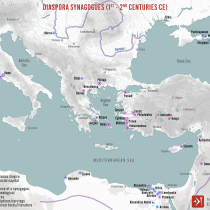
    Jewish diaspora synagogues across the Roman world showing historical continuity
    Map of Diaspora Synagogues (1st–2nd centuries CE) by Simeon Netchev, via World History Encyclopedia (CC BY-NC-ND).
    https://www.worldhistory.org/image/4141/

    Are the Jews currently living in Israel the same Jews the Bible speaks about? Are modern Jews truly the descendants of the ancient people of Israel?

    Those questions have recently resurfaced in a very public way. As you may know, a well-known public voice has recently called for genetic testing of the people of Israel. Why? To determine whether the promises of God still apply to them.

    This political pundit claims to be a Christian and demands to know the truth about these people. If modern Jews are not related to the covenant people described in Scripture, then all bets are off. Commands such as these could simply be ignored:

    • Do not boast against the natural branches (Rom. 11:18)

    • Do not be arrogant (Rom. 11:20)

    • Recognize God’s continuing purpose for them (Rom. 11:28–29)

    Regardless, he—and many others—have serious doubts, and they trumpet those doubts across the internet.

    But are they correct?

    Before getting into this, it’s important to note that curiosity itself is not wrong. Even allies of Israel may wonder about this genetic question. The good news is that there are answers—both from the Bible and from science.

    So let’s dig in.

    Here are four facts everyone should know about modern Jews, history, and genetics.


    1) Israel Was Never Genetically Pure

    When people suggest that a genetic test could determine who the “real Jews” are, they often begin with a mistaken assumption about how God originally constituted the nation of Israel.

    Israel was never a genetically pure people in the way many imagine.

    To see this, we need to go back to Genesis, of course.

    The patriarch of the Jewish people is Abraham, a descendant of Shem—one of Noah’s three sons who repopulated the world after the Flood.

    Noah’s other sons were Ham and Japheth, whose descendants spread into other regions of the world (Gen. 10). For a time these groups remained largely distinct, but over the centuries they inevitably mixed and intermarried.

    By the time Abraham appeared generations later, there is no reason to think his ancestry was “genetically pure” in any modern sense. Abraham lived in Ur of the Chaldeans, a major city in Mesopotamia and a crossroads of ancient trade and migration. Different peoples lived and interacted there, making it highly likely that families in that environment—including Abraham’s—carried a mixture of ancestral backgrounds.

    He had one genealogical line going back to Shem, but he likely had countless other lines connecting him to many different peoples. In other words, a single genealogical line does not determine one’s dominant genetic makeup. We’ll return to that idea in the next section.

    Now Abraham’s grandson Jacob—whom God renamed Israel—later went down to Egypt to join Joseph, bringing his entire household with him (Gen. 46:1–7). Through his twelve sons, the direct male descendants numbered about seventy (or seventy-five)¹. But the full household—including women, children, and servants—likely numbered in the hundreds. From the very beginning, this was a diverse household.

    But the genetic story becomes even more intriguing at the time of the Exodus.

    The “Mixed Multitude”

    At the time of the Exodus, Moses drops an important and relevant detail:

    “Then the children of Israel journeyed from Rameses to Succoth, about six hundred thousand men on foot, besides children. A mixed multitude went up with them also…”
    — Exodus 12:37–38

    Israelites leaving Egypt during the Exodus including the mixed multitude (Exodus 12:38)
    The Israelites leaving Egypt during the Exodus (Exodus 13).

    This is not a minor observation. Who exactly were the “mixed multitude” that left Egypt with Israel?

    When Israel departed Egypt, they did not leave alone. Along with them traveled a large group of foreigners from various backgrounds. These people came under the same law, worshiped the same God, and were incorporated into the covenant community. Scripture even states that if a foreigner joined Israel and kept the Passover, “he shall be as a native of the land” (Ex. 12:48–49).

    So from the very beginning, Israel was bound together not by genetic isolation, but by covenant.

    Marriage was never forbidden simply because someone came from another ethnic background; it was forbidden when it would lead Israel into idolatry (Deut. 7:3–4). The concern was always worship, not bloodlines.

    Many modern readers—including some well-meaning Christians—misunderstand this point. They imagine the ancient Jews as an ethnically sealed population that God placed within a geographic boundary. Perhaps they think of the kind of ancestry tests used to determine membership in some Native American tribes, where biological continuity is more concentrated.

    But that model would not work in the case of Israel. From the beginning, Israel functioned as an ethnically open society. They were never bound together by racial or biological uniformity. Instead, they were united by covenant faith, shared worship of the God of Israel, and a common culture formed by the Law.

    This also helps explain why people often wonder what Jesus actually looked like. Which people group would he have most resembled?

    A “Genetically Pure” Messiah?

    Yes, Jesus had a specific genealogical line of descent:

    Jesus → David → Judah → Jacob → Isaac → Abraham


    But even the genealogy of Jesus quietly reminds us that Israel’s history was never about ethnic purity. Matthew’s genealogy includes women such as Rahab, a Canaanite from Jericho, and Ruth, a Moabite who joined Israel by covenant faith (Matt. 1:5). Both became ancestors of King David—and ultimately of the Messiah Himself.

    Yet Mary would have had countless ancestral lines spreading in every direction across the ancient world. Only one line needed to connect Him to Jacob for Him to be:

    • the Son of David

    • the Lion of Judah

    • the Son of Abraham

    If “DNA purity” were the standard, even the Messiah would fail the test. But it was never about genetics—it was always about a specific genealogy.

    So does that mean modern genetics is useless? A moot subject?

    Actually, no. In fact, genetics turns out to be quite helpful—and it reveals something remarkable.


    2) Modern Jews Are Genetically Related to One Another

    When people observe Jewish populations around the world, a common question arises.

    Why do Jews often resemble the surrounding populations where they have lived? European Jews often resemble Europeans. African Jews resemble Africans. Asian Jews resemble Asians.

    So are these communities actually related?

    Genetic science says yes.

    Instead of trying to extract tiny DNA fragments from a small founding group thousands of years ago, researchers have asked a more meaningful question: Do Jewish populations share a common genetic ancestry with one another?

    Major peer-reviewed genetic studies — including Behar et al. (Nature, 2010)2 and Atzmon et al. (The American Journal of Human Genetics, 2010)3— analyzed Jewish populations from Europe, North Africa, the Middle East, and Central Asia.

    Their findings were striking, though not surprising for those familiar with the biblical record.

    Despite centuries of living among different host populations, Jewish communities form a distinct but related genetic cluster. In other words, they are more closely related to one another than to the surrounding populations among whom they lived.

    Even more importantly, their shared ancestry traces back to the ancient Near East—exactly what we would expect if these communities ultimately descend from the historic people of Israel.

    So the real genetic question is not: “Can we isolate a measurable percentage of Jacob’s DNA?”

    The meaningful question is: “Do Jewish populations show evidence of a shared historical origin?”

    And the answer, repeatedly, is yes.

    What About the Khazar Theory?

    At this point, someone following certain high-profile voices will inevitably raise the Khazar theory, suggesting that modern Jews are largely descended from a medieval Turkic kingdom whose ruling class adopted Judaism in the eighth or ninth century.⁴

    Even if some Khazars did convert—which historians generally acknowledge—that hardly proves what critics think it proves.

    Discovering that another people group may have entered Jewish ancestry is not shocking at all. As we have already seen, Israel was never a biologically sealed people to begin with. From the Exodus onward, outsiders joined the covenant community, and over centuries of diaspora life, conversion and intermarriage were inevitable.

    In other words, pointing to one additional people group somewhere in Jewish ancestry proves nothing.

    In fact, the argument unintentionally proves the opposite of what its advocates intend. Conversion and incorporation into the Jewish people have always been part of Jewish history.

    Population genetics also does not search for “pure” ancestry. The real question is whether Jewish populations still share a common historical origin—and modern genetic studies consistently show that they do.

    So pointing to a single medieval conversion and declaring “Aha!” only demonstrates a misunderstanding of both biblical history and basic genetics.


    3) The “Jewish Identity Theft” Theory Makes No Sense

    Even before considering the biblical and genetic evidence, the identity-theft theory collapses under its own weight.

    It is all risk and no reward.

    From the moment Israel emerged as a nation, the Jewish people have faced:

    • enslavement

    • exile

    • persecution

    • attempted extermination

    —from Pharaoh to Hitler.

    The Book of Revelation captures this long pattern of hostility in a striking vision in chapter 12. Israel appears as a woman pursued by a ravenous dragon. She is described as wearing a crown of twelve stars—imagery that echoes Joseph’s dream in Genesis 37:9—an unmistakable reference to the twelve sons, or tribes, of Israel.

    In the vision, the woman gives birth to the Messiah, who is then caught up to God’s throne, beyond the dragon’s reach. Enraged, the dragon turns his fury back on the woman and seeks to destroy her. Yet she is preserved by the intervention of God (see Rev. 12:1–16).

    Theologians have long debated why the dragon’s rage is directed toward Israel. Whatever the ultimate explanation, the pattern in history is striking.

    So we must ask a simple question: what would be the incentive for another people group to adopt that identity?

    History shows the opposite pattern. Persecuted minorities usually try to hide their identity, not invent one.

    For this reason, the idea that a global population somehow replaced the historic Jewish people—without leaving overwhelming historical evidence—is simply not a serious historical model.


    4) No Other People Fit the Biblical Description

    There is another problem with the impostor theory that is rarely addressed.

    The New Testament repeatedly speaks of a continuing Jewish people who exist in a state of unbelief.

    Paul describes them this way:

    “With respect to the gospel they are enemies, but with respect to election they are beloved for the sake of the fathers.”
    — Romans 11:28

    Paul was grieving over his fellow Jews who had rejected the Gospel. He knew that salvation comes only through faith in Jesus. Yet he also insisted that God had not finished with Israel. According to Romans 11, Israel has experienced a partial hardening for a season, but God still has a future purpose for them.

    In that same chapter, Paul commanded Gentile Christians not to boast against the Jewish people and not to become arrogant toward them. These warnings were written down for future generations of believers to read for centuries.

    And this raises a very simple question.

    If the Jews living in Israel and throughout the world today are impostors, then who exactly are the unbelieving Jews Paul was talking about?

    The Old Testament also contains prophecies describing Israel being gathered back to their land before their national repentance and restoration. One well-known example is the vision of the dry bones in Ezekiel 37, where Israel is first brought back to life as a nation and only afterward receives the breath of spiritual renewal. Other passages describe a similar pattern of regathering followed by repentance (for example, Deuteronomy 30:1–6; Ezekiel 36:24–27; and Zechariah 12:10).

    Again, the question is unavoidable:

    What other identifiable people group in the world

    • descends from the patriarchs

    • remains historically distinct among the nations

    • and continues largely in unbelief

    while still being recognized throughout history as the Jewish people?

    No other people group fits that description. The only community in the world that matches the biblical category of an unbelieving yet historically continuous Israel is the Jewish people themselves—both in Israel and throughout the diaspora.


    The Bottom Line

    You cannot escape the biblical implications—the warnings, promises, and prophecies concerning the people of Israel—simply by dismissing modern Jews as illegitimate.

    That proposed loophole fails on every level. It is:

    • not biblical

    • not historical

    • not scientific

    • not logical

    So here is a simple suggestion: open the Bible and examine the texts themselves.

    What do the Old and New Testaments actually say about the Jewish people? What do they reveal about unbelieving Jews—past, present, and future? And what do the Scriptures say about the nation of Israel?

    These things were revealed for our benefit, and they become a blessing when they are understood and believed (Rev. 1:3).

    And when you hear claims that modern Jews are impostors who somehow stole Israel’s identity, recognize the argument for what it is: a convenient excuse.

    Footnotes

    1. The number of Jacob’s household entering Egypt is given as seventy in the Masoretic Text (Gen. 46:27; Ex. 1:5)and seventy-five in the Greek Septuagint, which is the number cited in Acts 7:14

    2. Behar, Doron M., et al. The Genome-Wide Structure of the Jewish People. Nature 466 (2010): 238–242.
      https://www.nature.com/articles/nature09103

    3. Atzmon, Gil, et al. Abraham’s Children in the Genome Era: Major Jewish Diaspora Populations Comprise Distinct Genetic Clusters with Shared Middle Eastern Ancestry. The American Journal of Human Genetics 86 (2010): 850–859.
      https://pmc.ncbi.nlm.nih.gov/articles/PMC3032072/

    4. The Khazar conversion to Judaism is widely discussed in historical scholarship. While the Khazar elite likely adopted Judaism in the early medieval period, historians and geneticists find no evidence that this population replaced existing Jewish communities or accounts for the majority of modern Jewish ancestry.

  • How old was Abel when Cain killed him?

    How old was Abel when Cain killed him?

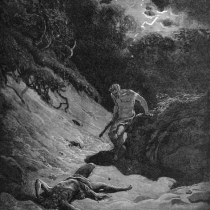
    Cain kills Abel
    Gustave Doré: Cain kills Abel

    Short answer: a lot older than most realize.  

    Scripture doesn’t specify Cain’s or Abel’s age at the time of the murder, but we do have clues indicating they were both quite old.  The textual evidence, in fact, seems to indicate they were well into their hundreds.  

    Come again?  If that sounds outlandish, consider the following.  

    Seth Was Not The 3rd Child

    Reading Genesis 4, alone, you may be tempted to think Cain, Abel and Seth were born in succession, since they’re the only children mentioned in the account.  On closer examination, however, this is not likely. While it’s likely Cain and Abel were the first two sons of Adam, Seth couldn’t have been the third.  

    In the narrative, we learn Seth was born after Abel’s death, and that he was a special replacement for Abel. 

    Gen. 4:25   And Adam knew his wife again, and she bore a son and named him Seth, “For God has appointed another seed for me instead of Abel, whom Cain killed.”

    Offerings of Cain and Abel
    The Offerings of Cain and Abel
    Carving from the main doors of the Sainte Chapelle in Paris

    We also know Cain and Abel were of working age at the time of the murder—Cain a farmer, Abel a rancher, respectively.  

    Gen. 4:2 ….. Now Abel was a keeper of sheep, but Cain was a tiller of the ground.

    At minimum, just based on this chapter alone, Abel would have been a generation apart from Seth.  If Seth was the 3rd child, one would have to ask why Adam and Eve abstained for so long (minimum 12-18 years) before having more children, especially given the commandment to be fruitful, multiply (Gen. 1:28)?  

    That said, the evidence goes way beyond this.

    Seth was born when Adam was 130

    In Genesis chapter 5 we have a genealogical record which reveals Adam was130 years old when he fathered Seth.

    Gen. 5:3 And Adam lived one hundred and thirty years, and begot a son in his own likeness, after his image, and named him Seth.

    Think about that.  If Cain and Abel were the first sons of Adam, conceived and born soon after the Creation, and Seth was born 130 years later, how could Seth possibly be the third son?  We would have to believe Adam and Eve refrained from relations for more than a century after Abel’s birth.  

    Another scenario is that Adam and Eve abstained for more than a century after bering created, until they finally had their first 3 sons—Cain, Abel and Seth.  None of these scenarios work. 

    First, Eve was likely the most attractive woman who ever lived.  She was created directly by God, prior to the Fall and before any sin or decay had touched the earth.  What motive, even fleshly motive, would Adam have had to ignore her for 100+ years?  

    Second, and more significantly, God commanded Adam and Eve to multiply and fill the earth (Gen. 1:28). If they abstained for a century, we’d have to assume they rebelled for a century, and there is no evidence to sustain this.  

    The simplest explanation is that Adam and Eve had a multitude of children after Abel and prior to Seth.  Cain and Abel were likely born in succession, followed by at least a couple dozen children before Seth.  But the evidence doesn’t stop there. 

    Cain feared retribution from his relatives

    When God confronted Cain about his brother’s death, he denied knowing about it.  “Am I my brother’s keeper” was his sarcastic rejoinder, based on Abel’s profession of keeping flocks (Gen. 4:9).  But when God cursed him and informed him of his fate, he changed his tune.  Cain feared for his life.  

    Gen. 4:13  And Cain said to the LORD, “My punishment is greater than I can bear! 14 …I shall be a fugitive and a vagabond on the earth, and it will happen that anyone who finds me will kill me.”

    Who was Cain talking about?  Obviously, there were other men in existence, at the time, who could do him harm.  He was not alone with his two parents, and he certainly wasn’t worried about future, yet-to-be-born siblings who would come around some 20 years later.  The simplest explanation is that he was afraid of his own adult brothers and their adult descendants. 

    In the Genesis 5 genealogy, we’re also told Adam had many sons and daughters.  

    Gen. 5:4 After he begot Seth, the days of Adam were eight hundred years; and he had sons and daughters. 5 So all the days that Adam lived were nine hundred and thirty years; and he died.

    According to the Jewish historian, Josephus, Adam had 33 sons and 23 daughters (Antiq. 1:68-3 notes).  This is not an inspired record, but Josephus was a reliable historian with access to writings and traditions that are now lost.  56 children is also quite logical, considering Adam’s lifespan of 930 years.  

    We also know Seth was not the firstborn even though he’s the first mentioned in this genealogy.  In fact, it’s unlikely any of the sons in this genealogy were firstborns.  Look at the fathers’ ages at the time of each sons’ birth: Seth’s father-130, Enosh’s father-105, Kenan’s father-90, Mahalalel’s father-70, Jared’s father-65, Enoch’s father-162, Methuselah’s father-65, Lamech’s father-187, Noah’s father-182.  These are clearly not firstborns, just sons in a particular lineage—in this case, Noah’s lineage, and ultimately Christ’s lineage.  

    Thus, Adam had numerous children before Seth and after Seth, and Cain was rightfully afraid of the former.  

    Cain and Abel both married with children?

    If Cain and Abel were over a century old at the time of the murder, they likely also had families and descendants, for they too were commanded to multiply and fill the earth (Gen. 1:28).  Is there any reason not to believe this?—particularly righteous Abel, whose sacrifice was more excellent than Cain’s (Heb. 11:4)?  I believe both had a wife and descendants at the time of the murder. It’s conjecture, but a logical inference from the Text. 

    Josephus, a first century Jewish historian, seems to corroborate this, writing that Cain and his wife were driven from the land. 

    Antiq. 1:58 God therefore did not inflict the punishment [of death] upon him, on account of his offering sacrifice, and thereby making supplication to him not to be extreme in his wrath to him; but he made him accursed, and threatened his posterity in the seventh generation. He also cast him, together with his wife, out of that land.
    ….60 And when Cain had travelled over many countries, he, with his wife, built a city named Nod, which is a place so called, and there he settled his abode; where also he had children…

    Again, his works are not inspired but they are reliable, and do reflect historical Jewish thought.  Scripture doesn’t specifically mention Cain’s wife being with him at this time, but it doesn’t rule it out, either.  

    Josephus also corroborates Adam and Eve having a plurality of daughters along with Cain and Abel. 

    Antiq. 1:52 Adam and Eve had two sons; the elder of them was named Cain; which name, when it is interpreted, signifies a possession. The younger was Abel, which signifies sorrow. They had also daughters.

    They both had opportunities to marry.  

    Conclusion

    Cain and Abel were likely over 120 years old when the first murder in history went down.  They were not alone on the earth, but elders in a rapidly growing population.  While the children of Adam would have been denied entrance into the Garden of Eden, they were all still living in the land of Eden, working and enjoying the good remnants of a fallen world. Then Cain murdered Abel and was driven from the land, along with this wife.  

    Obviously dogmatism isn’t warranted, but this is the most plausible inference from the biblical and historical data.  

    Does it matter?

    Yes.  Skeptics have long charged that Cain’s “wife” and his supposed “enemies” don’t fit in with the rest of the narrative.  They are plot-holes in a fictional account, that slipped through the editing process.  The Skeptic’s Annotated Bible, in connection with Gen. 4:14 notes,

    Every one that findeth me shall slay me. [v.14]

    Cain is worried after killing Abel and says, “Every one who finds me shall slay me.” This is a strange concern since there were only two other humans alive at the time — his parents!

    Skeptics have also been tauntingly asking, “Where did Cain find his wife?”  Being his mom was the only woman on earth at the time, who is this mysterious woman living in Nod?

    And Cain knew his wife. [v.17]
    That’s nice, but where the hell did she come from? The Bible doesn’t mention any of Cain’s sisters.

    Well, maybe he married his mom, or maybe God pulled another creation over in the next county. In any case, Cain and the mysterious Mrs. Cain have a son (another blue cigar!). His name is Enoch and he builds a city (population 3).

    Peter commanded us to give an answer (1Pet. 3:15), and Paul commanded us to tear down arguments against the knowledge of God (2Cor. 10:5). These objections are easily answered when we read carefully and understand what’s in the Text and what’s not in the Text. 

    If you’re fortunate enough to be confronted with one of these objections, make sure you’re ready. 

    Further Reading

    How old was Cain when he killed Abel? (Creation Ministries International)

    Cain’s Wife Still On Trial (Talk Genesis)

    Who was Cain’s Wife? (Answers in Genesis)

    Who Was Cain Afraid Of? (Midwest Apologetics)

  • Is the Age of the Earth Unrelated to Salvation?

    Is the Age of the Earth Unrelated to Salvation?

    Tactics: A game plan for discussing your Christian convictionsThis is the assertion of Greg Koukl in his book, “Tactics: A Game Plan for Discussing Your Christian Convictions”  I loved the book, but stumbled on something he said toward the end of it. In chapter 21, he seemed to urge his readers to stay away from certain topics like the age of the earth and end-times.  To illustrate, he shared a recollection of a man on a plane rigorously witnessing to passengers on either side of him.  While Koukl commended the man, he felt he delved into areas he shouldn’t have.

    On the way to sharing about the cross, our Christian passenger ranged from young earth creationism to Armageddon. Now that’s a lot to have to chew on to get to Jesus!  The basic Gospel is challenging enough and generally you’ll have to deal with a few obstacles that come up, but if the listener is interested, why complicate things with controversial issues unrelated to salvation?  Remember, you want to put a stone in his shoe, not a rock pile. 

    In general, I agree there are times we go further than we should.  The man on the plane may indeed have gone too far (I wasn’t there, so can’t say for certain).  The point is, I’m not critiquing that per se, but rather Koukl’s assertion that the age of the earth (and end-times) are irrelevant to the Gospel.  “Why complicate things with controversial issues unrelated to salvation?”  I think he’s mistaken on this. 

    Challenge Evolution, Not Age?

    Interestingly, Koukl does suggest engaging in the topic of evolution.  If you’ve listened to Greg for any length of time, you know he’s an old earth creationist, meaning he rejects the naturalistic view of evolution, but accepts the evolutionary timeline (millions/billions of years).  In his book, therefore, you’ll find several suggestions on how to challenge evolution, but nothing to challenge the deep time which is so vital to the rest of the theory.  This makes sense since he affirms the modern scientific view of deep time, and even sees the Big Bang as an apologetic asset. 

    I would challenge him on this, however.  I believe Mr. Koukl and old earth creationists have this exactly backwards.  Deep time (millions of years) is actually much more deleterious to the Gospel message than evolution.  Let me explain.  

    History Matters

    When people tell me the age of the earth doesn’t matter, I’ll usually acquiesce with a small clarification.  I might respond, “Precise age doesn’t matter, but the precise history does!  Do you agree with me that the history of the earth, as revealed in the Bible, matters?” 

    Hearing it framed this way, most genuine Bible-believing Christians will backpedal.  Many balk at the importance of age, but few at the importance of history, particularly biblical history.  The Bible, after all, is an inspired record of history.  I, then, explain that those of us who hold to a relatively young earth are not so much focused on age, but rather the sequence of historical events.  Sequence matters.  I’ll, then, make the case that it’s impossible to inject a naturalistic timeline into the Creation account, without also altering its history.  This matters, because biblical history, particularly of the Fall and its effect on the world, is foundational to the Gospel message.  Stay with me. 

    The Biblical Sequence

    A Good World

    The Biblical sequence is straightforward.  First, God created a good world.  Six times we’re told in Genesis chapter 1 that God’s creation was good, in addition to a final summary statement that it was very good.  

    Gen. 1:31 Then God saw everything that He had made, and indeed it was very good. So the evening and the morning were the sixth day.

    This summary statement is made at the end of the creation process and, therefore, includes everything God made, up to that point.  It includes all vegetation (day 3), all air and sea creatures (day 5), all land creatures and man (day 6).  Everything up to the creation of Adam and Eve was very good.  This seems to strongly imply things like death, pain and struggle were not part of the original creation, up until that point.  

    Original Sin

    Second, Man (Adam) sinned, disobeying God’s clear command regarding the tree of knowledge of good and evil.  Adam was warned he would die if he disobeyed God.  

    Gen. 2:16 And the LORD God commanded the man, saying, “Of every tree of the garden you may freely eat; 17 but of the tree of the knowledge of good and evil you shall not eat, for in the day that you eat of it you shall surely die.”

    As we know, Adam did not listen.  He took the fruit from Eve, his wife, and ate.  Sin, for the first time, had entered into the good creation.  

    A Cursed World

    Therefore, third, God cursed the world.  God cursed the creatures of the earth, the snake above all others (Gen. 3:14).  He multiplied birth pain for women (Gen. 3:16) and then, most, significantly, he brought death and struggle into the world (Gen. 3:17-19).  He spoke this final portion of the curse directly to Adam, whom He directly warned. 

    ‘Cursed is the ground for your sake; In toil you shall eat of it All the days of your life. Both thorns and thistles it shall bring forth for you, And you shall eat the herb of the field. In the sweat of your face you shall eat bread Till you return to the ground, For out of it you were taken; For dust you are, And to dust you shall return.”

    Death, pain and struggle were then added to the original creation, and remain to this day.  

    The Whole Creation in Bondage

    wolves killing their preyThis, by the way, includes death, pain and struggle for all creatures.  God said to the Serpent, “…You are cursed more than all cattle, And more than every beast of the field;…”  The implication is that all creatures are cursed, and the snake most of all. 

    Have you ever watched Nat Geo Wild?  It’s not easy to be a creature in the postlapsarian (post-fallen) world at the bottom of the food chain or even the top.  If you’re at the bottom, you’ll likely die a violent death and end up a meal for another (or many others).  If you’re at the top, you’ll grow old and weak, which will move you to the bottom.  Paul addressed the scope of Curse in his letter to the Romans.

    Rom. 8: 20 For the creation was subjected to futility, not willingly, but because of Him who subjected it in hope; 21 because the creation itself also will be delivered from the bondage of corruption….

    Predation in the fossil recordIt’s not only men who are trapped in the bondage of corruption.  The whole creation suffers, and awaits deliverance, from the time of the Curse until now.  

    Rom. 8:22 For we know that the whole creation groans and labors with birth pangs together until now.

    Vegetarianism Before Fall

    Don’t forget, however, this was not so, initially.  Before the Fall, all creatures, human and animal, were living in peace and not preying on one another.  We know this, because, in the beginning, God gave all creatures a vegetarian diet.  Read carefully what God said at the completion of the creation week.  

    Gen. 1:29  And God said, “See, I have given you every herb that yields seed which is on the face of all the earth, and every tree whose fruit yields seed; to you it shall be for food. 30 Also, to every beast of the earth, to every bird of the air, and to everything that creeps on the earth, in which there is life, I have given every green herb for food”; and it was so.

    Meat consumption and predation were not part of the original design.  The suffering we see in the world today was born out of sin (Adam’s sin), and we’re all feeling those birth pains until now.  

    Foundational Context to the Gospel

    Why is this important?  It’s all valuable context to the Gospel message.  The good news is that Jesus came into the world to undo what Adam did.  This is why Christ is called the last Adam (1Cor. 15:45). 

    1Cor. 15:45 And so it is written, “The first man Adam became a living being.” The last Adam became a life-giving spirit.

    Jesus came to fix a problem rooted in history, which is why we need to be careful not to distort that history.  That, however, is exactly what naturalistic timelines do.  They distort history by altering the sequence of important events.  

    A False History

    Billions of Years TimelineIn the evolutionary naturalistic scheme, the universe began at a big bang event 13.7 billions years ago.  The earth formed much later, about 4.6 billion years ago, and the first simple life forms about 3.8 billion years ago.  The first complex forms that we might call the first animals came much later, about 570 million years ago.  Plants developed long after this, about 480 million years ago.  The first spiders developed about 420 millions years ago, while tetrapods (land fish creatures) about 400 million years ago.  The first trees and forests developed about 380 millions years ago.  About 375 millions years ago, the first amphibians developed.  Crabs appeared about 360 million years ago, followed by reptiles 320 million years ago. Dinosaurs developed about 230 million years ago, and small mammals about 200 million years ago.  Then came birds 150m, flowers 130m, bees 100m, and snakes 90m ago.  Then we have the unfortunate extinction of the dinosaurs about 65-70 million years ago.  About 20 million years ago, the first apes began to appear, which gave rise to the first human-like hominids about 300 thousand years ago. (source)  Got that all down? 

    Death Before Sin? 
    Illustration of the problem of death before sin
    Illustration by Answers in Genesis

    All of this happened, ostensibly, before modern humans like Adam came to be.  That’s a long stint of life, struggle and death before the first man or first sin came into existence, and therein lies the problem.  If the days of Genesis are not literal, but rather long eras of time, as most old earth creationists claim, Adam cannot be responsible for the millions of years of death that preceded him.  If he came after the first hominids, which appeared at the very end of biological history, sin has nothing to do with death.  

    Even old earth creationists who believe in a literal created Adam, don’t believe he was responsible for the horrors that preceded him.  How could he be?

    Death, Very Good?

    They also believe death, at least animal death, in some sense, is good.  Animal death, if it existed before Adam, can’t be the result of the Curse, and therefore, must have been created by God from the very beginning.  It must, therefore, have been “very good,” as Gen. 1:31 clearly states everything through Adam’s creation was “very good.”   If pain, death, killing, disease, struggle, suffering, extinction, etc. all preceded Adam, they must be good.  Problematic?  I think so.  

    Only Human Death Caused by the Fall?

    Old earth creationists are also forced to limit the Curse of death to human death, since animal death existed prior.  I see 3 major problems with this. 

    First, what about the vegetarian diet given to animals at the very end of the creation week?  

    Gen. 1:30 Also, to every beast of the earth, to every bird of the air, and to everything that creeps on the earth, in which there is life, I have given every green herb for food”; and it was so.

    Why would God mention this after Adam’s creation, if animals had already been engaged in predation and meat consumption for millions of years?    

    death before sin - very good
    Illustration by Answers in Genesis

    Second, what about Paul’s words in Romans 8:20-22, that the whole creation suffers and awaits a future redemption?

    Rom. 8:19 For the earnest expectation of the creation eagerly waits for the revealing of the sons of God. ….. 21 because the creation itself also will be delivered from the bondage of corruption into the glorious liberty of the children of God. 

    If death and suffering are the norm and even “very good,” why would the creation long for a remedy?  Why change “very good”?  

    Third, what do we do with prophecies speaking of the restoration of animals?  Isaiah, for instance, spoke of a time when the “Rod from the stem of Jesse” (the Messiah) would come and restore God’s creatures to a peaceful coexistence and a vegetarian diet. 

    The Peaceable Kingdom painting by Edward Hicks
    Edward Hicks (1780–1849): The Peaceable Kingdom

    Is. 11:6 “The wolf also shall dwell with the lamb, The leopard shall lie down with the young goat, The calf and the young lion and the fatling together; And a little child shall lead them. 7 The cow and the bear shall graze; Their young ones shall lie down together; And the lion shall eat straw like the ox. 8 The nursing child shall play by the cobra’s hole, And the weaned child shall put his hand in the viper’s den. 9 They shall not hurt nor destroy in all My holy mountain, For the earth shall be full of the knowledge of the LORD As the waters cover the sea.

    Cows grazing with bears?  Lions eating straw with oxen?  This future restoration makes perfect sense if the beasts of the earth were originally vegetarian (Gen. 1:29-30), not preying on one another, and only later turned to meat to survive in a cursed world.  

    It makes little sense, however, if predation and death were part of the “very good” creation.  Why would very good need to be fixed?  

    The point is, history matters and, by extension, age matters. Naturalistic theories of deep time, even when coupled with creation, distort important history which is foundational to the Gospel message.  It’s a big problem that Christians and Christian leaders need to confront. 

    And here’s an irony you may not have considered before.   Evolution, by itself, without deep time, is quite harmless.  Indulge me for just a little longer. 

    Evolution (without time) Not a Big Problem

    Koukl and other old earth creationists believe evolution is a major issue of our day, while the age of the earth is not.  Ironically, the opposite is true.  

    Let’s say, hypothetically, Koukl reversed his position.  What if he believed that creatures currently do have the ability, over long periods of time, to change drastically from their original form?  Suppose, for instance, that new scientific discoveries proved mutations could indeed create new information, resulting in macro changes over millions of years.  Would this, in and of itself, harm the Gospel?  Not really—not without the assistance of deep time.  

    As long as one rejects millions of years and accepts biblical history, no significant theological problems arise.  Evolutionary macro-changes could only manifest in the distant future.  They could not have occurred in the past, as there hasn’t been enough time.  Universal common ancestry (Darwinism) would definitely be off the table, as earth has only been around a few thousand years.  Only creation, as described in Genesis 1, could explain the diversity we see today, and only the Flood, which happened after the Fall, could explain the fossil record (See: Fossils—Evidence of the Flood).  

    Evolution without time, is like a bullet without a gun.  It’s next to useless. 

    Deep Time is the Real Threat

    The point is, deep time/millions of years is a bigger threat to theology and the Gospel.  History matters and is by no means unrelated to salvation.  I’m not saying Koukl is wrong for challenging evolution.  I’m with him on this.  I don’t believe mutations will ever create new information resulting in animals changing from one kind to another.  I’m merely stating that, if the main concern is salvation and the Gospel, evolution is not the primary threat.  We have to confront the false secular histories of our age, which specifically undermine the historical context of the Gospel, and shipwreck the faith of many.  The best example might be Charles Templeton. 

    A Shipwrecked Faith

    Charles Templeton Farewell To God book coverCharles Templeton was a talented evangelist and close friend of Billy Graham’s.  Many, at the time, believed he was the more talented of the two.

    Templeton, however, bought into the lie of deep time, which ultimately shipwrecked his faith.  It forced him to harmonize his theology with a false history, making God responsible for the “carnival of blood” he saw everywhere. 

    Why does God’s grand design require creatures with teeth designed to crush spines or rend flesh, claws fashioned to seize and tear, venom to paralyze, mouths to suck blood, coils to constrict and smother—even expandable jaws so that prey may be swallowed whole and alive? . . . Nature is in Tennyson’s vivid phrase, “red in tooth and claw,” and life is a carnival of blood…

    vulture scavengingNotice he’s specifically speaking about animal suffering, and attributing their suffering to their Designer. 

    Ultimately, he rejected this version of God, and never truly came to know the true Creator and Savior of the world.  Buying into a false history, he missed an important truth I tell my kids often.  God did not originally make the world this way, and He will not leave it this way.  History and eschatology matter!  

    This is not to say true Christians can’t be wrong about the age of the earth.  I believe most old earth creationists are my brothers.  I just believe they underestimate the damage old earth theories can do. They, themselves, may have avoided a shipwreck, but others, like Charles Templeton, haven’t. 

    Tactics

    Tactics by Greg Koukl, book cover

    All this said, I enjoyed Koukl’s book and still recommend it.  It might, in fact, be my favorite read of the year.  Koukl is trying to get Christians to reason from Scripture, and perhaps get away from cookie-cutter Gospel presentations that come off rehearsed and inauthentic.  He offers great question-asking tactics that I believe are game changers.  Despite my disagreement in one paragraph, in one chapter, the rest of the book was a blessing.  It’s definitely equipped me to discuss my convictions better. 

    I would simply add, don’t shy away from history, or end-times discussions. People need to hear the truth about our origins and future.  If God opens that door for you, walk through it.  

    Further Reading:

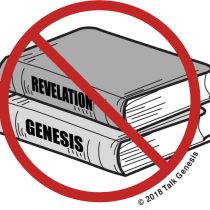
    Should Churches Avoid Genesis and Revelation? (Talk Genesis)

    Does the Age of the Earth Matter to the Gospel? (Is Genesis History?)

    Young Earth Creation & The Gospel (Answers in Genesis)

    Is the age of the earth important? (Creation Ministries, International)

    A Soul’s Salvation Could Hinge On the Earth’s Age (Apologetics Press)

    Earth Young or Old? Does It Matter? (Christian Courier)

    Does the Gospel Depend on a Young Earth? (Answers in Genesis)


  • Explaining The Gospel Through Holidays – Part 4: Independence Day

    Explaining The Gospel Through Holidays – Part 4: Independence Day

    Review

    Our holiday Gospel message started in the Fall, during Halloween season.  There, we discussed the true origins of death, and the remedy that was prophesied.  God promised a conqueror at that time who would, one day, defeat our adversary (Gen. 3:14-15).  If you haven’t yet read part 1 of this series, I suggest doing so before continuing.  

    During Christmas season, in the dead of Winter, we celebrated the arrival of this conqueror—the light who shined in the darkness.  At a most spiritually dark time in history, Jesus arrived, offering bright hope to all.  If you haven’t read part 2 of this series, I suggest doing so before continuing.  

    Then, during Easter season, we discussed the most important holiday on the Calendar—Easter.  As Spring emerged from the grips of Winter, we were reminded of the life-giving redemption Jesus accomplished for us on the Cross.  If you haven’t read part 3 of this series, I suggest doing so before continuing.  

    The Return of Christ

    Now, we come to the fourth and final aspect of this year-long Gospel presentation—the Return of Christ.  While Jesus has already accomplished our redemption and salvation on the Cross, many, including your kids, may be a little confused.  For, when they look around, they see plainly that death and suffering are still around.  Every kid with a computer, phone or television knows that God has not yet fixed the world.  Sin and wickedness are everywhere.  Scripture warns the devil is alive and actively preying on souls.  “Be sober, be vigilant,” Peter says, “because your adversary the devil walks about like a roaring lion, seeking whom he may devour.” (1Pet. 5:8)

    So what happened?  Simply put, not every aspect of the good news has played out yet.  The story is not over. The work of redemption is finished, but Jesus has not yet returned to earth to restore all things. We Christians, therefore, wait for the blessed hope, which is imminent, but not fulfilled.  Paul said, “… live soberly, righteously, and godly in the present age, looking for the blessed hope and glorious appearing of our great God and Savior Jesus Christ…” (Titus 2:12-13)  

    Don’t Forget The Ending

    book of RevelationIn our first article, I stressed the importance of starting at the beginning.  I would say the same for the ending.  Tell the full Gospel!  There are some important aspects of Jesus that very few know about.  Many know the works of his first coming, but few know the works of his second coming.  They know of the sacrifice of the Lamb, but not the wrath of the Lamb (Rev. 6:16).  They need to know both.  For a more thorough handling of this topic see: Should Churches Avoid Genesis and Revelation?

    After Jesus ascended into the sky, an angel proclaimed,

    Acts 1:11 “Men of Galilee,” … “why do you stand here looking into the sky? This same Jesus, who has been taken from you into heaven, will come back in the same way you have seen him go into heaven.”

    eyeWe also know from John’s testimony that, while few saw him leave, virtually all will see him return. 

    Rev. 1:7  Behold, He is coming with clouds, and every eye will see Him, even they who pierced Him. And all the tribes of the earth will mourn because of Him. Even so, Amen.

    We don’t know exactly how this will play out, but with TV, streaming video and other technologies, it’s easy to see how the entire world will be watching.  John also revealed that, unlike his departure, Christ’s return will be spectacular.

    Rev. 19:6 Then I heard what sounded like a great multitude, like the roar of rushing waters and like loud peals of thunder, shouting: “Hallelujah! For our Lord God Almighty reigns.

    I think it’s safe to say, we should expect fireworks!  Perhaps, you can see where I’m headed. 

    Independence Day

    American Flag and FireworksIndependence Day is the celebration of the establishment of America.  Every year, dazzling displays of fireworks fill American skies to remind us of the war of our origins—the Revolutionary War.  Others think of subsequent wars that were necessary to sustain us until now—including a war of repentance—the Civil War.  I love this symbolism and the gratitude it fosters.  

    For me, however, the symbolism goes further.  These celebrations not only take me back to the past, but also forward to the future. Fireworks—the likes of which the world has never seen—are coming.  Christian patriots, like myself, love America, but know its limitations.  We are citizens of America, but also citizens of the coming Kingdom—a better kingdom—one that will be everything our nation desires to be, but can’t due to our fleshly, human natures (Rom. 7). 

    Independence Day, for me, therefore, has dual symbolism.  It’s a time to honor my nation, and also look forward to the coming Kingdom.  It’s also the fourth and final holiday of my year-long Gospel presentation.  

    1. The Fall and the Promise of Christ – Halloween
    2. The Arrival of Christ – Christmas
    3. The Cross of Christ – Easter
    4. The Return of Christ – Independence Day

    A Coming Revolution

    Painting of the Tower of Babel by Pieter Bruegel the Elder, 1563 A.D.

    I see ID4 as an opportunity to, not only explain our great nation but, also, the Kingdom that is to come.  Jesus created the nations at Babel for our good, when he thwarted the first potential, centralized global empire.  At that time, he separated the early post-diluvian families by confusing their languages, forcing them to spread out and form the early nations of the earth (Gen. 11).  Satan has been attempting to globalize the world ever since, through imperialism and global politics, but unsuccessfully.  John tells us the antichrist will have some success at globalization during the Tribulation (Rev. 13:7), but, ultimately, will be thwarted, as well.  Only Christ will successfully establish a long-term world kingdom when he returns.  He will rule the nations righteously, at that time, for a thousand years (Rev. 20:2-7), preceding the eternal kingdom that will follow shortly after.  For more on this, see: What is the Millennium? 7 Answers to 7 Questions by David Jeremiah.

    Thus, when celebrating my nation’s origins, it makes sense, at least for me, to look ahead.  I’m thankful for a good (but flawed) nation, but more thankful for the perfect Kingdom on the horizon.  Thy Kingdom come!  

    Using Independence Day Symbols

    I recommend explaining these truths to your kids on the Fourth of July.  Learn about the familiar symbols we see on this day, and use them for good.  Scripture has a lot to say about the nations, both historically and eschatologically.  Below are some suggestions for your consideration. 

    Fireworks

    fireworksAs mentioned above, I can’t think of a better symbol to explain the return of Christ than fireworks. Primarily, they remind us of the Revolutionary War that preceded our founding.  I wouldn’t want to remove or diminish this symbolism in any way.  Christians, of all people, should understand the importance of showing gratitude for sacrifice.  America has its sins, but it is, by far, the best place to live in the world today. The proof of this is countless immigrants, of every shade and ethnicity, trying to get here by any means possible (even illegally).  Furthermore, Paul commanded us to show respect and honor to our nation with “taxes, customs, fear and honor” (Rom. 13:7). Patriotism is a good testimony, and the lack thereof can be a bad testimony. 

    That said, I also recommend telling your kids of a future Kingdom that will be even better (infinitely better).  These same fireworks can remind us of the spectacular events that will precede the establishment of the Millennial Kingdom.  Jesus said,

    Matt. 24:27 For as the lightning comes from the east and flashes to the west, so also will the coming of the Son of Man be.

    John revealed,

    Rev. 19:6 Then I heard what sounded like a great multitude, like the roar of rushing waters and like loud peals of thunder, shouting: “Hallelujah!  For our Lord God Almighty reigns. 7 Let us rejoice and be glad and give him glory! For the wedding of the Lamb has come, and his bride has made herself ready. 

    It will be unlike any event ever witnessed in history.  Tell your kids of fireworks of the past, and of those coming in the future.   Remind them every year!  

    Red, White and Blue

    red, white and blue dessertLike all holidays, the Fourth of July has its distinctive colors—namely red, white and blue.  While American, patriotic colors have no official meaning, we do have good historical tradition to draw from.  Per the website, Flags of Valor,

    No federal law or rule offers an official reason for the flag’s colors. We do have, however, the words of Charles Thomson the secretary of the Continental Congress, who was a key player in the design of the Great Seal of the United States. Of the red, white and blue colors on the Great Seal he said “White signifies purity and innocence, Red, hardiness & valor, and Blue, the color of the Chief signifies vigilance, perseverance & justice.” (source)

    Purity, valor and justice sound like pretty good values to me.  We, as American Christians, need to strive for purity and innocence (white).  Jesus told us to be “shrewd as snakes and as innocent as doves.” (Mat. 10:16).  We also need to appreciate the valor that has kept our nation safe and free.  “Greater love has no one than this, than to lay down one’s life for his friends.” (John 15:13)  We can’t ever forget the valor and sacrifice of our soldiers, which has kept our enemies at bay (red).  We, also, as American Christians, need to appreciate the value of truth and justice.  We need to be willing to fight evil, particularly evil ideas (and there are a lot of them floating around today).  If Christians don’t speak up for truth and justice, who will? (blue)

    All this said, only the Millennial Kingdom will meet God’s perfect governing standard.  Everyone is looking for utopia, and they’re disappointed at every turn.  It’s not coming and not possible with fallen men at the helm.  It will come with Christ.  The Millennial Kingdom will be pure in every sense (white).  Jesus will defeat his enemies quickly and decisively (red), and rule with perfect justice and mercy (blue).  Thy Kingdom come!

    The American Flag

    Original American Flag with 13 starsKnown, also, as the Stars and Stripes and Old Glory, the American Flag has an extensive and interesting history.  On June 14, 1777,

    …the Continental Congress adopted a resolution stating: “Resolved, That the flag of the United States be thirteen stripes, alternate red and white; that the union be thirteen stars, white in a blue field, representing a new Constellation.” (source)

    American FlagLater in 1818, Congress passed a new law requiring a new star to be added on July 4th, after the entrance of each new state to the union.  After this, many different star arrangements emerged throughout the years, as states were added.  The basic essence of the design, however, remained the same.  Our current 50-star flag come to be in 1959 when the last state of the union, Hawaii, was added. 

    It’s also interesting that the precise 50 star arrangement was designed by a high school student.  You can read that story here: THE HIGH SCHOOLER WHO DESIGNED THE 50-STAR AMERICAN FLAG

    Stars and Stripes Symbolism

    There are no official symbolic meanings ascribed to the stars and stripes, but there are some interesting traditions. Per World Atlas:

    …there is another interpretation of the stars and the stripes, which is not known to many people. According to 1977 the House of Representatives book, it states that “the star symbolizes heavens and the divine goal that humans have aspired from time immemorial.” The stripes symbolize the rays of light originating from the sun.

    America has always been a heaven-minded nation.  To this day, we have the most churches, the most missionaries, the most charities, etc.  The list goes on and on.  No one can deny that Christianity has thrived in America.  I pray our tradition of religious liberty continues (though it’s under siege).  I also pray that we, as American citizens, continue to look upward (stars), remaining one nation, under God.  Likewise, may God continue to shine his grace and mercy down on us (stripes). 

    As always, however, when we’re disappointed with our nation, let us never lose site of the Kingdom that is to come, that will never let God’s people down.  Thy Kingdom come.

    The American Bald Eagle

    Interestingly, we almost had a different national symbol……..well, sort of.  Benjamin Franklin didn’t like the bald eagle.  He noted, in a letter to his daughter, that the bird in the badge of the Society of the Cincinnati Medal, actually looked more like a turkey than an eagle.  He, then, went on to explain how he would have preferred the turkey.

    badge of the Society of the Cincinnati Medal
    badge of the Society of the Cincinnati Medal

    I am on this account not displeased that the Figure is not known as a Bald Eagle, but looks more like a Turkey. For the Truth the Turkey is in Comparison a much more respectable Bird, and withal a true original Native of America… He is besides, though a little vain & silly, a Bird of Courage, and would not hesitate to attack a Grenadier of the British Guards who should presume to invade his Farm Yard with a red Coat on.

    Sensing the sarcasm, I wouldn’t say he was actually advocating for the turkey, but rather venting over his dislike of the Bald Eagle.  From the same letter:

    For my own part I wish the Bald Eagle had not been chosen the Representative of our Country. He is a Bird of bad moral Character. He does not get his Living honestly. You may have seen him perched on some dead Tree near the River, where, too lazy to fish for himself, he watches the Labour of the Fishing Hawk; and when that diligent Bird has at length taken a Fish, and is bearing it to his Nest for the Support of his Mate and young Ones, the Bald Eagle pursues him and takes it from him. (source)

    Keep in mind these were the off-the-record musings of a man conversing with his daughter.  We probably shouldn’t take it too seriously.  Regardless, I disagree with the sentiment.  The Bald Eagle is, by far, a superior symbol.  Scripture agrees.  

    Theological Symbolism of the Eagle

    Soaring Bald EagleGod used the eagle as a symbolic description of the Exodus.

    Ex. 19:3  And Moses went up to God, and the LORD called to him from the mountain, saying, “Thus you shall say to the house of Jacob, and tell the children of Israel: 4 “You have seen what I did to the Egyptians, and how I bore you on eagles’ wings and brought you to Myself.

    He, also, used the eagle as a symbol of Himself regarding his relationship with Israel—a mother eagle caring for her young (Deut. 32:9-13).  The eagle is also a symbol of speed (2Sam. 1:23) and the majestic handiwork of God (Job 39:27-30).  He is a symbol of renewal (Psa. 103:5, Is. 40:31) and amazement (Prov. 30:18-19).  Eagles are symbols of God’s wrath and warnings to repent (Jer. 4:13), and God’s wrath toward Israel’s enemies (Jer. 48:40, 49:22, Rev. 8:13).  They are symbolic depictions of holy cherubs (Ezek. 1, Rev. 4:4-9).  He is also a symbol of rescue for Israel during the Tribulation (Rev. 12:13-14).  

    No disrespect to Mr. Franklin, but his turkey superiority theory just doesn’t fly.  May God continue to deliver our nation on eagles’ wings, and may we, as a country, live up to the goodness of this symbol.  

    The Great Seal

    The Great Seal of the United StatesI’d be remiss not mentioning the great seal, which is another one of our prominent nation symbols.  It and similar seals are prominent on US documents and currency.  They, generally, feature the American Bald Eagle with 13 arrows in his left talon and an olive branch with 13 leaves and olives in his right.  Peace through strength is a phrase used by former President Ronald Reagan and this symbolism of olive branches (peace) and arrows (strength) conveys this idea well.  American seals also typically feature the phrase e pluribus unum (out of many one). 

    Originally, this conveyed the idea of 13 distinct states united as one, and, eventually, came to represent the idea of many cultures melting into one.  America is a rare success story as an immigrant nation.  Foes from within don’t like the idea of a melting pot, or assimilation, but it’s been crucial to our survival.  We are different, yet also one. (I deal with this extensively in the article: Should Christians Embrace Nationalism? A Question of Origins).  

    It’s also worth noting that Christ’s Kingdom will be the ultimate e pluribus unum, consisting of all the peoples of the earth.  It will be a time of assimilation and unity, like never before.  Even the creatures of the earth will be at peace at that time—the wolf with the lamb, the leopard with the goat, the calf with the lion (Is. 11:6).  Isaiah tells us cows, bears, lions and oxen will graze together and their young will lie down together.  Even vipers and infants will be at peace at that time (Is. 11:7-8).  e pluribus unum is a righteous goal for America, but a guaranteed reality in the coming Kingdom. 

    For more information on facts and history of the Great Seal, see the Britannica article: Great Seal of the United States

    Summer

    July 4th occurs right after the Summer Solstice, providing even more usable symbolism.  If you’ve followed our previous articles, all the seasons of the year offer rich, usable theological symbolism.  Fall (Halloween) reminded us of the Fall of Adam, when darkness first began to overtake the light (see article 1).  Winter (Christmas) reminded us of the depth of spiritual darkness the world had plunged into when the light of the world arrived (see article 2).  Spring (Easter) reminded us of Christ’s victory on the Cross, when he brought redemption and life to the dead.  Light begins to overtake the darkness in Spring, bringing forth life from the dead of Winter (see article 3). 

    Water Slide FunLikewise, Summer can be used as a metaphor for the coming restoration.  Summer is characterized by warmth, sunshine, long days, short nights and bountiful crops.  It’s a time of rest and fun for those on school break.  It’s a time for travel and vacations. 

    The Millennial Kingdom, likewise, will be a time of rest, joy and happiness like no one has ever experienced (except Adam and Eve in the Garden).  This metaphorical Summer has not yet arrived, but it is coming. Study the Millennial Kingdom and talk to your kids about it.  For more information, see: What is the Millennial Kingdom, and should it be understood literally?   

    Paddle Board FunFor us, Summer/Patriotic season begins on Memorial day, the last Monday of of May, just prior to the first Summer month of June.  This is, generally, when you see flags going up and staying up all Summer.  This long season generally ends on September 11th when we remember the attack on the Twin Towers.  After that, Fall season seems to come into full swing with Halloween themes taking over stores and theme parks. 

    Using Independence Day Traditions

    Fireworks Shows

    Family Watching FireworksThe best fireworks shows are usually on the 4th, but many theme parks fire them up a week prior and several days after.  You may, also, want to consider taking a 4th of July vacation to a city known for their fireworks.  Enjoy them, and talk about their patriotic and theological symbolism.  Don’t let them go to waste.  

    4th of July Barbecue

    Hot Dog on 4th of July

    Feasting is an essential aspect of all holiday celebrations.  In fact, the terms feast and holy day are often interchangeable in Scripture.  

    Pull out all the stops next 4th of July.  Fire up your grill and enjoy God’s Summer bounty.  Then, remind your kids that a better feast is coming.  

    Rev. 3:20 Behold, I stand at the door and knock. If anyone hears My voice and opens the door, I will come in to him and dine with him, and he with Me.

    I believe this is likely an allusion to the marriage supper of the Lamb (Rev. 19:9), which all believers will partake of one day.  For more on this, see: What is the marriage supper of the Lamb?  

    Listen to Patriotic Music

    Another way to celebrate Independence Day is to listen to patriotic songs.  Here are some of my favorites.

    • “America The Beautiful” Ray Charles
    • “God Bless America” LeAnn Rimes
    • “God Bless the USA” Lee Greenwood
    • “Where the Stars and Stripes and the Eagles Fly” Aaron Tippin
    • “Chicken Fried” Zack Brown Band
    • “Pink Houses” John Mellencamp
    • “Battle Hymn of the Republic” SHeDAISY

    If you haven’t yet heard SHeDAISY’s rendering of Battle Hymn of the Republic, I can’t recommend it enough.  Consider the apocalyptic words of this great post-Civil War song. 

    Mine eyes have seen the glory of the coming of the Lord;
    he is trampling out the vintage where the grapes of wrath are stored;
    he hath loosed the fateful lightning of his terrible swift sword;
    his truth is marching on.

    He has sounded forth the trumpet that shall never call retreat;
    he is sifting out the hearts of all before his judgment seat.
    O be swift, my soul, to answer him; be jubilant, my feet!
    Our God is marching on.

    If that song doesn’t get you thinking about the second coming, nothing will.  The wrath of the Lamb is coming, and the world needs to hear about it.  You can read about the song’s background and history here: The Song That Marches On: History of the Battle Hymn of the Republic

    Objections and Concerns

    Patriotism is Idolatry

    We are citizens of the Kingdom, not citizens of America!

    While perhaps good intentioned, this is biblically flawed. Paul commanded us to respect and honor our nation, (Romans 13:1-7) and he never once renounced his national identity as a Roman citizen. 

    Acts 16:37 But Paul said to the officers: “They beat us publicly without a trial, even though we are Roman citizens, and threw us into prison. And now do they want to get rid of us quietly? No! Let them come themselves and escort us out.”

    (See also: Acts 16:37-38, Acts 22:25-29, Acts 23:27)  Paul also appealed to Roman law and Caesar on occasion (Acts 25:8-12, Acts 26:32, Acts 28:19). 

    I suspicion those making this objection may be missing the entire point of the Church.  Scripture makes it clear the Church is not a nation like Israel.  It is rather a community of believers sent out to abide in other nations, and live under their authority.  As good citizens, we become a testimony to our fellow citizens.  Anti-patriotism often has the opposite effect, conveying ingratitude.  Don’t fall into this bad thinking.  (Further reading: Should Christians Embrace Nationalism? A Question of Origins

    America Has Illegitimate Origins

    America is the product of a sinful rebellion against Great Britain, and, therefore, should not be honored.

    Some theologians hold that the American Revolution violated Paul’s teachings in Romans 13 to obey your governing leaders.  This may or may not be the case, but it’s irrelevant to the issue of patriotism and honor.  Paul was a Roman citizen, and Rome was, by no means, a saintly nation with impeccably righteous origins.  Yet, as a Roman citizen, Paul penned his instructions to respect and honor your national governments. 

    That said, the premise of the above argument may be flawed.  Yes, God ordained the various governments of the world, but this was done in the wake of Babel to affirm the nations who are spread out all over the earth.  God separated the nations at Babel for our good.  Attempts at global domination, therefore, by empires like Babylon, Persia, Greece, Rome, England, Germany, etc., were doomed to fail, and I believe God ordained their failures.  While I can’t be dogmatic, I highly doubt Paul’s commands in Romans 13 were intended to aid global conquerers, who are reaching out with their tentacles all over the earth.  Nor to I think Romans 13 is a prohibition against throwing off the oppression of foreign empire, when it becomes possible.  Was Poland in sin for fighting back against Germany in 1945, after Germany successfully invaded and took control in 1939?  I don’t think this was Paul’s point.  I could be wrong.  

    Regardless, America is a legitimate nation, and American Christians owe it respect and honor.  

    America is Evil!

    We cannot participate in the patriotic holidays of a nation that has engaged in wickedness like slavery!

    Paul said, “for all have sinned and fall short of the glory of God…” (Rom. 3:23)  When I hear the above objection, I can’t help but think of Paul, who was a Roman citizen.  Rome was, by no means, a righteous nation.  I’ve heard estimates that up to 50% of its population, at one time, were slaves. Yet, Paul honored and respected his country (Rom. 13:7).  We need to do the same. 

    No one can deny America has its sins and blemishes.  The slavery and racism our country engaged in was evil, and we paid a terrible price for it during the Civil War.  Murdering the unborn is also evil.  Hitler and Stalin, combined, murdered approximately 30 million people.  We’ve doubled this in abortions—60 million and counting—since Roe v Wade in 1974.  

    No one is denying the sinful nature of our nation (and all nations), and no one is saying we should endorse its sins. But, we must honor the institutions and authorities God has ordained.  Showing respect and honor to your nation is not an endorsement of its sins, and conversely, calling out its sins is not an act of disrespect or dishonor.  We can do this respectfully, and we should.  We should also point out the good, and there is a lot of it.  

    The Millennial Kingdom is Not Literal

    But, I don’t believe in a literal thousand year Millennial Kingdom on earth!  

    Good men disagree with me on this.  I read Scripture straightforwardly and literally, particularly the books of Genesis and Revelation. Premillennialism and pretribulationism, in my view, are the most literal approaches to end-times prophecy.  The best books on these subjects, in my humble opinion, are by Ron Rhodes. I recommend: The End Times in Chronological Order: A Complete Overview to Understanding Bible Prophecy, The 8 Great Debates of Bible Prophecy: Understanding the Ongoing Controversies, 40 Days Through Revelation: Uncovering the Mystery of the End Times.  He’s written many others, as well.  You can view them here

    That said, I wouldn’t put interpreting Revelation in the same category as interpreting Genesis.  Compromised views of Genesis cause much more theological harm (See: How Important Is Genesis 1-3? by John MacArthur, Does Genesis Matter by Ken Ham).  I would say, however, that it’s important to get Revelation right, especially considering the blessing that’s at stake. 

    Rev. 1:3 Blessed is he who reads and those who hear the words of this prophecy, and keep those things which are written in it; for the time is near.

    But, many see it different.  If this is you, we still agree on the future return of Christ, as all orthodox Christians hold to this.  Fireworks, therefore, could be a symbol of the second coming for all believers, if they choose to use it in this way.  

    Final Thought

    The easiest Gospel to understand is the full Gospel.  Don’t rob it of its beginning and ending context.  The message begins in Genesis, where God created the world and pronounced it “very good.”  History took a dire turn soon after, when Adam sinned and brought corruption and death into the world.  God then revealed his plan of redemption to send a conqueror—a Seed—who would one day crush our adversary (Gen. 3:15). Thousands of years later the Seed arrived and died for our sins on the Cross.  He, then, rose again and ascended to the heavens.  Those who trust in him have eternal life, and will enter his Kingdom when he returns.  Thy Kingdom come! 

    Tell this full Gospel to your kids (and to anyone else who will listen).  Explain it through holidays.  Furthermore, enjoy the holidays. May they become a blessing like never before.  

    Previous Articles:

    Explaining the Gospel through Holidays – Part 1: Halloween
    The Fall and the Promise of Christ

    Explaining the Gospel through Holidays – Part 2: Christmas
    The Arrival of Christ

    Explaining the Gospel through Holidays – Part 3: Easter
    The Cross of Christ


  • Explaining the Gospel through Holidays – Part 3: Easter

    Explaining the Gospel through Holidays – Part 3: Easter

    Review

    Our Gospel journey through holidays started during the Fall-Halloween season, when we reflected on the Curse God placed on the world.  God promised a Conqueror at that time, who would one day defeat our adversary, the devil (Gen. 3:14-15).  If you haven’t read part 1 of this series, I suggest doing so before continuing.  

    Our journey resumed in the dead of Winter, at Christmas, when we celebrated the arrival of this Conqueror into a spiritually dark world.  The birth of Jesus was a partial fulfillment of the Seed prophecy of Gen. 3:15.  If you haven’t yet read part 2 of this series, I suggest doing so before continuing. 

    The Cross of Christ

    Now, we come to the third and most important part of this year-long Gospel presentation—the Cross of Christ. 

    1. The Fall and the Promise of Christ – Halloween
    2. The Arrival of Christ – Christmas
    3. The Cross of Christ – Easter
    4. The Return of Christ

    While it’s important to understand the origins of sin and the arrival of its conqueror, it’s all for nothing without the Cross.  No one can be saved without knowing who Jesus is and what he accomplished at Calvary.  

    Easter

    The Most Important Holiday

    empty tomb scene
    James Tissot (French, 1836-1902). Mary Magdalene and the Holy Women at the Tomb, 1886-1894. Brooklyn Museum, Purchased by public subscription, 00.159.329

    The Crucifixion and Resurrection, by far, are the most important elements of the Gospel message.  Paul said,

    1Cor. 15:3 For what I received I passed on to you as of first importance: that Christ died for our sins according to the Scriptures, 4 that he was buried, that he was raised on the third day according to the Scriptures,

    Admittedly, Easter may not be the most festive or fun holiday, as far as symbols and activities go.  Christmas would be hard to top in that category.  Theologically speaking, however, Easter is first. As wonderful as the celebration of Christmas is, without Easter, it is meaningless.  

    The History of Easter

    The tradition of setting aside an annual celebration of the Crucifixion and Resurrection is very old, going all the way back to the first or second century.  Easter started, in essence, as a Christianized Passover celebration.  Since Jesus was crucified during the time of the passover, it made sense for early Christians to focus on him during Jewish Passover celebrations.  He, after all, is our Passover Lamb.  (For more on this, see, What is the Passover Lamb? How is Jesus our Passover Lamb?)

    Critics of Easter are quick to point out that the New Testament never calls for such an annual celebration, and they are correct (on that small point).  They fail, however, to see the larger point of Christian liberty in the New Testament Church age. Paul made it clear in Romans 14 that we are free to set aside sacred days, in accordance with our conscience (Rom. 14:5). Considering the centrality of the Cross, it’s only fitting these annual celebrations arose very early in Church history.  

    The earliest writings about Easter go back to the second century, and most agree they likely started in the first century (source).  For an overview of the origins of Easter, I recommend this helpful article: What is the History of the Easter Holiday?

    Using Easter Symbols

    I believe, we, as Christians, need to take advantage of every Gospel opportunity that comes our way, and Easter season might be the biggest.  It is filled with wonderful usable symbols that point to the events and the effects of the Cross.  

    Many stumble on these symbols, however—particularly a couple of them.  I know I did.  For many years, I was convinced eggs and bunnies were pagan infiltrators meant to subvert the true message of the holiday.  I was wrong, and will do my best to explain why I was wrong.  

    Please note, however, regardless of how convincing my case may be, Christians are only obligated to God and their conscience (Rom. 14:12-23). We are free to use or ignore any symbol out there.  God owns them all and no one has a monopoly on how they’re used.  “Let each be convinced in his own mind.” (Rom. 14:5)

    The Cross

    That said, let’s start with a non-controversial symbol.  Easter is all about the Cross of Christ.  The Cross is, without question, the chief symbol of Easter and the entire Christian faith.  It is the instrument by which Christ, our Passover Lamb, became our sacrifice.  It’s also interesting that, even before his disciples knew of his fate on the Cross, Jesus instructed them to take up this symbol.  

    Matt. 16:24 Then Jesus said to His disciples, “If anyone desires to come after Me, let him deny himself, and take up his cross, and follow Me.

    flower decorative crossThe message of the Cross is simple.  We were once separated from God, without hope.  Adam, our forefather, fell (became separated from God) in the Garden, and we with him.  God gave us the Law through Moses, but no one could keep it.

    Then, Jesus arrived!  Dying on the Cross, he took away the requirements of the Law.  He then rose again, triumphing over our spiritual enemies.  Those who repent and trust in him are forgiven and given new life in him.  Paul said it better. 

    Col. 2:13 And you, being dead in your trespasses and the uncircumcision of your flesh, He has made alive together with Him, having forgiven you all trespasses, 14 having wiped out the handwriting of requirements that was against us, which was contrary to us. And He has taken it out of the way, having nailed it to the cross. 15 Having disarmed principalities and powers, He made a public spectacle of them, triumphing over them in it.

    Display crosses everywhere on Easter.  Talk to your kids about what they represent.  

    The Empty Tomb

    empty tomb decorThe Crucifixion is incomplete without the Resurrection. Christ conquered death by raising himself from the dead.  

    John 2:19 Jesus answered and said to them, “Destroy this temple, and in three days I will raise it up.”

    Remind your kids that, just as Jesus was raised, so we will be also— those of us who are found in him.

    2Cor. 4:14 knowing that He who raised up the Lord Jesus will also raise us up with Jesus, and will present us with you.

    Spring Season

    Unlike the two symbols above which point to the events of Easter, the remaining symbols we’ll discuss point to the effects of Easter—namely, new life!  Most traditional Easter symbols are related to Spring, which, in and of itself, is a wonderful symbol of new life.  

    Easter spring meadow sceneThe vernal (Spring) equinox, around March 21, is that time of year when the lengths of the day and the night become equal—12 hours each.  Going forward, the days become longer and the nights shorter.  It’s the exact opposite of what happened at the Fall equinox.  For more on this, review the first article of this series

    Spring is the season of increasing daylight.  It’s about blooming flowers and flourishing wildlife.  It’s characterized by new births and hatchings all over the planet.  Spring, therefore, becomes the perfect analogy for the new spiritual birth we receive when we come to the Cross.  

    Resurrection Season

    It’s also notable that God may have had a hand in this symbolism.  We don’t know the season Jesus was born (though we celebrate it during winter), but we do know when he was resurrected.  Jesus definitely rose in the Spring.  The arrest, crucifixion and resurrection of Jesus all took place during the time of the Passover, beginning on Nissan 14 on the Jewish calendar. 

    Was this an accident?  Impossible.  Coincidence?  I doubt it.  I won’t be dogmatic, but it makes sense that God, from eternity past, would choose to resurrect Jesus in the Spring.  The symbolism is too perfect to be coincidental.  

    Regardless, I recommend using Spring season to explain new life to your kids.  Use the Spring decor that’s so abundant during Easter, to illustrate the new life we have in Christ. As the angel commanded the apostles after freeing them from their chains, “Go, stand in the temple courts and tell the people all about this new life.” (Acts 5:20) 

    Easter Colors and Flowers

    Easter flower boquetJust as evergreen colors symbolized life during Christmas season, so pastel colors symbolize life during Easter.  In fact, they symbolize new life.  Spring is that time of year when new flowers of numerous colors emerge from dead foliage.  They can remind us of Christ’s resurrection from the dead, and of our new life in him, after being dead in our sins and trespasses.  

    Rom. 6:4 We were therefore buried with him through baptism into death in order that, just as Christ was raised from the dead through the glory of the Father, we too may live a new life.

    Pastel colors and flowers can also represent abundant life.  Jesus said he came to give us life, and give it abundantly (John 10:10).  Easter colors build on Christmas colors and surpass them.  Use them to explain abundant life to your kids.  

    Easter Lilies

    While any flower can be used to convey the message of new life, lilies, historically, have been the most prominent.  Called by some, “white-robed apostle of hope”, their white pure flowers and trumpet shape has set them apart.  For more on their history, see: The History of the Easter Lily & How It Became the Most Popular Easter Flower.  

    Let your kids know that Christians will be adorned like lilies, one day.    

    Rev. 6:11 Then a white robe was given to each of them; and it was said to them that they should rest a little while longer, until both the number of their fellow servants and their brethren, who would be killed as they were, was completed.

    Trumpet this truth often, especially during Easter season.  

    Easter Eggs

    Easter eggsEgg production, especially in pre-technology times, slowed drastically in the Winter, and naturally bounced back in the Spring.  Eggs, therefore, became natural Spring symbols.  They are obvious symbols of life, in that they produce life and also provide food.  It should be no surprise Christians found them useful.  

    Pagan Origins of Easter Eggs?

    They are a bit controversial, however.  Perhaps, like me, you’ve heard Easter eggs are fertility symbols honoring a Saxon goddess named Eastre (or Eostre). It’s not true. In fact, it’s doubtful this goddess was ever worshipped by anyone.  She is only mentioned in passing by one eighth century historian and not found anywhere else in historical writings or artifacts.  The predominance of evidence suggests she never existed in the minds of ancient pagans or anyone else.  We’ll discuss this further in the concerns and objections section.  

    That said, it should not matter to Christians, either way.  We need not worry what symbols ancient pagans used.  God created the egg and no one has a monopoly on its symbolism.  I would surmise, however, that some may be comforted by the fact that these pagan rumors are false.  For further reading, see: Are “Easter eggs” biblical?.  

    The True History of Easter Eggs

    Passover Seder plate with eggWhile the precise details of the origins of Easter eggs are unclear, there are viable explanations to consider.  The article linked above (Are “Easter eggs” biblical?) points out that eggs were and are prominent symbols of the Passover Seder.  Since Easter was born out of the Passover celebration, it’s easy to see how this symbolic element transferred over.  In Jewish tradition, Seder eggs symbolize new life.  As one writer explains,

    One of the reasons we have the egg at the Seder is because it symbolizes the beginning of life, and Passover marks the very beginning of our national existence.

    He goes on to explain, that eggs more precisely represent potential life, being that the Jewish people were freed from Egypt, but not quite yet where they wanted to be.   

    Let’s look at the journey of our egg. The egg is first inside the hen. It is then laid and thereby freed from the constraints previously imposed upon it. But has the egg been hatched? Has a little chick emerged from the shell yet? The answer is no. The egg, you see, is only potential life. It is not yet a living being. One day, please G‑d, a chick will emerge and the cycle of life will continue. (source)

    New Abundant Life

    For Christians, however, this “potential life” has been realized in Christ.  Through Christ, anyone can have life and have it abundantly.  

    John 10:10 ….I have come that they may have life, and that they may have it more abundantly.

    Thus, Christians began to die eggs red to symbolize Christ’s sacrifice, and die them Spring colors to symbolize the new life it brings.

    It’s also notable that Easter celebrations, historically, have been preceded by fasts of various lengths (in some cases, 40 days!).  Since chickens don’t halt production during these Spring fasting periods, egg stockpiles would have multiplied.  It should be no surprise Christians found creative symbolic uses for them.  Don’t let this symbolism dye (pun intended).  Easter eggs represent new life.  Let your kids know how to get this new life. 

    Easter Bunnies

    In addition to flowers and eggs, certain animals also convey Spring, and by extension, new life.  The most prominent, no surprise, are rabbits and hares.  

    Though charges of paganism abound, I don’t believe this symbol was borrowed from pagans, either.  I wouldn’t mind hijacking it if it was, but there is no evidence to support this claim.  To my knowledge, there was no goddess named Eostre worshipped by the Saxons or any other pagans, and there is no fertility goddess in the vicinity associated with hares or rabbits.  For more on this, see: Is the Easter Bunny a pagan symbol?

    Protestant Christian Origins

    OsterhaseIn all likelihood, German Protestant Christians invented the Easter Bunny (Osterhase).  Rabbits and hares likely became associated with Easter because of their Springtime prominence.  They are noticeably visible and active in Spring, in fact, some say they go crazy in the Spring (See: Do Rabbits Really Go Crazy in March?).  Christians likely adopted them, not as fertility symbols per se, but as new life symbols, seeing how rabbits and hares emerge so abundantly at the close of Winter.  It’s not hard to see how this symbolism arose, especially considering how German Protestants emphasized born-again theology.  

     John 3:3 ….“Very truly I tell you, no one can see the kingdom of God unless they are born again….6 Flesh gives birth to flesh, but the Spirit gives birth to spirit. 7 You should not be surprised at my saying, ‘You must be born again.’

    While the precise details of their origins has been lost, the above is much more feasible than the pagan goddess theory.  For further reading, see: What is the origin of the Easter bunny and Easter eggs? and also, Does Easter have a pagan derivation?

    I, personally, see no reason why the Easter Bunny, even a magical egg-hiding bunny, cannot symbolize the new birth and new life we have in Christ.  

    1Pet. 1:23 For you have been born again, not of perishable seed, but of imperishable, through the living and enduring word of God.

    Easter Chicks and Hatchlings

    Easter hatchling deviled eggsChicks and hatchlings are also prominent symbols of Easter for the same reason flowers, eggs and bunnies are.  They are prominent in the Spring.  Hatchling numbers would naturally decline in the Winter, and bounce back in Spring.  It’s easy to see how they became new life symbols. Put them to work.  Let your kids know what they represent.

    John 5:24  “Most assuredly, I say to you, he who hears My word and believes in Him who sent Me has everlasting life, and shall not come into judgment, but has passed from death into life.

    Using Easter Traditions

    Easter also has an abundance of traditional events and activities that can create valuable opportunities for the Gospel.  Here are a few:

    Good Friday Service

    Good Friday, for us, is the most sober holiday of the year.  If you want to fully appreciate the Resurrection, it’s important to understand the Crucifixion that preceded it.  Our free gift of salvation came at a tremendous price which we can never forget.  Make sure your kids know why this needed to happen.  A review of the first article in this series may help.  

    Easter Sunrise Service

    Yes, getting up at dark is hard, but it’s worth it on Easter morning.  Jesus arose in the twilight of the morning, just prior to the sunrise.  Biblical morning or dawn is that time when night begins to transition to day. We’re told Mary Magdalene either left for the tomb, or arrived at the tomb at this time before the full daylight.  

    John 20:1 Now the first day of the week Mary Magdalene went to the tomb early, while it was still dark, and saw that the stone had been taken away from the tomb.

    Jesus merely needed to stay dead an instant after dawn on the first day of the week (Sunday) in order to fulfill his time in the heart of the earth.  There was no need for him to stay any longer, which is why his body was missing even before dawn was complete.  

    I recommend going to sunrise service if your church offers one.  It can be a great way to get into the minds of those who first discovered the empty tomb.  Let the dawn of Easter morning symbolize the dawn of life you received when you first believed.  

    Easter Sunday Service

    Without question, Easter is the highest Church attendance day of the year.  For whatever reason, seekers like going to Church on Easter Sunday.  For this reason, many pastors deliver their best Gospel presentation of the year.  Take advantage of it!  Invite friends and family.  While there’s always a good chance they’ll say no, there’s a better chance they’ll say yes on Easter Sunday.  

    Don’t get me wrong, salvation is never about the odds.  God is sovereign over salvation.  That said, if Easter Sunday is opening doors for the Gospel, you can rest assured, God has a hand in it.  

    Passion Plays

    I love Passion plays.  In fact, I like them more than some popular Passion movies.  For one, they’re less gory, and more kid-friendly.  They’re also more endearing, with non-professional actors and producers.  

    This is not to say the Gibson movie doesn’t have its place. I believe it does, and has moved many over the years.  But a hometown Passion play, to me, is a great opportunity for outreach, not only sharing the message of the Cross, but introducing people to the Christian community.  If one of these exists near you, take advantage of it. 

    Dying Easter Eggs

    dying Easter eggI find dying Easter eggs to be the perfect time to talk about what they represent.  What better time could there be to explain their symbolism?  Eggs contain new life, and they also provide food to sustain life. Adding Spring coloring to them only reinforces this symbolism.  

    Rom. 6:4 We were therefore buried with him through baptism into death in order that, just as Christ was raised from the dead through the glory of the Father, we too may live a new life.

    Hunting Easter Eggs

    hidden Easter eggEvery year, millions of kids hunt these wonderful symbols.  Rarely, however, do I see good symbolism attached to this activity.  Let’s change this. Scripture is filled with exhortations about seeking God and seeking the lost.  

    Heb. 11:6 But without faith it is impossible to please Him, for he who comes to God must believe that He is, and that He is a rewarder of those who diligently seek Him.

    Jesus, himself, exhorted men to seek.

    Luke 11:9   “So I say to you, ask, and it will be given to you; seek, and you will find; knock, and it will be opened to you. 10 For everyone who asks receives, and he who seeks finds, and to him who knocks it will be opened.

    Next Easter, after hunting is complete, discuss these concepts with your kids.  While enjoying the fruits of their labor, tell them about the real prize that all men need to seek—new life.  Let them know this Life is a person.  

    John 14:6  Jesus said to him, “I am the way, the truth, and the life. No one comes to the Father except through Me.

    Making Easter Baskets

    I, personally, use Easter baskets to explain the importance of Christian fellowship and togetherness.  If Easter eggs symbolize new life, the gathering of these new lives into baskets could remind us of the importance of the church assembly.  

    Heb. 10:24 And let us consider one another in order to stir up love and good works, 25 not forsaking the assembling of ourselves together, as is the manner of some, but exhorting one another, and so much the more as you see the Day approaching.

    Christian fellowship is not an option.  It’s essential and commanded in Scripture. Logs that burn together burn brightly.  Logs that burn alone die quickly.  Use Easter baskets to explain this truth to your kids.  

    Easter Brunch/Dinner

    Easter hot-crossed bunsFeasting, in and of itself, carries significant theological symbolism.  We will one day dine with Christ—those of us who have come to the Cross for forgiveness.  You can read about it here: What is the marriage supper of the Lamb?

    Enjoy, therefore, your Easter feast with all its traditional fixings. Go all out, as you look forward to the better feast that is coming. 

    Concerns, Objections and Confusion

    The Date of Easter Every Year

    Why are Easter dates so drastically different year to year?

    While this isn’t a concern, per se, it is a source of confusion.  Unlike Halloween and Christmas, Easter does not have a fixed solar calendar date.  It’s based, rather, in part, on the lunar cycle, based loosely on the Jewish calendar. Easter occurs on the first Sunday, after the first full moon, after the vernal equinox. Clear as mud??  

    Easter full moonSimply put, the date of Easter, every year, is based on the first full moon of Spring.  It is always the first Sunday after the first full moon after March 21 (the first day of Spring according to the traditional Church calendar).  This creates a lot of possibilities, as the first Spring full moon can occur up to 29 days after this date.  In addition, Sunday can occur up to 7 days after that.  The dates of Easter, therefore, can span from March 22 to April 25. 

    Some fun facts: The last time Easter occurred on the earliest possible date, March 22, was in 1818.  This won’t happen again until 2285.  The last time it was on the latest possible date, April 25, was in 1943.  This won’t happen again until 2038.  source.  Mark your calendars!

    A Pagan Goddess?

    The name Easter comes from a pagan goddess that Christians borrowed to appease their culture.  

    Happy Easter signThis is simply not the case.  In fact, you may find it interesting that, in most languages, the word for Easter is not derived from the word East, but rather from the Hebrew word for Passover—Pesach.  Take a look at the following words for Easter in other languages.  

    • Latin – Pascha or Festa Paschalia
    • Greek – Paskha
    • Bulgarian – Paskha
    • Danish – Paaske
    • Dutch – Pasen
    • Finnish – Pääsiäinen
    • French – Pâques
    • Indonesian – Paskah
    • Irish – Cáisc
    • Italian – Pasqua
    • Lower Rhine German – Paisken
    • Norwegian – Påske
    • Portuguese – Páscoa
    • Romanian – Pasti
    • Russian – Paskha
    • Scottish Gaelic – Càisg
    • Spanish – Pascua
    • Swedish – Påsk
    • Welsh – Pasg (source)

    Would this have happened if Easter was a revived pagan festival?  

    Eastre (Eostre)

    One might then ask, Why are the English and German words different?  Did they succumb to pagan influence?  

    Not at all.  We’ve all heard the rumor that Easter was named after a Saxon goddess named Eastre (or Eostre).  I can assure you, that’s all this is—a rumor.  Easter comes from the word East (Osten in German) possibly because the sun was rising in the East when Christ rose from the dead.  Ostern also has etymological ties to the word dawn, which would also tie into the Resurrection account.  

    Furthermore, it’s doubtful that a goddess named Eastre or Eostre ever existed in the minds of ancient pagans.  So far, no historical nor archaeological evidence has turned up to verify her worship.  The rumor has its roots in the writings of the Venerable Bede, an eighth century English monk and historian.  He made a passing reference to this deity in his treatise on Saxon culture in 725 Ad.  Per GotQuestions.org,

    The only mention of Eastre comes from a passing reference in the writings of the Venerable Bede, an eighth-century monk and historian. Bede wrote, “Eosturmonath has a name which is now translated as ‘Paschal month,’ and which was once called after a goddess of theirs named Eostre, in whose honor feasts were celebrated in that month. Now they designate the Paschal season by her name, calling the joys of the new rite by the time-honoured name of the old observance” (De Temporum Ratione).  (source)

    History and archaeology, however, have not corroborated this claim.  The Got Questions article continues,

    And that’s it. Eostre is not mentioned in any other ancient writing; we have found no shrines, no altars, nothing to document the worship of Eastre. It is possible that Bede simply extrapolated the name of the goddess from the name of the month.

    The True Origins of the Name Easter

    The most logical explanation is that Easter and Ostern were derived from the word East or even more likely from the word dawn.  From GotQuestions.org:

    Others contend that the word Easter ultimately derives from the Latin phrase in albis, related to alba (“dawn” or “daybreak” in Spanish and Italian). In Old High German, albis became eostarum, which eventually became Ostern in modern German and Easter in English.

    If so, the connection to the Resurrection would seem obvious.  Jesus rose at dawn, when the sun was rising in the East.  While dogmatism is impossible, this is much more logical than the pagan goddess theory.  Even Encyclopedia Britannica admits to the dubiousness of Christians naming their most important holiday after a pagan goddess.  

    Given the determination with which Christians combated all forms of paganism (the belief in multiple deities), this appears a rather dubious presumption. There is now widespread consensus that the word derives from the Christian designation of Easter week as in albis, a Latin phrase that was understood as the plural of alba (“dawn”) and became eostarum in Old High German, the precursor of the modern German and English term.

    For more on this and other dubious claims about the pagan roots of Easter, I recommend this short free Kindle book by JP Holding: Easter is Pagan And Other Fables.  

    Easter Related to Ishtar?

    Others claim Easter and its symbols are linked to Ishtar—a fertility goddess worshipped in some ancient Semitic cultures.  The problem with this is, there is no etymological connection between her name and Easter.  Even more problematic is the fact we don’t see her associated with eggs or bunnies in any way.  Her symbolic animal, rather, was a lion. 

    For a complete refutation of the Ishtar theory, see: Easter and Good Friday: questions and answers – Does Easter have a pagan derivation? by Jonathan Sarfati

    Final Thought

    Easter is the oldest and most important Christian holiday.  Its Spring-themed symbols are not pagan.  They are Christian in origin and offer great opportunities to explain the new life we have in Christ, through the Cross. Use them as you see fit, in accordance with your conscience. 

    Next, we’ll take a closer look at a beloved national holiday, that may lend itself to some deeper theological symbolism. 

    Previous Articles:

    Explaining the Gospel through Holidays – Part 1: Halloween
    The Fall and the Promise of Christ

    Explaining the Gospel through Holidays – Part 2: Christmas
    The Arrival of Christ

    Next Article:

    Explaining the Gospel through Holidays – Part 4: Independence Day
    The Return of Christ


  • Explaining the Gospel through Holidays – Part 2: Christmas

    Explaining the Gospel through Holidays – Part 2: Christmas

    Review

    On Halloween, we focused on the prophesy of the Seed—the coming Conqueror, who would defeat our adversary, the devil (Gen. 3:14-15).  This coming Savior was to be a male child (seed), born of a woman.  He would conquer (crush the head of) the devil (the Serpent) who tempted the first couple.  If you haven’t yet read part 1 of this series, I suggest doing so before continuing.  

    The Arrival of Christ

    Today, however, we are way beyond the dim lights of prophecy.  The promised Seed has arrived!  This amazing prophecy we celebrated at Halloween (Gen. 3:14-15) has been fulfilled in the histories we celebrate at Christmas and Easter.

    Christmas

    Christmas is the is the second holiday of my year-long Gospel presentation. 

    1. The Fall and the Promise of Christ – Halloween
    2. The Arrival of Christ – Christmas
    3. The Cross of Christ
    4. The Return of Christ

    If you want to know what Christmas is all about, look no further than Linus van Pelt—the wisest animated character of all time.  In response to a frustrated Charlie Brown, he proclaimed:

    And there were in the same country shepherds abiding in the field, keeping watch over their flock by night, and, lo, the angel of the Lord came upon them, and the glory of the Lord shone round about them: and they were sore afraid, and the angel said unto them, Fear not: for, behold, I bring you good tidings of great joy, which shall be to all people.  For unto you is born this day in the city of David a Saviour, which is Christ the Lord.  And this shall be a sign unto you; Ye shall find the babe wrapped in swaddling clothes, lying in a manger.  And suddenly there was with the angel a multitude of the heavenly host praising God, and saying,  Glory to God in the highest, and on earth peace, good will toward men.  

    .

    That’s what Christmas is all about, Charlie Brown.

    The wait is over.  The long awaited Seed, Messiah, Savior has arrived.  

    Missing Christmas

    That said, Christmas is lost on many, including many Christians.  Its symbols and themes are familiar and nice, but not particularly meaningful.  For many they are confusing, even distracting.  Where is Jesus in all this?!

    I thought the same way for many years as a new Christian.  Christmas was always fun, especially celebrating with my kids, but no big deal.  Its symbols had little meaning to me.  That all changed, however, after a little digging and research.  If you are where I was, I recommend taking a closer look at some of these symbols and traditions.  You may be missing a blessing in plain sight.  

    Using Christmas Symbols

    I find a treasure trove of opportunity in Christmas symbols.  Most are packed with traditional theological meaning which merely needs to be learned and shared.  Others, admittedly, lack traditional meaning, but are full of potential, as I’ll explain.  Bottom line, Jesus is everywhere during Christmas season.  

    Christmas Lights

    Christmas Lighted HouseChristmas is the light-show of the year. In a real sense, Christmas is all about the lights. That said, most are in the dark about their significance and meaning.  Don’t let your kids be among these.

    Theological Significance of Lights

    During Halloween, we saw significance in the dim lights which represented the prophecy of the coming Seed (Gen. 3:14-15).  Christmas, by contrast, is about bright lights.  They represent the historical arrival of the Seed—Jesusthe light of the world

    John 8:12  Then Jesus spoke to them again, saying, “I am the light of the world. He who follows Me shall not walk in darkness, but have the light of life.”

    Jesus is the bright light who shines in the darkness.  

    John 1:4 In him was life, and that life was the light of all mankind. 5 The light shines in the darkness, and the darkness has not overcome it. ……9 The true light that gives light to everyone was coming into the world.

    Angels as Lights

    These lights also symbolize the brilliant Angels who announced Christ’s birth to the shepherds (Luke 2:8-20).  No modern light-show could possibly rival this one.  As the classic song goes,

    Said the night wind to the little lamb:
    “Do you see what I see?
    Way up in the sky, little lamb
    Do you see what I see?
    A star, a star, dancing in the night
    With a tail as big as a kite
    With a tail as big as a kite”

    Lights also represent the followers of Jesus, who become children of light.

    John 12:35 Then Jesus told them, “You are going to have the light just a little while longer. Walk while you have the light, before darkness overtakes you. …. 36 Believe in the light while you have the light, so that you may become children of light.”…

    Those of us who believe are commanded to shine brightly in a dark world. 

    Matt. 5:14 “You are the light of the world. A town built on a hill cannot be hidden. 15 Neither do people light a lamp and put it under a bowl. Instead they put it on its stand, and it gives light to everyone in the house. 16 In the same way, let your light shine before others, that they may see your good deeds and glorify your Father in heaven.

    History of Christmas Lights

    Some believe this tradition can be traced back to the reformer Martin Luther (See: ‘The First Christmas Tree Lights’).  The tradition using modern electric bulbs, on the other hand, is generally traced to Edward Johnson, a friend and business partner of Thomas Edison (See: Here’s How Christmas Lights Came to Be).

    Regardless, everyone loves Christmas lights.  Don’t miss the opportunity they provide.  Remind your kids of their meaning every year.  Do it until they start reminding you!  

    Winter Solstice

    No one knows the exact calendar date Jesus was born.  Virtually all Christians understand it was NOT on December 25th.  This is merely the day we set aside to celebrate it.  That said, I’m thankful for this date as it provides some great usable symbolism. 

    The Darkest Season

    Christmas comes to us in the dead of winter, which is the darkest time of year.  The Winter solstice occurs around December 21st, when we have the longest night, and shortest day of the year. Christmas Eve is just three days later. What a fitting time to celebrate the arrival of Jesus into a spiritually dark world.  He is the light who shines in the darkness (John 1:5).

    During Halloween, we used the Fall Equinox (when the nights first overtook the days) to explain the origin of spiritual darkness.  Likewise, use the Winter Solstice to explain the depth that darkness had reached, when Christ arrived.  

    John 1:5 And the light shines in the darkness, and the darkness did not comprehend it.

    The Coldest Season

    Winter is also the coldest season of the year, which can represent the coldness of human nature and the cold reception Christ received when he entered the world.

    John 1:10 He was in the world, and though the world was made through him, the world did not recognize him. 11 He came to that which was his own, but his own did not receive him.

    Use this valuable symbol to teach your kids important theological concepts like human depravity, the sin nature, and our desperate need for a Savior.  

    Christmas Colors

    Christmas colors are the first things that comes to my mind when thinking about Christmas symbolism. Red and green dominate, with splashes of gold and backgrounds of white. These colors are prominently displayed in lights and decorations, everywhere. 

    Red & Green

    Red and green are the foundational colors of Christmas—red, representing the blood of Christ, and green representing the life that blood bought. 

    Jesus dying for our transgressions was clearly prophesied hundreds of years before he was born (Is. 53).  The Magi, who visited Christ as a child, offered him myrrh, which was an embalming oil.  From the very beginning, Jesus was the “….Lamb slain from the foundation of the world….” (Rev. 13:8).

    It is through this death, that we have everlasting eternal life.  

    John 11:25  Jesus said to her, “I am the resurrection and the life. He who believes in Me, though he may die, he shall live. 26 And whoever lives and believes in Me shall never die. Do you believe this?”

    This life is symbolized by the color green, which is the color of vegetation.  Educate your kids about these colors every Christmas season. 

    GOLD

    Gold reminds us of the riches we have in Christ—those of us who believe. Let gold remind you of the streets of gold we’ll inherit.

    Rev. 21:21 …. The great street of the city was of gold, as pure as transparent glass.

    Think, also, of the gift of gold the Magi gave to Jesus.  (Gold Frankincense & Myrrh).  Gold was a gift for kings, symbolizing Christ, our king.  

    Is. 9:6 For unto us a Child is born, Unto us a Son is given; And the government will be upon His shoulder.

    SNOW

    Snow is a prominent symbol during Christmas season—even where it doesn’t snow. It’s pure white color reminds us of the cleansing of our sin and positional purity we have in Christ. As the classic hymn says,

    White as snow
    white as snow, though my sins were as scarlet
    Lord I know, Lord
    I know, That I’m clean and forgiven
    Through the power of your blood, through the wonder of your love, through faith in you I know that I can be
    white as snow

    The coldness of snow, like the coldness of Winter, can also remind us of our cold dead nature.  Christ came that we might be saved from this fallen state and purified unto eternal life. 

    Don’t allow the symbolism of snow to go unnoticed.  Use it to explain the washing of regeneration.  

    Titus 3:5 not by works of righteousness which we have done, but according to His mercy He saved us, through the washing of regeneration and renewing of the Holy Spirit, 6 whom He poured out on us abundantly through Jesus Christ our Savior,

    SNOWMEN

    While snowmen are prominent modern symbols of Christmas, they do seem to lack traditional theological significance.  I, however, see a great opportunity in them. 

    Theological Symbolism

    Snowmen, like snow and winter, can remind us of the cold dead spiritual state of the natural man.  In addition, they can symbolize those who have been made pure—white as snow—by the blood of Christ.

    Snowmen can also symbolize the life Christ gives to the dead.  Just as snowmen, in popular stories, come alive, so we, once spiritually dead, have been made alive in Christ.

    John 5:24 “Very truly I tell you, whoever hears my word and believes him who sent me has eternal life and will not be judged but has crossed over from death to life.

    Use snowmen to explain our positional purity in Christ—those of us who have placed our hope in him.

    1John 3:3 And everyone who has this hope in Him purifies himself, just as He is pure.

    Cold Climate Animals

    With snow being such a prominent Christmas symbol, it’s no surprise cold climate animals have been added to the mix. Reindeer, polar bears and penguins dominate the seasonal landscape. Narwals have been gaining popularity, interestingly.  Arctic foxes and huskies have also become common fixtures.  But, like snowmen, these lack theological significance—at least traditionally.  That doesn’t mean, however, we can’t give them significance.  Consider the following:

    Theological Symbolism

    Cold climate animals, like Winter itself, can remind us of the spiritually cold world Christ entered. They also can teach about the merciful provisions of our Creator, who equipped them to survive in harsh climates. Bears and penguins are great examples.  (See: Bears across the world … Bears are some of God’s most amazing creatures!, also: Penguins—Perplexing and Proficient!)

    Likewise, God gives us his Holy Spirit who equips us to persevere in a spiritually cold/fallen world.  He has equipped us to bear the corruption of our environment.  He “…will not allow you to be tempted beyond what you are able…” (1Cor. 10:13).  God’s grace abounds, even in a fallen world. 

    CHRISTMAS TREES

    Christmas trees are evergreen trees (remaining green all year long), reminding us of the everlasting life we have in Christ. 

    The star at the top of the tree can represent the hovering Eastern Star that announced Christ’s arrival to the Magi, or the angel who announced his birth to the shepherds.  The Christmas tree can also represent Jesus, himself, while the lights and ornaments on it can represent his followers. 

    Centuries ago, Christmas ornaments were actual fruits that were brought in and hung on evergreen trees.  They’ve since been replaced by synthetic ornaments, but carry the same meaning.  Christmas trees, therefore, represent Christ, who established his Church and bore much fruit. 

    1Cor. 15:20 But now Christ is risen from the dead, and has become the firstfruits of those who have fallen asleep……. 23 But each one in his own order: Christ the firstfruits, afterward those who are Christ’s at His coming.

    History

    In early German traditions, the Christmas Tree represented the Tree of Life in the Garden of Eden. They were known as Paradise Trees.  Followers of Jesus will see this tree, once again, in the New Jerusalem (Rev. 22:2, 14). Jesus specifically told us we will eat from this tree, again.

    Rev. 2:7 Whoever has ears, let them hear what the Spirit says to the churches. To the one who is victorious, I will give the right to eat from the tree of life, which is in the paradise of God.

    Teach your kids about the rich symbolism of the Christmas tree.  It is the Gospel! 

    Santa Claus

    Santa Claus!? Oh, no, you did not just go there!?

    Yeah, I guess I did. Many see a stumbling block in Santa. I see an opportunity.

    Nicholas of Myra

    Nicholas of Myra is the historical figure behind the Santa Claus symbol. He was a famous (or should I say, legendary) Christian, known for his kindness and charity.  

    The real Santa (per legend) was a devout follower of Christ.  Many believe he was present at the Council of Nicaea where he affirmed the deity of Christ and other essential doctrines.  Legend has it, he was quite the zealot—even manhandling heretics and running them out of town (see: Bishop Nicholas Loses His Cool).  He was more famous, however, for his kindness and charity, especially toward the poor.  

    Using the Santa Symbol

    There will always be debate regarding the precise historicity of Nicholas and his deeds, but don’t get caught up in this. Nicholas serves as a wonderful symbol to teach your kids about the transforming power of the Gospel. The kindness and charity he exhibited were not natural, just as they are not natural to any of us. They were fruits of the Spirit who indwelled him.

    Gal. 5:22  But the fruit of the Spirit is love, joy, peace, longsuffering, kindness, goodness, faithfulness, 23 gentleness, self-control. Against such there is no law.

    Let your kids know Santa is a worshiper of Christ. If you’re concerned he’s somehow replacing Christ or God, make the distinction clear.  If you tell your kids Santa is not God, but a mere worshiper, they’ll believe you. 

    Once your kids grow older and debunk the North Pole version of Santa, introduce them to the historical Nicholas.  Keep the Santa symbol alive.  Let them know he was a redeemed sinner, transformed by the Holy Spirit.  We who are in Christ can and will do the deeds of Nicholas, and beyond. 

    Phil. 2:13 for it is God who works in you both to will and to do for His good pleasure.

    Research Nicholas

    I recommend reading up on Nicholas of Myra, and sharing some of his stories.  The articles below provide a good introduction. 

    Saint Nicholas of Myra, Bishop and Wonder-Worker
    The Life and the Legend of the Saint Who Became Santa Claus

    Who Was St. Nicholas?
    Biblical Archaeology Society

    Also read up on the transformation from Nicholas of Myra to the modern Santa Claus.

    The Modern Santa Claus

    On the lighter side, check out Kirk Cameron’s Saving Christmas. Find it streaming this next Christmas season, or consider buying the DVD. It’s hilarious and you’ll find the segment on Nicholas a blessing—just as Kirk’s cynical brother-in-law did. 

    Christmas Stockings

    The tradition of Christmas stockings is tied to the legend of Nicholas. It comes from a particular story of him helping a poor man with dowries for his daughters. Wanting to help in secret, Nicholas delivered a bag of gold coins at night when the man and his daughters were sleeping.  According to accounts, he reached through an open window, and placed the bag in a stocking hanging by the fireplace. He did this again on two other occasions covering all three daughters. You can read a detailed version of the story here: Legend of the Christmas Stocking.

    For us, filling Christmas stockings is a symbol of charity enabled by our changed hearts. It is a symbol of the work of the Holy Spirit. 

    Eph. 2:10 For we are His workmanship, created in Christ Jesus for good works, which God prepared beforehand that we should walk in them.

    Christmas Gifts

    Christmas Gifts

    Gifts are the main focus of Christmas for most kids, so don’t neglect their symbolism. The Christmas tradition of gift giving is largely influenced by the legends of Nicholas (the gift-giver of Myra).  All Christians should be charitable gift-givers. 

    Our main focus, however, is Christ. He is the pearl of great price—the greatest gift of all. He is our gift from the Father (John 3:16). And he, himself, offers us the free gift of eternal life. 

    Rom. 6:23 For the wages of sin is death, but the gift of God is eternal life in Christ Jesus our Lord.

    Jesus, also, gives us the gift of the Spirit, who empowers us to live the Christian life and abound in charity and good works. 

    2Cor. 9:15 Thanks be to God for His indescribable gift!

    Gifts should point us also to the God the Father who is the ultimate gift-giver. 

    James 1:17 Every good and perfect gift is from above, coming down from the Father of the heavenly lights, who does not change like shifting shadows.

    We’ll discuss gifts further in the Christmas Traditions section. 

    Christmas Folklore

    Santa Clause on Flying SledMuch of the Christmas folklore we have today comes directly from the minds of poet Clement Clarke Moore and artist Thomas Nast.  Moore’s, Twas the Night Before Christmas (originally called A Visit from St. Nicholas – 1822), along with Nast’s illustrations created the modern Santa story we all grew up with. 

    Christians have mixed feelings about what to do with this folklore.  I, myself, see an opportunity.  

    The North Pole

    Santa’s North Pole home was invented by artist Thomas Nast.  It is not in the Night Before Christmas poem, but Nast made the connection later in an illustration called “Santa Clausville, N.P.” (short for North Pole).  It seemed reasonable that if Santa was always dressed in winter clothes and hung with reindeer, the North Pole would make for an ideal abode.  See: How the North Pole became part of Santa’s story

    Being this symbol is here to stay, I suggest letting it represent heaven.  Once your kids debunk the fictional story, let them know the real Nicholas is far more North than they realize.  He has passed from death to life and is now in paradise with Christ.  

    Luke 23:43  And Jesus said to him, “Assuredly, I say to you, today you will be with Me in Paradise.”

    This is the fate of everyone in Christ.  

    Immortality

    The modern Santa is magical and immortal.  This could be used to symbolize the glorified state Christians will attain at the end of the age.  

    Phil. 3:20 For our citizenship is in heaven, from which we also eagerly wait for the Savior, the Lord Jesus Christ, 21 who will transform our lowly body that it may be conformed to His glorious body, according to the working by which He is able even to subdue all things to Himself.

    Once your kids debunk the magical attributes of Santa, turn them, too, into symbols. Use them to explain the new bodies all Christians will receive.  We don’t know what they’ll be like (1John 3:2), but we know they will exceed by far anything a poet or artist could come up with.  

    Rudolph

    Rudolph the Red Nosed Reindeer has indeed gone down in history.  Kids love this story.  I know I did. 

    Rudolph the Red-Nosed ReindeerThe film, essentially, is about misfits and outcasts realizing their unique talents and using them for good.  Rudolph came to realize his luminous nose was the perfect remedy for a storm that almost cancelled Christmas.  Apparently, Santa, despite all his magical technology, did not have a viable flashlight option to guide his sleigh.  Plot holes aside, the Robert Lewis May story was a huge hit, and captivated the nation in booklets, movie adaptations and songs.  Rudolph has become a true Christmas icon. 

    I, therefore, recommend giving this magical reindeer some usable theological symbolism.  Rudolph used to hide his light, before finally allowing it to shine and accomplish great things.  How much more should we, having a much greater light—the Gospel?

    Luke 8:16 “No one, when he has lit a lamp, covers it with a vessel or puts it under a bed, but sets it on a lampstand, that those who enter may see the light.

    Rudolph’s light saved Christmas.  Ours, the light of the Gospel, saves souls.  

    Candy Canes

    Candy canes are all over the place on Christmas. They are shaped like a shepherd’s cane to remind us of our good shepherd, Jesus.

    John 10:11 “I am the good shepherd. The good shepherd gives His life for the sheep.

    When turned upside down, they becomes the letter J which stands for Jesus.

    Candy canes are rocklike, reminding us of the the rock of our salvation (Psa. 62:6).  They are striped to remind us of the stripes (wounds) Jesus underwent to heal us (Is. 53:5, 1Pet. 2:24)—red stripes representing his blood, white stripes, the purity it brings (I John 1:7). The peppermint flavor of candy canes represents biblical spices associated with sacrifice and embalming (like hyssop and those brought by the Magi).  The brittleness of candy canes represents the fragile, breakable, human body Christ took on, which was broken for us (I Cor. 11:24).  And the gifting of candy canes, represents the gift of Christ that is offered to all.  

    The story of the candy cane is a great way to share the Gospel with your kids and anyone else willing to listen.  For more information, see: Teach About Jesus with The Legend Of The Candy Cane

    Wreaths

    Wreaths, like Christmas trees, are made from evergreens which represent everlasting life. Their circular design symbolizes Christ as an eternal being, with no beginning or end.

    Rev. 22:12 “Look, I am coming soon! My reward is with me, and I will give to each person according to what they have done. 13 I am the Alpha and the Omega, the First and the Last, the Beginning and the End.

    Some wreaths are made from thorny plants which can represent the suffering Jesus endured, and the crown of thorns he wore.  Explain this prominent symbol to your kids.  

    Holly

    Boughs of holly are also common Christmas decorations. A bough (pronounced bow) is a branch. Holly boughs, being evergreen, also represent everlasting life. Their berries represent Christ’s blood and their thorns, his suffering.

    They can also symbolize branches of the Vine—the true Vine, Jesus Christ. True Christians remain in the Vine forever.

    John 15:5 “I am the vine; you are the branches. If you remain in me and I in you, you will bear much fruit; apart from me you can do nothing.

    Poinsettias

    Poinsettias are amazing plants with brilliant green and red leaves. They scream Christmas.

    According to folklore, they were once all green until the top leaves were miraculously turned red. This happened when two young poor kids gave them to a Church as a Christmas gift. You can read a detailed version of the story here: The Poinsettia – Christmas Flower.

    For us, it’s all about the colors.  They remind us of the blood of Christ (red) and the life it brings (green).  

    Gingerbread

    Gingerbread, traditionally, does not have strong theological symbolism (as far as I’ve researched).  It has, however, become a favorite Christmastime treat.  You can read about its history here: Christmas Tradition of Gingerbread

    Nonetheless, we allow Gingerbread to remind us of Jesus—the bread of God.

    John 6:33 For the bread of God is the bread that comes down from heaven and gives life to the world.”

    Jesus referred to himself as the bread of life.

    John 6:35  Then Jesus declared, “I am the bread of life. Whoever comes to me will never go hungry, and whoever believes in me will never be thirsty.

    Gingerbread men and houses, therefore can symbolize people and households who follow Christ.  Their multiple shapes and sizes can represent followers from every tribe, tongue, and color.  Don’t miss the wonderful teaching opportunity these tasty treats provide.  

    Using Christmas Traditions

    I also find great opportunity in the many traditions of Christmas.  No other holiday boasts more cherished events and activities.  Don’t let them go to waste.  They too can help explain the Gospel if you let them. 

    Gift Opening

    The anticipation of Christmas day can be overwhelming for kids.  They look at those gifts under the tree day after day, as the calendar winds down.  While not particularly fun, this tradition of waiting can be theologically instructive. 

    Men had been waiting for the coming Seed since God first prophesied about him in the Garden of Eden (Gen. 3:15).  Just as wrapped gifts offer subtle clues about their contents, so messianic prophecies offered clues about who the Messiah would be, and what he would do. 

    When your kids talk about the difficulty of the wait, I recommend reading to them the account of Simeon, who knew messianic prophecy and waited a life-time to see his Messiah.  

    Luke 2:25 And behold, there was a man in Jerusalem whose name was Simeon, and this man was just and devout, waiting for the Consolation of Israel, and the Holy Spirit was upon him. 26 And it had been revealed to him by the Holy Spirit that he would not see death before he had seen the Lord’s Christ. 27 So he came by the Spirit into the temple. And when the parents brought in the Child Jesus, to do for Him according to the custom of the law, 28 he took Him up in his arms and blessed God and said:

    29 “Lord, now You are letting Your servant depart in peace, According to Your word; 30 For my eyes have seen Your salvation 31 Which You have prepared before the face of all peoples, 32 A light to bring revelation to the Gentiles, And the glory of Your people Israel.”

    We, also, will wait a life-time to see our Lord face to face.  Not easy, but it will be well worth the wait.  

    Christmas Music

    There are a couple of secular radio stations in my area who switch to Christmas music 24/7 in November and December.  During this time, they play the classics: Silent Night, Joy to the World, Carol of the Bells, Little Drummer Boy, etc.  The secular hits are blessings as well, as they repeat that politically incorrect word—Christmas!

    I marvel how this happens in an increasingly antagonistic and politically correct society.  It’s one of many reasons I’m thankful Christmas is mainstream, and not just a religious holiday.  What other time of year do we hear the name of Christ proclaimed and exalted in public venues?

    I recommend creating your own Christmas music list to meditate on during the season.  Here are some of my favorites.  

    • “Do You Hear” Whitney Houston
    • “Little Drummer Boy” Bob Seger & The Silver Bullet Band
    • “Please Come Home For Christmas” Eagles
    • “O Holy Night” Céline Dion
    • “White Christmas” The Drifters
    • “Joy to the World” Train
    • “Hark! The Herald Angels Sing” Carrie Underwood
    • “I’ll Be Home for Christmas” Tony Bennett
    • “Deck the Halls” Mannheim Steamroller
    • “Carol of the Bells” Mannheim Steamroller
    • “Rudolph the Red-Nosed Reindeer” Ray Charles
    • “That Christmasy Feeling” Johnny Cash
    • “The First Noel” Rascal Flatts
    • “Silent Night” Martina McBride
    • “Blue Christmas” Elvis Presley & Martina McBride
    • “Jingle Bells” Frank Sinatra
    • “Drummer Boy” Idina Menzel, Jennifer Nettles
    • “Have Yourself a Merry Little Christmas” Dan + Shay
    • “A Holly Jolly Christmas” Lady Antebellum
    • “What Child Is This?” Carrie Underwood
    • “Let It Be Christmas” Alan Jackson
    • “God Rest Ye Merry Gentlemen” Rascal Flatts

    Concerts, Shows and Events

    Christmas concerts and events are available in abundance during Christmas season.  Many churches put together high-end productions with talented choirs and orchestras.  Others put on Nativity plays and winter festivals.  One pastor friend of mine puts on a “Town of Bethlehem” simulation that’s quite the hit in his town.

    Tickets for these events are normally free, as they are opportunities to share the Gospel.  Use these events to stimulate conversations and sharing opportunities.  

    Christmas Light Drive

    In our town, there are several brilliantly decorated houses to visit in December.  One cul-de-sac in particular, has become legendary, with all the residents participating in a big way.  People drive and walk its sidewalks, every December, turning it into a month-long block party.  

    I can’t think of a better time to talk to your family about the theological significance of lights and other symbols.  

    Christmas Treat Talk

    Christmas treat talks are a personal tradition I’ve come up with.  In short, it’s a time to eat traditional Christmas treats with my kids and talk about Christmas symbols.  We usually have it on Christmas Eve or the day before.

    In these, we briefly review points from our last candy talk on Halloween—the Fall, Curse, and promised SeedEverything goes back to Genesis!  Before going forward, I need to remind them there was a real nightmare before Christmas—one Tim Burton and Hollywood know nothing of.  (See the previous article in this series.)

    Then, while snacking on gingerbread, peppermint bark and other seasonal favorites, we talk about the long awaited arrival of Christ.  Allow your kids to drive the discussion. Let them pick the symbols they want to discuss and listen to their questions carefully.  And don’t feel the need to cover every symbol.  I recommend letting them choose a few, and change it up every year.  The more your kids set the tempo, the more they’ll enjoy and retain the information.  

    Christmas Dinner

    Second only to Thanksgiving, Christmas dinner is a feast to remember.  Like Thanksgiving, it normally features a turkey or ham, and numerous side-dishes and desserts. 

    Feasting, in and of itself, is signifiant for Christians.  Jesus will dine, one day, with those who open their hearts to him.

    Rev. 3:20 Behold, I stand at the door and knock. If anyone hears My voice and opens the door, I will come in to him and dine with him, and he with Me.

    This, in part, likely refers to the marriage supper of the Lamb. 

    Rev. 19:9  Then he said to me, “Write: ‘Blessed are those who are called to the marriage supper of the Lamb!’ ” And he said to me, “These are the true sayings of God.”

    For more on this see: What is the marriage supper of the Lamb?

    Think of this future feast during Christmas dinner.  Make it as good as humanly possible, but, let your family know a better feast is coming. 

    New Years

    For us, Christmas season spans from Black Friday (the day after Thanksgiving), to New Years Day.  Most seem to agree with this, keeping their decorations up and lights on until New Years Day or later.  The two holidays are often mentioned in tandem in songs and greetings—Merry Christmas and Happy New year.  This makes sense, considering their proximity. 

    My daughter asked me the other day if New Years could also be used symbolically, in any way, to point us to Christ.  What a great question!  The answer is absolutely, in fact, it wouldn’t really be that symbolic.  Our modern calendar is already based on the birth of Christ.  All history is now BC, before Christ, or AD anno Domini (in the year of the Lord), all history during the earthly life of Christ and afterward. 

    Every year, Christmas ushers in a new year, which can remind us of this new era Jesus ushered in.  The year we celebrate tells us approximately how long ago Christ was born.  I say approximately, as there is no consensus on the precise date.  The BC/AD system was not implemented until the 8th century and the implementors likely were off a few years.  For more on this see: What is the meaning of BC and AD (B.C. and A.D.)?  

    How fitting, though.  Jesus is the primary reference point of all history, just as he should be.  He is the creator of history.  He impacted history and our calendar like no one else could.  Remind your kids of this magnificent truth every New Years Eve as the timer counts down. 

    Concerns and Objections

    Commercialism & Materialism

    Commercialism has ruined Christmas!

    There are many things wrong with this objection.  First, there is nothing, in and of itself, wrong with commercialism or capitalism.  Neither gift giving nor receiving are condemned in Scripture.  Investing in gifts and decorations is a good thing, especially if it honors Jesus.  Think of the poor woman the disciples rebuked when she anointed Christ with a costly bottle of perfume. Jesus rebuked them and praised her gift (Matt. 26:7-13). 

    Instead, we should be thankful for a free capitalistic society which allows us to invest in this great holiday. Would we rather be restricted under communism?  For a more in-depth look at this topic, see: What does the Bible say about capitalism?  

    Second, commercialism creates more opportunity for the Gospel, not less. It costs money to decorate towns which, in turn, promotes the season.  Americans love Christmas, and many churches take full advantage (as they should). They offer productions, musicals and snow festivals which anyone can attend.  These are great opportunities to expose people to the Gospel. 

    Third, Christmas commercialism saves many businesses, and through this, blesses many families. Black Friday is specifically known to move companies from red (debt) to black (profit) for the year. How is this a bad thing? Do we really want to end this? 

    The commercialism/materialism charge is a non-starter.  Don’t let it steal your joy.  

    Secularism

    Christmas has become secular. The message of Jesus’ birth is lost!

    Hopefully the information above has mollified this concern. The message of the Nativity is everywhere on Christmas, for those willing to see it. 

    It is certainly true that many Americans choose not to focus on Jesus during Christmas.  They don’t look at Christmas symbols the same way I do, and that is their choice.  I see no reason to worry about this so long as I’m free to celebrate and decorate how I choose.  I definitely don’t want my society compelling religiosity.  Instead, I enjoy the freedom which allows me to look and pray for opportunities to share what Christmas means to me.  

    Paganism

    But Christmas is pagan!  It’s a revived pagan festival!

    Christmas, perhaps more than any other holiday, is inundated with charges of paganism.  The answer to these charges is the liberty Paul outlined for us in Romans 14.  We Christians need not worry what ancient pagans did, and what symbols they used.  If you use them to glorify God, it is acceptable worship.  

    That said, most of the charges against Christmas and its symbols are erroneous.  They are riddled with fallacious history and bad logic.  For an in-depth study, I recommend this small online book by JP Holding: Christmas is Pagan and Other Myths. To my knowledge, it’s only available in a kindle edition. Whether you’re struggling with doubts or fielding objections, you’ll find this book a blessing.

    In short, there is very little evidence Christmas evolved out of pagan traditions.  There is a rumor that Church officials chose December 25th to christianize a formerly pagan tradition.  It’s possible, I suppose, but even if true, this would not be a problem, so long as we’re not engaging in actual paganism.  

    That said, there is little evidence supporting this rumor.  Ancient pagan holidays were celebrated all year long.  Had a different day been chosen, critics would have found a different pagan connection.  The mere proximity of an ancient holiday is not proof it influenced a modern one. 

    Unbiblical

    Christmas is not a biblical holiday.  There are many holidays in the Bible, but nothing about celebrating the Nativity.  

    This is true, in fact no holidays are commanded throughout the entire New Testament.  Paul, instead, gives us liberty to set aside sacred days in accordance with our conscience.  

    Rom. 14:5 One person esteems one day above another; another esteems every day alike. Let each be fully convinced in his own mind. 6 He who observes the day, observes it to the Lord; and he who does not observe the day, to the Lord he does not observe it.

    That should be crystal clear to all.  Celebrating Christmas is not compelled, but it is also not prohibited.  

    Romans 14 was written on the heels of Romans 13 which is about living in Gentile nations under Gentile governments. It’s not surprising, therefore, that Paul then addressed sacred days and holidays, as they exist in every nation.  Christians would have wondered what to do with them, and Paul tells us very clearly we have liberty in accordance with our conscience. 

    This was not the case, by the way, for Israel which was a stand alone nation. God established Israel with laws and traditions, including holidays.  There are 7 of them.  He did not, however, do this for the Church, apart from communion on the first day of the week. The rest was left up to us.  

    Celebrating the Nativity, annually, is perfectly acceptable to God, so long as it’s done with a clear conscience.  

    Rom. 14:18 For he who serves Christ in these things is acceptable to God and approved by men.

    It does not matter if a celebration is outlined or commanded in the Bible.  You are free to observe or ignore any sacred day. If you enjoy Christmas, celebrate it to the fullest.  Conversely, if it violates your conscience in any way, don’t celebrate it.  “….for whatever is not from faith is sin…” (Rom. 14:23). 

    Final Thought

    I’ve always told my kids, if you want Christmas to remain magical, you have to give it theological significance.  If it is reduced to confusing decorations and year-end gifts, the magic will fade.  It’ll become mundane, even burdensome.  

    If, on the other hand, it points you to Jesus and the Gospel, the magic will remain and multiply.  I hope this article contributes to that end. 

    Next, we’ll take a closer look at Easter and its confusing symbols.  

    Previous Article

    Explaining the Gospel through Holidays – Part 1: Halloween
    The Fall and the Promise of Christ

    Next Articles

    Explaining the Gospel through Holidays – Part 3: Easter
    The Cross of Christ

    Explaining the Gospel through Holidays – Part 4: Independence Day
    The Return of Christ


  • Explaining the Gospel through Holidays – Part 1: Halloween

    Explaining the Gospel through Holidays – Part 1: Halloween

    Series Introduction

    Halloween Christmas Easter and 4th of July SymbolsTraditional holidays offer a treasure trove of opportunity for the Gospel, if you know how to use them.  I use four, in particular, to explain the Gospel to my kids.  Two are obvious, the other two require some creativity (more on this later). I use these four holidays over the course of a year to explain four basic aspects of the Gospel. 

    1. The Fall and the Promise of Christ
    2. The Arrival of Christ
    3. The Cross of Christ
    4. The Return of Christ

    These elements comprise what I sometimes call the full Gospel. Some presentations leave out the Fall, which set the stage for the Gospel.  Others leave out the return of Christ which is the culmination of the Gospel. This is a mistake, in my opinion. Both of these events, historical and future, give vital context to the Gospel message. (I discussed this in a recent article: Should Churches Avoid Genesis and Revelation.)

    In this four-part series, I’ll offer some simple ideas on how to use these four holidays, and their symbols, to their full theological potential.  Used correctly, they are excellent conveyers of the Gospel message. 

    Holiday Symbols

    The key in utilizing any holiday to its full potential is establishing meanings for its various symbols.  All holidays have traditional unique colors and symbols we are familiar with.  In many cases, they have wonderful traditional meanings that can be learned and shared (as in the case of Christmas).  In other cases, the symbols are good, but vague, and require explaining (as in the case of Easter).  Still, in other cases, they need to be creatively repurposed and put to good use.  That will be the case for the first holiday featured in this article.  

    Holiday Liberty

    Before I begin, however, I should say a word about Christian liberty.  Some Christians avoid holidays for a range of reasons.  They assert traditional Christian holidays are not found in the Bible, and that we are not commanded to celebrate Christ’s birth or resurrection on specific days.  This is true.  Others argue Christmas, Easter, and other favorites are pagan in origin.  This is not true, as I’ll explain.  The arguments above are sincere, but critically flawed in a number of ways.  

    First, God has given us liberty in regard to holiday observances.  Paul said we are free to set apart sacred days.  

    Rom. 14:5 One person considers one day more sacred than another; another considers every day alike. Each of them should be fully convinced in their own mind. 6 Whoever regards one day as special does so to the Lord….

    Holiday observances are a matter of conscience.  There’s no prohibition against a particular day set apart unto the Lord.  It doesn’t matter if a holiday is not mentioned in Scripture.  If it’s celebrated unto the Lord, it’s approved. 

    Second, historical uses of certain dates and symbols are totally irrelevant.  God is not concerned about what pagans did yesterday, he is concerned about what you do today.  If you glorify God on a particular day with a clear conscience, you need not worry about what ancient pagans did.  It doesn’t matter if they used the same symbol you’re using for a different purpose.  If you use it for good, God approves.

    Third, most of these claims regarding pagan origins are bogus.  They are often based on poor research, unreliable sources and poor logic.  I know, because I’m guilty of it.  I used to believe Halloween was a revived Samhain festival, Christmas was a Saturnalia celebration, and Easter was the name of an ancient Saxon goddess.  Boy was I duped!  I’ll discuss these in more detail as they come up.  Let’s go ahead and tackle the first holiday of our series.  

    The Fall and the Promise of Christ

    When I explain the Gospel, I generally start with the Creation and the Fall in the Garden of Eden.  Some may find this strange, but I would argue it’s essential.  Why start anywhere else but the beginning?  Before I explain Jesus’ arrival and sacrifice, I need to explain why God sent him.  How can I explain the life we have in Christ without first explaining the death we suffered in Adam?  Death is not a pleasant subject, but it is a vital one.  I need to explain this enemy (1Cor. 15:26) that entered the world and prompted the coming of Christ. 

    Halloween

    Halloween SceneAs you may have guessed, I believe the best time to do this is during Halloween season, when symbols of death are everywhere—when gravestones, skeletons and deadly creatures dominate the landscape.  

    I understand the uneasiness.  Like many, I’ve stumbled over Halloween.  I had no idea what to do with it, and, for many years, ignored it.  Then it hit me.  Why not use it to explain the Fall and Curse?  Why not use it to explain the origins of death which Christ came to conquer?  

    It just so happens Halloween highlights something important to the Gospel, and obscured by modern evolutionary culture.  It is, therefore, the first holiday of my year-long Gospel presentation. 

    1. The Fall and the Promise of Christ – Halloween
    2. The Arrival of Christ
    3. The Cross of Christ
    4. The Return of Christ

    Confusion About Death

    Our culture, today, has a flawed view of death in that they don’t know where it came from, or why it exists. Most believe it’s been in place millions of years in accordance with evolutionary timelines, and most, interestingly, don’t see it as a bad thing.  A popular kid’s movie has rebranded it the circle of life. 

    When we die, our bodies become the grass, and the antelope eat the grass. And so, we are all connected in the great Circle of Life… 

    A great circle?  That doesn’t sound so bad!  

    Evolutionary Confusion

    The reason for this confusion is simple.  People are confused about the history of the earth. 

    Illustration of Mother Nature and Father TimeThere are two basic false gods of our age—Mother Nature and Father Time.  These are not personal gods like the pagans worshipped, but rather “scientific” concepts.  All you need are small changes in nature, eons of time, and voilà!  Nothing is impossible.  Even something as complex as the human brain can slowly self assemble over enough time.  No Creator necessary.

    These ideas (gods) have even infiltrated the modern Church—especially the idea deep time (millions of years).  As a result, the Creation account has been obscured, and the origin of death has become a mystery.  Think about it.  If evolutionary timelines are correct, death and suffering existed long before the first humans appeared.  Prehistoric animals like dinosaurs could not have died because of anything Adam did in the Garden of Eden.  Death existed long before this and has nothing to do with Adam or his sin.  

    The Biblical View of Death

    Adam and Eve banished from the Garden of Eden by an angel
    French artist and illustrator Gustave Dore (1832–1883)

    The biblical history of death, however, is very different.  The Bible describes it as an enemy (1Cor. 15:26) that entered the world through Adam (Gen. 2:17, 3:19, Rom. 5:12-19). God did not initially create the cycle of death we see all around us.  In the beginning, everything was “very good” (Gen. 1:31). 

    Gen. 1:31 God saw all that he had made, and it was very good. And there was evening, and there was morning—the sixth day.

    Death came later when Adam disobeyed and was banished from the Garden of Eden.  It entered the world through sin, and has reigned ever since.  

    The Halloween Opportunity

    This is why I see such a wonderful opportunity in Halloween. What could possibly be a better time to set the record straight on the history of the earth, and the origins of death? Christmas and Easter, as wonderful as they are, need context. The good news of Christ’s arrival and sacrifice only make sense in light of the bad news of Adam’s Fall.

    I also find it convenient that Halloween precedes Christmas and Easter, following the biblical chronology—Curse (Halloween), Christ’s arrival (Christmas), the Cross (Easter).  Halloween, Christmas and Easter occur in succession, just as the historical events did, making for a perfect sequential presentation.  Perhaps you’re seeing the same opportunity I’m seeing.

    The Evasive History of Halloween

    Before getting into its symbols and traditions, I should touch briefly on the origins of Halloween.  For years I bought into the theory it was a refurbished Samhain (SAH-win) festival, in a feeble attempt christianize a pagan holiday.  Many good, smart, godly people believe this.  It’s not true.  Samhain was a real historical cross-quarter festival of the ancient Celts, but far removed from the original All Saints Day and modern Halloween.  I’ve searched in vain for a link between Samhain and Halloween with no success.  Like many other links, it’s missing.  

    Halloween (also known as All Hallows Eve), began centuries ago as the eve of All Saints day—a Christian holiday which honors martyrs (men and women murdered for their faith). It was, in essence, a Christian memorial day.  In this case, however, the Eve began to overshadowed the Day, and took on a very different emphasis.  Unlike Christmas Eve, which upholds the emphasis of the Day it precedes, All Hallows Eve became a contrast.  All Saints Day highlights saints who have died, while the Eve highlights the not-so-saintly, and highlights death in general.  I’m not sure how and why this happened, but it’s easy to see the contrast, and the logical link between Halloween and All Saints Day (rather than some ancient pagan festival). 

    1950s Trick or Treating photo
    1950s Trick or Treating

    I also should point out, this contrast has been expressed differently throughout history, especially in America.  Many don’t know this, but Halloween in America, not too long ago, bore no resemblance to our modern celebration.  There was a time, in 1800s and early 1900s, “When Halloween Was All Tricks and No Treats.”  It was, instead, a national day of pranks and mischief.  Some of these pranks were so severe they ended in fatalities, both for the pranked and pranksters. The most dangerous instances involved arson (source: Halloween Was Once So Dangerous That Some Cities Considered Banning It). 

    Thankfully, things have changed. By the mid 1900s, youths on Halloween went from terrorizing communities, to wearing costumes and politely asking neighbors for candy.  Here’s how:

    The Founder of Modern Halloween?
    Elizabeth Krebs, the Founder of our Modern Halloween
    Elizabeth Krebs, the Founder of our Modern Halloween

    There are some wild theories about the origins of Halloween parties and the Trick or Treat traditionI used to believe it was the product of pagans collaborating with satanists.  If you’ve had similar thoughts, I’m happy to tell you the real story.  From the article, Elizabeth Krebs, the Founder of our Modern Halloween:

    If you think Halloween has its origins with satanists and pagans, guess again. Elizabeth Krebs, a woman you’ve probably never heard of unless you are from Hiawatha, Kansas, is actually a very important part of our history with Halloween and how it’s currently celebrated.

    Krebs, like everyone else at that time, was distressed about recurring property damage on October 31st.  The All Hallows Eve pranksters were active in her community, and her prized garden was a favorite target.  The article continues:

    Elizabeth Krebs was the president of the local garden club in Hiawatha, Kansas back in 1912. On the morning of November 1st of that year, Elizabeth woke to find her prize-winning garden smashed to bits. There were other reports of havoc; fences being destroyed, houses egged, and windows being smashed. She knew it had to be the same culprits who had destroyed other flowers around town – rowdy children. In her town, kids were notorious for creating all kinds of destruction on Halloween night. Desperate to make her town garden-smashing free, Elizabeth put together a plan.

    Her plan, in essence, was a party the following year (1913) on October 31st.  All the kids in her neighborhood were invited to enjoy a variety of sweet treats, which dissuaded many from engaging in mischief that night.  Not all, however.  Some vandalism still occurred. 

    Sticking to her guns, she organized an evening costume parade the following year, in 1914. Success! Instead of acting like ghouls, the kids merely dressed up like them. No vandalism occurred and a new American tradition was born.  The practice spread quickly throughout Kansas and the rest of the United States. 

    Halloween may be secular in origin, but it’s not pagan or satanic.  Don’t be stumbled by these rumors. 

    Using Halloween Symbols

    With that in mind, let’s delve into the potential usefulness of modern Halloween symbols.  Unlike Christmas and Easter (which we’ll cover in the next articles), Halloween symbols don’t have much in the way of traditional biblical symbolism.  Nevertheless, its traditional symbols can be useful in explaining the darkest time in human history—the Fall.  

    GRAVESTONES & SKELETONS

    Skeletons and GravestonesGravestones and skeletons are the most basic symbols of Halloween. They are prominent and obvious. I don’t believe there’s a more definitive symbol out there.  

    Gravestones and skeletons remind us of what entered the world when Adam sinned.  “but of the tree of the knowledge of good and evil you shall not eat, for in the day that you eat of it you shall surely die.” (Gen. 2:17)  “For dust you are, And to dust you shall return.” (Gen. 3:19)  Only Bible believers have a true understanding of death.  I suggest using these symbols to broach the subject and explain it to others, starting with our kids.  If we don’t, who will?

    Paul lamented,

    Rom. 7:24 What a wretched man I am! Who will rescue me from this body that is subject to death? 25 Thanks be to God, who delivers me through Jesus Christ our Lord!

    EVIL CREATURES

    WerewolfWhile the creatures of Halloween often have a supernatural element, they can remind us of how treacherous some humans and animals have become. Predation among animals began after the Fall, and will continue until Christ returns and restores all things (Is. 11:6-9).

    Wolves killing preyWerewolves are scary, but so are real wolves who take down their prey slowly and eat them while they are still alive. Let your kids know this is not a great circle, but a tragic cycle that entered the world through Adam.  Let them also know it will cease, one day, when Christ returns. 

    “The wolf also shall dwell with the lamb, The leopard shall lie down with the young goat, The calf and the young lion and the fatling together; And a little child shall lead them.

    Other iconic symbols include vampires, witches, and monsters created in laboratories.  While fictional, they can remind us of the non-fictional treachery of some actual human beings.  Monsters are real, and take many forms.  They may not look as fancy as the mythical ones, but they are just as wicked.  Use the symbolism of evil creatures to broach the subject of the sin nature that is in all men—a nature that entered the world when Adam sinned—a nature we must fight every day.  This fight won’t end until Jesus returns and subdues all enemies.  

    Fall Season

    For many, the Fall Equinox marks the beginning of Halloween season (usually September 22).  The Equinox, in and of itself, offers rich and useful theological symbolism.  It marks that time of year when the nights become equal in length to the days, and then overtake them going forward.  Most young kids don’t know that night and day lengths change throughout the year.  Explain this phenomenon, and then explain how it coincides symbolically with what happened in the Garden of Eden. Just as the Fall Equinox marks the beginning of literal darkness, so Adam’s Fall marks the beginning of spiritual darkness.

    Fall leavesFall season is also characterized by colder weather and dying leaves. This also can symbolically remind us of Adam’s fall, when death entered the world (Rom. 5:12-19).

    It’s easy to see why various day of the dead festivals are observed during the Fall. The symbolism is hard to miss.

    Nocturnal Animals

    cat and bat silhouetteBats, cats and rats are on full display during Halloween season.  The association seems fairly obvious.  Fall marks the time when nights surpass the days in length.  It’s easy to see how creatures of the night would become highlighted.

    Let nocturnal animals like bats and cats symbolize the darkness they lurk in.  Let this, in turn, symbolize the spiritual darkness Adam allowed into the world, when he disobeyed God.  We have all been born into this spiritual darkness.  Those of us in Christ, however, have been set free from it.

    Eph. 5:8 For you were once darkness, but now you are light in the Lord. Live as children of light

    Spiders and Webs

    Spiders on Deviled EggsSpiders and their webs always play a significant role in Halloween decor.  They are prominent on walls, ceilings and even on tasty food dishes.  It makes sense, considering they are apex predators in the bug world.  Spiders, like other predatory animals, remind us we are in a fallen world where death reigns.  Death was defeated at the Cross, but will remain until Christ returns to restore the world. 

    When you see spider decor, use it to bring up the topic of predation, and where it came from.  Remind your kids that modern carnivorous animals didn’t always crave blood.  They used to eat vegetables.  

    Gen. 1:30 Also, to every beast of the earth, to every bird of the air, and to everything that creeps on the earth, in which there is life, I have given every green herb for food”; and it was so. 

    For an interesting read, see: Pollen-eating spiders

    Spooky Trees

    Spooky TreeSpooky trees are another prominent symbol on Halloween. They are usually dark with daunting branches that can grab you at any moment.  We all remember the tree from 80s Poltergeist film that attacked Robbie and nearly devoured him. 

    When I see these trees, I’m reminded of the Tree of Knowledge of Good and Evil.  Adam was expressly warned not to partake—that he would die if he partook.  He didn’t listen. 

    The death we see all around us, today, involved a tree at the very beginning of history.  Remind your kids of this history when you come across these symbols.  Remind them, also, of the Tree of Life that was in the Garden—a tree we will see again in heaven. 

    (Suggested reading: The Tree of the Knowledge of Good and Evil: Evil or Good?)

    PUMPKINS

    World's Heaviest PumpkinPumpkins are a prominent feature of Halloween decor. They, by far, are my favorite fruit.  Nothing rivals them in size or weight. Can you believe the heaviest one on record was over 2600 pounds?  I surmise they were even bigger in the past, before the Flood. 

    T-Rex statue with pumpkin in mouthWe allow pumpkins to remind us of God’s provision after the Fall. Their size and protective skin preserve their food for men and animals throughout the Fall season, and even into the Winter season.

    It’s also fun to speculate about what animals fed on these giants fruits throughout history.  Did T-Rex bite into them?  His teeth suggest he was carnivorous, but we know from Scripture that all animals were once vegetarian. Even T-Rex was an herbivore before the Fall.  (for further reading, see: When did animals become carnivorous?, also Unexpectedly Vegetarian Animals—What Does it Mean?)

    Jack-o’-lanterns

    Jack-o'-lanternsFinally, we come to the Jack-o’-lantern—the true face of Halloween.  It is by far the most prominent symbol of the season. And unlike other Halloween symbols, this one can be used to teach a positive aspect of the Gospel. 

    History of Jack-o’-lanterns

    First, let’s get a little into its history.  The backstory of this symbol is interesting.  Originally, in Ireland, turnips were carved into lanterns based on the legend of Stingy Jack.  Jack was a shrewd man who escaped Hell by tricking the devil, but also missed out on Heaven, due to his stinginess.  Stuck between realms, he wanders in the darkness with a lantern carved from a turnip.  You can read a more detailed account of the legend here: Jack O’Lanterns and The Tale Of Stingy Jack.  When the tradition came to America, turnips were replaced with pumpkins, being more readily available and easier to hollow out. 

    The legend is interesting, but theologically flawed.  Men cannot fool the devil, no matter how shrewd they think they are.  To be fair, the story does, in a sense, teach this, in that Stingy Jack didn’t make it to heaven. 

    Hijack The Lantern

    I see something a little different in the Jack O Lantern, however.  I suppose I’ve hijacked it, and given it some new symbolism.  Parting from traditional symbolism, we, instead, find significance in dim flickering light that shines forth from it.  This reminds us of a specific prophecy that God gave to Adam, Eve and the Serpent. 

    Light is a significant metaphor in the Bible, representing revelation and knowledge.  This includes prophecies that are often vague and dim at the time they are given.  If the history of Jesus is represented by the bright lights on Christmas, it seems fitting that prophecies about Christ, before his first coming could be represented by dim lights.  

    The Promise of Christ

    Crushing the Head of the Serpent statueThe protevangelium, or first Gospel, as it’s sometimes called, is a prophecy that God spoke to the Serpent, in the Garden of Eden. 

    So the LORD God said to the serpent: “Because you have done this, You are cursed more than all cattle, And more than every beast of the field;……..And I will put enmity Between you and the woman, And between your seed and her Seed; He shall bruise your head, And you shall bruise His heel. (Gen. 3:14-15)

    Gen. 3:15 Jack-O-LanternAccording to this promise, a male (he) offspring would one day be born of a woman (her seed).  He would be hated (enmity) by the devil’s (Serpent’s) offspring.  The prophecy states he would fatally wound the devil (bruise your head), while non-fatally wounding himself (bruise your heal).  

    From that moment, Adam and his descendants began watching for the coming Seed, who would conquer the Serpent.  Their knowledge of him was limited, like a dim light.  It got brighter as more prophetic details were supplied, but didn’t become bright until Christ himself arrived (which we’ll discuss in the next article). 

    Make no mistake, however.  God proclaimed Jesus to Adam and Eve even as He cursed the world.  For further study see: Seed of Promise in Genesis 3:15What is the protoevangelium? and What does Genesis 3:15 mean that “he will crush your head, and you will strike his heel”?.

    Halloween Colors

    Like all holidays, Halloween has distinctive colors.  Without question, orange and black dominate.  Orange became prominent, likely in association with fire or perhaps the color of pumpkins.  Black likely comes from the darkness that surrounds the season.

    For us, black represents the darkness brought on by the Fall (Gen. 2:17), while orange represents the dim flame that shines through it—the prophecy of hope—the first prophecy of the coming Seed (Gen. 3:15). 

    Some other notable colors of Halloween are green, brown and purple. Purple is a twilight color, symbolizing the transition from day to night. Brown is the color of dying, falling leaves, and some shades of green are associated with decay.  Also, some Halloween creatures have green skin.  All of these fit with the general theme of the Fall and Curse.  

    Using Halloween Traditions

    TRICK OR TREAT

    Trick or TreatersHalloween season culminates on October 31st, when millions of kids participate in a nationwide costume party called Trick or Treat.  Every year at dusk, with flashlight-armed parents in tow, kids roam their neighborhoods, knocking on any door with a porch light on. A polite “trick or treat” with bags and buckets extended is then rewarded with handfuls of their favorite candy.  It’s an amazing and bizarre tradition, going all the way back to Elizabeth Krebs who first persuaded kids to prefer treats over tricks. 

    THEOLOGICAL OPPORTUNITY

    I believe there are some good theological opportunities in the Trick or Treat tradition.  For us, it is a time to walk around and notice the fallen world.  I ask my kids to pay careful attention to what they see, so we can talk about it later. Our Halloween talk usually happens at the end of the night, or the next day, while we enjoy the fruits of our labor.

    Halloween CandySpeaking of which, we also see theological significance in the candy. Think about it. In the midst of the most disturbing symbolism imaginable, my kids collect mountains of their favorite treats. What a great illustration of God’s provision and grace, which never ceases, even in the midst of the Curse.

    Halloween Candy Talk

    To finish off the season, on Halloween night (or the day after) we had our Halloween candy talk (that is, when my kids were still young).  Kids are naturally interested in God, and curious about topics like Halloween.  Take advantage of it. 

    I suggest keeping it simple and flexible.  Talks can go in a lot of different directions, from Creationism, to the Curse, to the Cross and Christ’s return. Consider discussing the dangers of occultism and Ouija Boards, if you feel the time is right.  Discuss differences between real and fake monsters (the real ones come in human form and are much more dangerous). It’s also a great time to talk about theological issues like original sin and the sin nature. Let the discussions be child-driven, with a little creative guidance on your part. Kids ask great questions, and when they set the direction, the discussions are always interesting.

    CONCERNS AND OBJECTIONS

    Samhain

    Halloween is the ancient pagan festival of Samhain and Christians should not partake in it!

    As I discussed earlier, we have liberty to observe certain dates and symbols, so long as we use them to worship God and have a clear conscience.

    That said, Halloween is not a descendant of Samhain (sow-win). I’ve researched this, and I don’t see a line of connection, historically, or traditionally. Yes, they’re both Fall festivals, and you can glean some similarities in some of the alleged practices, but they are vague, especially considering how little we know about Samhain.  Halloween celebrations became a way for communities to dissuade mischief and vandalism on October 31st.  

    Furthermore, the vast majority of Halloween celebrants have never heard of Samhain.  Ask a hundred kids and their parents about Samhain and virtually none will know what you’re talking about. Halloween can only be a Samhain celebration if one consciously makes it one.  I don’t know anyone who does. 

    All that said, follow your conscience.  If you believe Halloween is a form of Samhain, you should avoid it.  

    OCCULTISM

    Participating in Halloween is participating in the occult!

    To this I respond, not for me, it isn’t. In fact, I make it a point to discuss the dangers of the occult every year. The devil and demons are real and not to be played with. Tarot cards, seances and ouija boards are forbidden in Scripture, and dangerous. I don’t think Churches discuss this subject enough, and I can’t think of a better time to do it.

    Do some dabble in these practices on Halloween?  I’m sure they do.  I find Halloween, therefore, the perfect time to discuss this subject.  If your kids know of these dangers, they may be able to dissuade others who don’t.  

    Immoral Behavior

    I don’t want my kids partaking in immoral celebrations.

    I feel the same way.  Halloween parties and events should be scrutinized like any other.  Know where your kids are, who they are with, and what they’re doing.  The specific day or holiday is irrelevant.  Halloween is not a time to relax your moral standards, nor is Christmas or any other holiday.

    Immorality will always be out there. Some will use Halloween as an opportunity, and parents need to be diligent.

    MOCKING THE DEVIL?

    I don’t feel comfortable mocking the devil.

    I don’t either. In fact, the Bible warns against this. I have heard some suggest Halloween could be a time to ridicule the devil whom Christ defeated. I understand the reasoning, but don’t do it. 

    We need not fear evil or the devil, but rebuking and mocking him is forbidden in Scripture. Jude revealed that even Michael the archangel, when disputing with the devil over Moses’ body, did not rebuke him directly.

    Jude 9 But even the archangel Michael, when he was disputing with the devil about the body of Moses, did not himself dare to condemn him for slander but said, “The Lord rebuke you!”

    If Michael refrained, how much more should we? For this reason, we take devil decor and costumes completely off the table. The devil is real, and to be avoided in every way.  Unlike some other issues, this is not merely a matter of conscience. Scripture is clear.

    TOO SCARY

    My kids get scared. They can’t handle some Halloween events.

    This is why I don’t believe there is a clear cut way to handle Halloween. All kids and families are different. Younger kids need to be kept away from the scarier events and activities. In fact, some events should be avoided by all Christians. There are certainly many I avoid. 

    On Halloween night, young kids may need to go out earlier, and finish before it gets too dark. It depends on your child, your neighborhood and your informed instincts.  You alone decide how to handle Halloween, in accordance with your conscience. If you can’t do something in good faith, don’t do it (Rom. 14:23). 

    Final Thought

    Don’t waste Halloween.  Use its themes and symbols to teach important truths to your kids.  Teach them the biblical view of Creation, and the correct sequence of events—particularly that death is the direct result of Adam’s sin in the Garden of Eden.  Evolutionary thinking, and even old earth creation models obscure this truth.  Use Halloween to set the record straight!  Keep it simple and let the imagery around you do the work.  Teach your kids also about the coming Seed who was prophesied from the beginning (Gen. 3:15).  Halloween is the perfect prequel to Christmas and Easter.

    Next Articles

    Explaining the Gospel through Holidays – Part 2: Christmas
    The Arrival of Christ

    Explaining the Gospel through Holidays – Part 3: Easter
    The Cross of Christ

    Explaining the Gospel through Holidays – Part 4: Independence Day
    The Return of Christ

  • What did Jesus mean by 3 days and 3 nights in the heart of the earth?

    What did Jesus mean by 3 days and 3 nights in the heart of the earth?

    James Tissot (French, 1836-1902). The Morning Judgment, 1886-1894. Brooklyn Museum, Purchased by public subscription, 00.159.254.

    As Easter approaches this year, I expect all of the usual debates over the Crucifixion-Resurrection timeline.

    Was Jesus crucified on Friday or on Wednesday? Did he rise from the dead Sunday morning, or Saturday night? And, was he literally 3 days and 3 nights in the heart of the earth?

    But, there’s another question that needs to be addressed. What exactly did Jesus mean by the phrase “heart of the earth” where he would spend 3 days and nights?  Is it a reference to his death and time in the grave?  Or does it refer to something broader, something that possibly started sooner?

    The answer to this question might be key in answering others, and might change the trajectory of this debate.

    The Crucifixion Debate

    James Tissot (French, 1836-1902). The Death of Jesus, 1886-1894. Brooklyn Museum, Purchased by public subscription, 00.159.305

    Matt. 12:40 For as Jonah was three days and three nights in the belly of a huge fish, so the Son of Man will be three days and three nights in the heart of the earth.

    The general consensus on both sides is that you can’t have 3 literal days and 3 literal nights, if you hold to the Friday Sunday timeline.  If “heart of the earth” is a reference to the grave, there is not enough time between the death of Jesus Friday evening, and his resurrection Sunday morning. Conversely, if we accept the Friday crucifixion, we must understand the 3 days and 3 nights in a more idiomatic sense—3 partial days. 

    It’s a bit of a conundrum, as there are good arguments on both sides.  The Friday crucifixion is overwhelmingly supported by Scripture, and Jesus’ statement about 3 days and 3 nights seems explicit, as well.  So which do we choose?

    Actually, maybe we don’t have to.  Maybe, instead, we can reconcile these two ostensibly opposing truths.

    Meaning of Heart of the Earth?

    There’s a neglected aspect of this debate that might be preventing us from getting to the true heart of the matter—namely, the meaning of the phrase “heart of the earth.”

    I sometimes marvel how seldom this phrase is addressed in the context of this debate.  Most are willing to debate the meaning of 3 days and 3 nights (as they should), but rarely do they address the phrase that follows, which actually is a metaphor.  You would think it would be up for at least some debate, especially considering it’s only mentioned once in all of Scripture.  Hopefully this article will give it the attention it deserves.

    First, however, let’s look at the solid biblical case for the Friday crucifixion.

    Definitely Friday

    Historically, the Church has held that Jesus was crucified Friday morning, died on the cross before sundown, and rose from the dead Sunday morning.  Scripture clearly states, in many places, Jesus rose from the dead early the first day of the week (Sunday), which was the third day since his crucifixion. Counting backward, if Sunday is the third day, Saturday is the second day, and Friday the first.

    Luke 24 Timeline

    This timeline is perhaps best documented in Luke’s 24th chapter.  The account begins Sunday morning (the first day of the week) when the empty tomb is discovered.

    Luke 24:1 On the first day of the week, very early in the morning, the women took the spices they had prepared and went to the tomb. 2 They found the stone rolled away from the tomb, 3 but when they entered, they did not find the body of the Lord Jesus. (emphasis mine)

    The women were met, instead, by Angels who reminded them Jesus rose, just as he said, on the third day.

    Luke 24:5 …“Why do you look for the living among the dead? 6 He is not here; he has risen! Remember how he told you, while he was still with you in Galilee: 7 ‘The Son of Man must be delivered over to the hands of sinners, be crucified and on the third day be raised again.’ ” (emphasis mine)

    James Tissot (French, 1836-1902). The Pilgrims of Emmaus on the Road, 1886-1894. Brooklyn Museum, Purchased by public subscription, 00.159.338

    Luke adds more details through Cleopas who spoke to Jesus (unaware) on Sunday (the first day of the week) on his journey to Emmaus.  The passage below confirms that Sunday was the third day.

    Luke 24:20 The chief priests and our rulers handed him over to be sentenced to death, and they crucified him; 21 but we had hoped that he was the one who was going to redeem Israel. And what is more, it is the third day since all this took place. 22 In addition, some of our women amazed us. They went to the tomb early this morning 23 but didn’t find his body… (emphasis mine)

    We glean three important facts from this:  1) The disciples were speaking with the risen Lord on the first day (Sunday)  2) It was the same day the empty tomb was discovered. 3) It was the third day since Christ’s crucifixion.

    Later, in this same chapter, Luke documents Christ himself speaking to the disciples in Jerusalem, affirming he rose the third day.

    Luke 24:46 …“This is what is written: The Messiah will suffer and rise from the dead on the third day… (emphasis mine)

    The matter is all but settled.

    Preparation Day

    James Tissot (French, 1836-1902). The Body of Jesus Carried to the Anointing Stone, 1886-1894. Brooklyn Museum, Purchased by public subscription, 00.159.322

    Luke corroborates this further in his account of Joseph of Arimathea—a God fearing man who asked Pilot for the body of Jesus after the crucifixion.  The account documents Jesus was crucified and entombed on the Preparation Day before sundown, before the Sabbath.

    Luke 23:52 Going to Pilate, he asked for Jesus’ body. 53 Then he took it down, wrapped it in linen cloth and placed it in a tomb cut in the rock, one in which no one had yet been laid. 54 It was Preparation Day, and the Sabbath was about to begin. (emphasis mine)

    Sabbath literally means seven, as it is the seventh day of the week (Saturday). It was a day of rest where no work could be done (Gen. 2:2-3, Ex. 20:9-11). The sixth day (Friday), therefore, was the day of preparation for the Sabbath.  Both Luke and Mark (Mark 15:42-44) tell us Jesus died and was buried on the Preparation Day.  There is no question Jesus died on Friday afternoon before sundown and was raised to life on Sunday morning, sometime after dawn.

    Add to this the unanimous testimony of the Early Church and there is no other conclusion.  Below is the Friday crucifixion timeline according to the common understanding of days starting at dawn.

    Friday Crucifixion Timeline

    This next chart is in accordance with the Jewish understanding of days starting at dusk.  This is how the Disciples would have understood the Resurrection timeline.

    Friday Crucifixion Timeline Jewish perspective

    Defining Days

    Day can be understood in different ways, depending on context, but the God gave its primary meaning.  It is the light portion (daytime) of the day/night cycle.

    Gen. 1:3 And God said, “Let there be light,” and there was light. 4 God saw that the light was good, and he separated the light from the darkness. 5 God called the light “day,”and the darkness he called “night.” And there was evening, and there was morning—the first day. (emphasis mine)

    In the charts above, you’ll notice all three days are represented.

    3 Nights?

    But what about the nights?  Virtually all references to the Resurrection timeline in the New Testament mention days alone, but one breaks the pattern.  In Matthew’s Gospel, Jesus clearly told the Pharisees he would be in the heart of the earth for 3 days and also for 3 nights (Matt. 12:40).  And herein lies the problem. If you count a portion of a day as a day, and a portion of a night as a night, you only have two nights from Friday evening to Sunday morning.  It’s close, but we’re missing a night portion.

    Idiomatic Language

    Many try to explain this apparent discrepancy by citing idiomatic language and the principle of inclusive reckoning. The Jews, at that time, viewed any portion of a day as a full day and night.  Therefore, 3 days and 3 nights is just an idiomatic way of saying three partial days.  Per Meyer’s NT Commentary,

    Jesus was dead only a day and two nights. But, in accordance with the popular method of computation (1 Samuel 30:12 f.; Matthew 27:63), the parts of the first and third day are counted as whole days, as would be further suggested by the parallel that is drawn between the fate of the antitype and that of Jonah.

    Per Jamieson-Fausset-Brown Bible Commentary,

    The period during which He was to lie in the grave is here expressed in round numbers, according to the Jewish way of speaking, which was to regard any part of a day, however small, included within a period of days, as a full day.

    I’ve always had misgivings about this explanation.  I agree with the principle of inclusive reckoning—that a partial day should be counted as a day—but Christ went further and mentioned nights. What is more, Jesus our Creator, back in Genesis, gave distinct meanings to days and nights (Gen. 1:5).  He also assigned a specific number to the days and the nights, each having its own number.

    Think of the arguments scientific creationists have made over the decades defending the literal days of creation.  Sarfati, for instance, points out that there are 410 instances in Scripture, outside of Genesis 1, when the word day (or days) occurs with a number.  In every one of these, it is referring to a normal day.1  Am I off base to wonder if the same argument should apply to nights?  Words matter and if Jesus went to the trouble of assigning a specific number to a specific word, we need to take heed, even if it poses some difficulties.

    Wednesday to the Rescue?

    Many attempt to resolve this difficulty by embracing a Wednesday crucifixion.  This is an interesting and elaborate theory many good men have labored over.

    Proponents maintain Jesus was crucified Wednesday and buried shortly before sundown.  This was, in theory, the day before a special sabbath holiday (the Passover) which happened to fall on Thursday at that time.  Wednesday, therefore, became a special day of preparation for this Passover that would begin at sundown that evening.

    Wednesday Crucifixion Timeline

    The timeline is as follows:  Jesus was crucified Wednesday morning, and died before sundown.  He was also placed in his tomb before sundown. He remained there all night Wednesday night, Thursday and Thursday night, Friday, and Friday night, and all day Saturday until sundown.  Then, at some point after sundown on Saturday night (beginning of Sunday to the Jews), he rose from the dead. The chart below is from the common view of days beginning at dawn.

    Wednesday Crucifixion Timeline

    Here is a chart from the Jewish perspective of the days beginning at dusk.

    Wednesday Crucifixion timeline - Jewish perspective

    According to this timeline, Jesus remained 3 full days and 3 full nights in his tomb.  He was also in his tomb a small portion of the day on Wednesday and a portion of Saturday night (the start of Sunday), but the important part is, he was 3 full days and nights in the tomb—72 hours.

    Saturday Night Resurrection

    They, also, maintain Jesus did not rise Sunday morning, but, rather, the night before.  To support this, they cite Mary Magdalene’s discovery the empty tomb “while it was still dark.”

    John 20:1 Early on the first day of the week, while it was still dark, Mary Magdalene went to the tomb and saw that the stone had been removed from the entrance. (emphasis mine)

    Problems with Wednesday

    Several things have moved me away from this view, the biggest being Luke chapter 24.  Cleopas stated explicitly that Sunday was the third day since the crucifixion and that it had not yet fully passed.  They were still in it while they were speaking.  The Wednesday theory implies it did pass, and that the next day had started.  See the charts below.

    Problem with Wednesday CrucifixionProblem with Wednesday CrucifixionAccording to the Wednesday theory, Saturday is the third day in the grave.  But this can’t be.  Look at renderings of this passage by Young and Mounce.

    Luke 24:21 ….this third day is passing to-day, since these things happened. (Young’s)

    Luke 24:21 ….Indeed besides all this, but it is now the third day since these things happened. (Mounce)

    The clear testimony of Scripture is that Sunday was the third day, and was still in progress when Cleopas mentioned it.  This confirms Saturday was the second day, and Friday was the crucifixion day.

    Heart of the Earth: A closer Look

    Then what did Jesus mean by 3 days and 3 nights?  A closer look at his statement may be warranted.

    Matt. 12:40 For as Jonah was three days and three nights in the belly of a huge fish, so the Son of Man will be three days and three nights in the heart of the earth. (emphasis mine)

    Maybe we should focus less on the 3 days and 3 nights, and more on the phrase that followed?  What did he mean by “heart of the earth.”

    The Grave?

    Is it, specifically, a reference to the grave?  Most assume it is.  I always did.  It’s definitely a reference, in part, to Christ’s burial, but is it exclusively a metaphor for the tomb?  Upon closer examination, I think not.

    First, the heart of the earth metaphor is not found anywhere else in Scripture.  It is not used in the Old Testament, nor anywhere else in the New Testament.  This is significant because Christ could have used some well known terms and idioms to specify the grave, including the phrase under the earth (Ex. 20:4Phil. 2:10Rev. 5:3Rev. 5:13).  He didn’t.

    Second, while we don’t have a comparative reference for this specific phrase, we do have a parallel statement.  Jesus directly compared himself being in the heart of the earth to Jonah being in the belly of the whale.  Thus, heart of the earth and belly of the whale are, in some sense, analogous.

    This should not be glossed over.  Christ’s experience in the heart of the earth is akin to Jonah’s experience in the belly of the whale, and, interestingly enough, Jonah never died.  He was captive, or imprisoned, so to speak, in the belly of the whale, but Scripture does not specifically say he died.  Certainly Jesus died, and was speaking of his own death and burial to some extent, but captivity seems to be the general idea in this analogy.

    It’s also noteworthy that belly of the whale or belly of the beast are common metaphors, today, and neither imply the grave.

    Per Collins Dictionary: Generally it means being in the middle of a very bad situation or a dangerous place. You can be in the “Belly of the Beast” if you go into the central command of enemy headquarters.

    This doesn’t necessarily give us insight into the ancient understanding, but it is noteworthy that no one today infers death or the grave from these phrases.  They rather imply a dangerous place or situation.

    Third, if heart of the earth was to be understood as middle of the earth, it likely would not have registered in the ancient mind as a reference to burial.  Earth means land in Scripture. “And God called the dry land Earth” (Gen. 1:10).  If this was a literal reference to land, they, more likely, would have understood it as a geographical surface location—middle of the Garden (Gen. 2:9), the middle of the camps (Num. 2:17), the middle of all Israel (Deut. 11:6), etc.  It would have been similar to the way we understand the term heartland.  For something buried, we’d use a term like underground, which would be akin to the ancient expression, under the earth (i.e. under the land).

    Forth, and perhaps most importantly, both heart and earth are common metaphors in Scripture with a range of metaphorical meanings that don’t imply death.  Earth, as a metaphor, often refers to the inhabitants of the earth (1Chr. 16:31, Psa. 96:11, Psa. 97:1, Psa. 99:1, Is. 34:1, Is. 45:8).  It also depicts sin in various ways—earthly men (1Cor. 15:48),  earthly things (Phil. 3:19, Col. 3:2), earthly nature (Col. 3:5), earthly wisdom (James 3:15).

    Heart, on the other hand, can refer to the middle of something, but it’s rare.  It overwhelmingly conveys the idea of desires and moral values. “He said to them, “You are the ones who justify yourselves in the eyes of others, but God knows your hearts. What people value highly is detestable in God’s sight.”—Luke 16:15.

    Hell, Hades, Sheol?

    Another popular theory is that heart of the earth refers the underworld where Jesus preached to the captive spirits (1 Peter 3:19–20).  The problem is, this realm is never referred to as the heart of the earth.

    That said, I can see why some draw this conclusion.  To the modern mind, earth is understood as a planet, and its heart as its core.  It would be a nomenclature fallacy, however, to impose this thinking on the ancient mind. This is because the modern definition of earth is not perfectly synonymous with the ancient definition.  Earth, in the Bible, simply means land. Look how it is defined in Genesis.

    Gen. 1:10 And God called the dry land Earth, and the gathering together of the waters He called Seas….

    This is further supported by the fact that earth and sea are always distinct in Scripture.  Notice how Moses treats them distinctly in his summary of the creation account.

    Ex. 20:11 For in six days the LORD made the heavens and the earth, the sea, and all that is in them

    Moses, like all the biblical authors, understood the earth and the sea as distinct (Neh. 9:6, Psa. 69:34, Psa. 96:11, Psa. 135:6, Psa. 146:6, Ezek. 38:20, Amos 9:6, Acts 4:24, Acts 14:15, Rev. 10:6, Rev. 12:12, Rev. 14:7, Rev. 21:1).  That’s because the general meaning of earth in the Bible is land.

    The phrase heart of the earth, therefore, should literally be understood as heart of the land, and likely does not mean what most have assumed.

    Earthly Rulers and Judges

    This brings me to my thesis, that heart of the earth is a reference to earthly rulers and judges.  A clue for this theory might be found in the Book of Deuteronomy where Moses reminded the Israelites what God did to the ruling authorities in Egypt.  Notice the metaphor.

    Deut. 11:3 the signs he performed and the things he did in the heart of Egypt, both to Pharaoh king of Egypt and to his whole country; 4 what he did to the Egyptian army, to its horses and chariots, how he overwhelmed them with the waters of the Red Sea as they were pursuing you, and how the LORD brought lasting ruin on them.

    Moses is speaking of the middle of a specific land—the land of Egypt.  Notice, also, he identifies the rulers of this land (Pharaoh and his armies) as the heart.  Pharaoh’s heart, which was hardened by God, was also the heart of Egypt which was ultimately judged by God. As mentioned above, the heart is akin to the values of an individual or people.  The will of a nation is controlled by its heart—it’s governing authorities.

    The Incarceration of Jesus

    James Tissot (French, 1836-1902). The Tribunal of Annas, 1886-1894. Brooklyn Museum, Purchased by public subscription, 00.159.243

    With this in mind, I would propose Jesus was not speaking of his death and burial alone, when he spoke about the heart of the earth. It was included, but he was speaking more broadly of his subjection to earthly authorities.

    Jesus was crucified Friday morning, but arrested and taken captive the night before in Gethsemane.  This is when the horror of the Passion began.  This is when he entered the belly of the whale, so to speak.

    James Tissot (French, 1836-1902). The Morning Judgment, 1886-1894. Brooklyn Museum, Purchased by public subscription, 00.159.254.

    Jesus died for us, but was also made sin for us (2Cor. 5:21).  I suggest this began Thursday night, the moment he allowed himself to be captured and judged by earthly (sinful) men.  The rulers and Pharisees attempted to incarcerate him many times, but Jesus did not permit it until that fateful Thursday night. That’s when he willingly gave himself over for judgement.  That’s when he entered the heart of the earth (incarceration, judgement, crucifixion, death, burial) where he remained until his resurrection on Sunday morning.

    I believe this conveys the true meaning of the heart of the earth, and if I’m correct, we’ve found our missing night!  Below is the heart of the earth timeline according to the modern understanding of days.

    3 days and 3 nights in the heart of the earth

    This timeline is even more comprehensive when looked at from the Jewish perspective of days.

    3 days and 3 nights in the heart of the earth - Jewish perspective

    Corroborating References

    James Tissot (French, 1836-1902). Maltreatments in the House of Caiaphas, 1886-1894. Brooklyn Museum, Purchased by public subscription, 00.159.252

    Does the rest of the New Testament corroborate this focus on the arrest and incarceration of Jesus? Indeed it does.  Let’s go back to Luke 24 and look closely at the testimony of Cleopas.

    Luke 24:20 The chief priests and our rulers handed him over to be sentenced to death, and they crucified him; 21…. And what is more, it is the third day since all this took place. (emphasis mine)

    Notice he didn’t just cite the crucifixion, but also mentioned the handing over of Jesus to earthly authorities.  This is a focus we find throughout all the Gospels.  All of the passages below reference Christ’s incarceration in conjunction with his crucifixion and resurrection on the third day.

    • “suffer many things at the hands of the elders, the chief priests and the teachers of the law, crucified, resurrected third day (Matt. 16:21)
    • “delivered into the hands of men,” crucified, resurrected third day (Matt. 17:22)
    • “delivered over to the chief priests and the teachers of the law,” crucified, resurrected third day (Matt. 20:18-19, Mark 10:33-34)
    • “suffer many things and be rejected by the elders, the chief priests and the teachers of the law,” crucified, resurrected third day (Luke 9:21-22)
    • “delivered over to the Gentiles,” crucified, resurrected third day (Luke 18:32-33)
    • “delivered over to the hands of sinners,” crucified, resurrected third day (Luke 24:7).

    The delivering over of Jesus to earthly authorities is rarely left out of the resurrection timeline.  It’s difficult to find a third day reference that doesn’t include it.

    Jonah a Type of Christ

    It’s also notable that, if the incarnation is included in the heart of the earth timeline, Jonah becomes an almost perfect messianic type.  For, Jonah entered the sea and the custody of the whale, willingly, much like Jesus entered into the custody of sinful men. Note Jonah’s final words on the ship.

    Jonah 1:12  “Pick me up and throw me into the sea,” he replied, “and it will become calm. I know that it is my fault that this great storm has come upon you.”

    Though Jonah ran from God’s command initially, he willingly became captive to the whale for the sake of the others.  He did not fight for his life, but offered it, on his own accord, for his shipmates. In that sense, he became a clear type of his Messiah who was to come.

    John 10:17 The reason my Father loves me is that I lay down my life—only to take it up again. 18 No one takes it from me, but I lay it down of my own accord. I have authority to lay it down and authority to take it up again. This command I received from my Father.”

    This was the sign of Jonah (Matt. 12:39, Matt. 16:4, Luke 11:29-30).

    Just one loose end remaining.  Did Jesus rise Saturday night or Sunday morning?

    Definitely Sunday Morning

    What about Mary Magdalene’s testimony that it was still dark when she discovered the empty tomb?

    John 20:1 Early on the first day of the week, while it was still dark, Mary Magdalene went to the tomb and saw that the stone had been removed from the entrance. (emphasis mine)

    Sunrise is not characterized by darkness.  Once the sun cracks the horizon, the day is bright and all darkness is gone.  Does this mean Jesus rose at night, before morning?  If it does, our timeline is, once again, in jeopardy.

    The objection, however, comes from a misunderstanding about when morning starts.

    Defining Morning

    Evening and morning are transitional periods that mark the close of the day and the close of the night. Take a look at how God defines them.

    Gen. 1:5 God called the light “day,” and the darkness he called “night.” And there was evening, and there was morning—the first day.

    Notice that evening (‘erev) is paralleled with day, while morning (boqer) is paralleled with night.  This is because evening marks the close of the day, while morning marks the close of the night: Day > evening > Night > morning.

    The day ends at dusk (evening), when the light begins to fade to darkness.  Conversely, the night ends at dawn (morning), when the darkness begins to give way to light—a process that begins 30-45 minutes prior to sunrise.  This is true in modern thinking as well. (Here are a couple of interesting articles on dusk and dawn that might be helpful.  What Is Dusk? and What Is Dawn?)

    Early

    James Tissot (French, 1836-1902). Mary Magdalene and the Holy Women at the Tomb, 1886-1894. Brooklyn Museum, Purchased by public subscription, 00.159.329

    If you’re still not convinced, we need only to examine the term early (proi in the Greek), from John’s account of Mary Magdalene.  It literally means in the morning, early (Mounce Greek Dictionary).

    John 20:1 Early on the first day of the week, while it was still dark, Mary Magdalene went to the tomb and saw that the stone had been removed from the entrance. (emphasis mine)

    Clearly John was speaking of the persisting darkness of the twilight of the morning, before sunrise. It would make no sense for him to use this term, had Mary Magdalene visited the tomb at night, before dawn.

    Some may still persist and point out that John’s passage does not explicitly mention the resurrection, only the discovery of the empty tomb. But Mark’s parallel passage does.

    Mark 16:9 Now when He rose early on the first day of the week, He appeared first to Mary Magdalene, out of whom He had cast seven demons. (emphasis mine)

    Case closed! Jesus was taken into custody for judgement Thursday night, tried and crucified on Friday and then rose again early in the twilight of the morning on Sunday.  Our 3 day and night timeline is complete.

    Does it matter?

    Good men disagree on this topic.  The truth is, I may be wrong.  I may have missed something big, and if so, I trust others will reach out and let me know.

    I would, however, challenge readers to consider the importance of interpreting the Bible in a straightforward fashion.  Passages should be taken literally unless there are clear indications to do otherwise.  Christ’s specific mention of 3 nights is explicit and deserves serious consideration.  I hope I’ve provided that above.

    Furthermore, skeptics cite this apparent timeline discrepancy as an “error” in Scripture (see: notes from the Skeptic’s Annotated Bible). Do we have a good answer for them?  We should.

    1Pet. 3:15 But sanctify the Lord God in your hearts, and always be ready to give a defense to everyone who asks you a reason for the hope that is in you, with meekness and fear;

    Final Thought

    The Kiss of Judas, (El Beso de Judas), Francisco Salzillo, carving, 1754

    For me, the real blessing of this study was not merely solving the riddle of the Resurrection timeline and the meaning of the phrase heart of the earth (if I’ve indeed discovered it).

    That was a blessing to be sure, but the bigger blessing was a deeper understanding Jesus’ sacrifice.  The picture is now bigger and more vivid. It began Thursday night in Gethsemane where he willingly entered into the hands of sinful rulers.  He endured their judgements through the night and into the morning. Then he endured the Cross all day, and died to atone for the sins of the world.  Afterward, he was placed in his tomb, where he remained until Sunday morning, when he rose and raised me up with him.

    Col. 3:1 If then you were raised with Christ, seek those things which are above, where Christ is, sitting at the right hand of God.

    Thank you, Lord.

    Related Topic

    Explaining the Gospel through Holidays – Part 3: Easter

  • Should Churches Avoid Genesis and Revelation?

    Should Churches Avoid Genesis and Revelation?

    Abstract

    Genesis and Revelation bannedA few years ago, I had the opportunity to speak with a well-known Creationist and author who was speaking at a homeschool convention we attended.  Later, at his booth, I introduced myself and we talked for a bit about a range of things.  He told me one thing in particular, however, that stood out and stayed with me ever since.  He said many conservative pastors wanted him to speak at their churches, but their deacon and elder boards wouldn’t allow it.  When I asked why, he said it was because they had a general policy to avoid the books of Genesis and Revelation.  Wow!  I was floored then and have been ever since.

    But, I know it’s true.  Whether consciously or subconsciously, many churches avoid Genesis 1-11 and Revelation.  Not all, of course, but I think it’s safe to say, most.  And it begs the question, why?

    In this article, we’ll delve into some of the “controversial” aspects of Genesis and Revelation, which may be fueling their avoidance.  To be sure, they are different books, but they share some intriguing commonalities.  What are these commonalities and do they warrant avoidance?  More to the point, does God want churches to avoid these books?

    After a careful examination of Scripture, we’ll see the answer is a resounding, NO.  The only thing we avoid by avoiding Genesis and Revelation is God’s blessing.

    Too Much Interpretive Controversy?

    The first controversial commonality might be interpretation controversies.  There is no question, Genesis and Revelation invite disagreement and argument. That’s a given.  Genesis, as we know, has seen a surge of alternative interpretations since the rise of the deep-time/evolutionary paradigm, and Revelation has always been the subject of disagreement, albeit for different reasons.

    Churches today want to focus on unity, and taking a stand on either of these books is a surefire way to rock the boat.  Let’s be honest. Members have left over less.

    But interpretative controversies should never be a reason to avoid any part of God’s word.  This would be the worst possible way to promote unity.  Remember, the Church is not trying to achieve unity at all costs.  Jesus, himself, said he would be a source of controversy and division (Matt. 10:34-37).  The Church, rather, should be seeking unity in the faith and in the knowledge of Christ so it can combat the doctrinal trickery of men.  Listen carefully to how Paul instructs church leaders to promote unity in the body of Christ.

    Eph. 4:11 And He Himself gave some to be apostles, some prophets, some evangelists, and some pastors and teachers, 12 for the equipping of the saints for the work of ministry, for the edifying of the body of Christ, 13 till we all come to the unity of the faith and of the knowledge of the Son of God, to a perfect man, to the measure of the stature of the fullness of Christ; 14 that we should no longer be children, tossed to and fro and carried about with every wind of doctrine, by the trickery of men, in the cunning craftiness of deceitful plotting, 15 but, speaking the truth in love, may grow up in all things into Him who is the head—Christ—16 from whom the whole body, joined and knit together by what every joint supplies, according to the effective working by which every part does its share, causes growth of the body for the edifying of itself in love.

    It is the unity of the faith that joins and knits us together.  Scripture prevents the children of God from being tossed around by the various false doctrines that divide us. We don’t want the type of unity that comes from avoiding Scripture.  That is a false unity that could inflate the number of tares in the Church.  We need Scripture to stabilize us, and not just some Scripture. We need all of it.

    Paul told the overseers of the Church that he had fulfilled his duty to them by declaring the “whole counsel of God.”  He then warned that savage wolves and false teachers would arise and attempt to divide the flock.  Nevertheless, he was confident the “whole counsel of God” would protect them.

    Acts 20:26 Therefore I testify to you this day that I am innocent of the blood of all men. 27 For I have not shunned to declare to you the whole counsel of God. 28 Therefore take heed to yourselves and to all the flock, among which the Holy Spirit has made you overseers, to shepherd the church of God which He purchased with His own blood. 29 For I know this, that after my departure savage wolves will come in among you, not sparing the flock. 30 Also from among yourselves men will rise up, speaking perverse things, to draw away the disciples after themselves.

    Scripture is God’s Counsel to the Church, and we need all of it, from beginning to end.  Paul told Timothy that “all Scripture,” including the Old Testament which Timothy knew from childhood, is able to make us “complete,” and “thoroughly equipped for every good work” (1Tim. 3:15-17).  Are we so foolish to think we just need a little Scripture?

    There is no question unity in the Church is difficult, but without the whole counsel of Scripture, it’s nearly impossible. Avoiding the beginning and end of the Bible can’t possibly be a good solution to the problem.

    Too Much Bad News?

    That said, there’s another commonality in these books that might play an even greater role in their avoidance. Both Genesis and Revelation are rife with bad news.

    It’s not all bad, of course. Genesis contains the protevangelium1—the very first Gospel prophecy (Gen. 3:15) and Revelation contains the Gospel throughout.  Both books have good news, throughout, and both proclaim Jesus throughout.  But, if you’re looking for positive, uplifting, inspirational stories, I can see why some shy away.

    Bad News in Genesis

    Genesis chronicles humanity’s fall from grace and the entrance of sin and death into the world.  All the suffering we see around us today is the result of events recorded in Genesis 2-3.

    God didn’t create the world this way, initially.  In the beginning, everything was good.

    Gen. 1:31 Then God saw everything that He had made, and indeed it was very good. So the evening and the morning were the sixth day.

    Adam and Eve Driven out of Eden by Paul Gustave Doré
    “Adam and Eve Driven out of Eden” Paul Gustave Doré, engraving – 1865

    This all changed, however, when Adam ignored God’s warning, and brought judgement on himself and his descendants.

    Gen. 3:17 Then to Adam He said, “Because you have heeded the voice of your wife, and have eaten from the tree of which I commanded you, saying, “You shall not eat of it’: ‘Cursed is the ground for your sake; In toil you shall eat of it All the days of your life. 18 Both thorns and thistles it shall bring forth for you, And you shall eat the herb of the field. 19 In the sweat of your face you shall eat bread Till you return to the ground, For out of it you were taken; For dust you are, And to dust you shall return.”

    From that day forward, human beings have had an innate, hereditary sin nature that has rendered them accountable to God.  As wickedness multiplied on the earth, so did God’s judgments.

    Rom. 5:12  Therefore, just as through one man sin entered the world, and death through sin, and thus death spread to all men, because all sinned…

    The Fall is truly the most tragic news in all of history, and its effects continue to multiply.

    Bad News in Revelation

    Revelation, on the other hand, chronicles the culmination of sin and judgment which began at the Fall.  It contains the terrifying conclusion of the Fall.  Sin entered through Adam, but will reach its apex in the last days, when the last Adam2 (Jesus Christ) will carry out God’s judgement (Acts 17:31).

    A time of tribulation is coming when the world will suffer like never before (Mat. 24:21). Jesus is the Lamb, but he is also the Lion (Rev. 5:5) who will release terrible wrath on the world (Rev. 6).

    It’s easy, therefore, to see why some churches are reluctant to dive into Genesis (1-11) and the apocalyptic portions of Revelation.  Isn’t Church supposed to be about Good News?  Doesn’t the world need to hear the Gospel?

    Bad News Provides Needed Context

    The folly of this argument should be apparent. The fall of man and coming wrath provide vital context for the good news.  The historical fall of Adam created the need for the historical sacrifice of Christ (Rom. 5:12-19), and the coming final judgments reveals our desperate need to receive forgiveness through faith. “Knowing, therefore, the terror of the Lord, we persuade men…” (2Cor. 5:11).

    image from Answers in Genesis

    Without the bad news, the good news makes no sense.  If there was no fall, no curse, and no future judgment, there is no need for the Cross.  They are all linked together in an unbreakable storyline that must be told from beginning to end.  Jesus specifically referred to himself as the Beginning and the End.

    Rev. 22:13 I am the Alpha and the Omega, the Beginning and the End, the First and the Last.”

    Funny how we rarely think of him in these terms.  The bad news argument is definitely a non-starter.

    Too Much Wrath?

    This brings me to a third commonality of Genesis and Revelation which might steer some well meaning pastors and teachers away.  Both contain epic accounts of worldwide wrath.  We see judgment throughout Scripture, but nothing comes close to the Flood and Apocalypse.

    The Flood

    For the antediluvians (people who lived before the Flood), God’s wrath culminated at the time of the Flood when He killed millions, perhaps over a billion people.

    Gen. 6:5  Then the LORD saw that the wickedness of man was great in the earth, and that every intent of the thoughts of his heart was only evil continually.

    Gen. 7:23 So He destroyed all living things which were on the face of the ground: both man and cattle, creeping thing and bird of the air. They were destroyed from the earth. Only Noah and those who were with him in the ark remained alive.

    The Deluge by Francis Danny
    The Deluge, exhibited 1840, Francis Danby 1793-1861, Presented by the Friends of the Tate Gallery 1971

    The Noachian Flood is often depicted as a fun children’s story.  We’ve all seen the pictures of jolly-Noah and his wife stuffed in the cute boat with the protruding giraffe.  This is a tragic misrepresentation (as Ken Ham often points out).  The Flood was the most terrifying demonstration of God’s wrath the world had ever seen.  Countless, millions of people and creatures were pummeled and drowned by the flood waters.  There is nothing fun about this account.  Imagine listening to crowds beating the outer walls of the Ark and screaming until their voices are muffled.  Noah was a man of sorrow who witnessed the terror of the Lord like no one else.

    The Apocalypse

    Four Horsemen of the Apocalypse by Viktor Vasnetsov
    Four Horsemen of the Apocalypse, Viktor Vasnetsov-1887

    And yet, as terrifying as the Flood was, the coming tribulation will be worse.  Jesus said of this time, “…there will be great tribulation, such as has not been since the beginning of the world until this time, no, nor ever shall be.” (Matt. 24:21). The terror aspect of the Flood lasted perhaps a few days or weeks (maybe a little longer) until the last living creature on the earth drew its last breath.  The terror of the Apocalypse will last 7 years.  The book of Revelation reveals 21 future judgments that Jesus himself will unleash over this period of time.  They will consist of 7 seal judgments, 7 trumpet judgements and 7 bowl judgements.  They will make the sufferings of the Flood seem mild.  From GotQuestions.org:3

    The seven seals include the appearance of the Antichrist (Revelation 6:1–2), great warfare (Revelation 6:3–4), famine (Revelation 6:5–6), plague (Revelation 6:7–8), the martyrdom of believers in Christ (Revelation 6:9–11), a devastating earthquake causing terrible devastation, and astronomical upheaval (Revelation 6:12–14). Those who survive the six seals are right to cry out, “Fall on us and hide us from the face of him who sits on the throne and from the wrath of the Lamb! For the great day of their wrath has come, and who can stand?” (Revelation 6:16–17).

    The seventh seal introduces the seven trumpet judgments. The trumpets include hail and fire that destroy much of the plant life in the world (Revelation 8:7), the death of much of the world’s aquatic life (Revelation 8:8–9; 8:10–11), the darkening of the sun and moon (Revelation 8:12), a plague of “demonic locusts” that torture the unsaved (Revelation 9:1–11), and the march of a demonic army that kills a third of humanity (Revelation 9:12–21).

    The seventh trumpet calls forth seven angels who carry the seven bowls of God’s wrath (Revelation 11:15–19; 15:1–8). The bowl judgments include painful sores afflicting humanity (Revelation 16:2), the death of every living thing in the sea (Revelation 16:3), the turning of rivers to blood (Revelation 16:4–7), an intensifying of the sun’s heat (Revelation 16:8–9), great darkness and an intensification of the sores from the first bowl (Revelation 16:10–11), the advance the Antichrist’s armies at Armageddon (Revelation 16:12–14), and a devastating earthquake followed by giant hailstones (Revelation 16:15–21).3

    Both the Flood and the Apocalypse are tragic accounts of God’s patience coming to an end.   They are terrifying worldwide outpourings.  I, therefore, understand the concern.  It’s hard to preach about these things with a smile (nor would I expect anyone to). But they are important accounts that warn us of God’s justice.  True, they can elicit fear, but the fear of the Lord is a much needed blessing.  It is the beginning of wisdom (Psa. 111:10Prov. 1:79:10).

    The Blessing of Fear

    Many Christians do not want to be seen as fear-mongers. Isn’t the Gospel about eliminating fear?  Do we really want to be scaring people into heaven? 

    Actually, we kind of do.  Christianity is not about ending fear, but rather, refocusing fear.  Jesus said,

    Matt. 10:28 And do not fear those who kill the body but cannot kill the soul. But rather fear Him who is able to destroy both soul and body in hell.

    We need to be very careful to differentiate the fear of the Lord from the fear of everything else.  It is the fear of the Lord that drives other fears away.  The fear of the Lord can also lead to wisdom, which can lead to the Cross.

    The Pardon of the Good Thief by James Tissot
    James Tissot (French, 1836-1902). The Pardon of the Good Thief 1886-1894. Brooklyn Museum, Purchased by public subscription, 00.159.296

    The best example of this might be Luke’s account of the two thieves crucified with Christ.  You’ll recall one entered Paradise, the other did not.  One accepted the Gospel, the other did not.  And yes, one feared God, the other did not.

    Luke 23:39 Then one of the criminals who were hanged blasphemed Him, saying, “If You are the Christ, save Yourself and us.” 40 But the other, answering, rebuked him, saying, “Do you not even fear God, seeing you are under the same condemnation? 41 And we indeed justly, for we receive the due reward of our deeds; but this Man has done nothing wrong.” 42 Then he said to Jesus, “Lord, remember me when You come into Your kingdom.” 43   And Jesus said to him, “Assuredly, I say to you, today you will be with Me in Paradise.”

    The fear of God was a fountain of life for one of the thieves who found himself condemned alongside Christ.  It lead him to the Cross—literally—unto faith, salvation and Paradise.  The other approached the Cross without fear, and perished.  We definitely don’t want this fate for others.  We want them to have a healthy fear of God when they are confronted with the truth of the Cross.

    The content of wrath in Genesis and Revelation is definitely not something to avoid.  It is indeed a blessing.  The world needs to know about God’s wrath that they might fear Him unto wisdom.

    This leaves me with one final objection I’ve heard many times.

    Preach Only The Cross?

    Many Christians claim that Paul urged the Church to avoid everything in Scripture except Christ and him crucified.  I can’t tell you how many times I’ve heard the following argument.

    Stop worrying about Genesis.  Just talk about Jesus!  Preach Christ and him crucified and let everything else go.  Have you not read Paul?  “For I determined to know nothing among you except Jesus Christ, and Him crucified” (1Cor. 2:2).

    First, let me say, yes, I have read Paul, and we Christians are definitely all about the Good News.  I love the Good News.  There is no salvation apart from it.  Paul said, “…I am not ashamed of the gospel, for it is the power of God for salvation to everyone who believes…” (Rom. 1:16) He also said, “…woe is me if I do not preach the gospel,” (1Cor. 9:16).

    But, this does not mean we avoid the rest of the Bible and it certainly doesn’t mean we ignore Genesis and Revelation.  The objector fails to understand that Paul handled various audiences in different ways.  Yes, there were times when he focused on Christ and him crucified, but there were other times when he gave background information. Mars Hill comes to mind, where Paul actually focused on historical judgment and prophetic wrath.

    Paul at Mars Hill

    The men and women gathered at Mars Hill were a very different audience than Paul was accustomed to.  They did not have the foundational knowledge of the Jews and God-fearing Greeks in the synagogues.  They did not know the true history of their origins,4 nor the nature of their Creator.  Somewhere along the line, they lost their history and were limited to fantastical mythologies and legends. We’re all familiar with Greek mythology.  It’s fascinating, but it’s not history.

    They also took great pride in their ability to reason, and were quite good at it.  But they had no foundational truth to reason from.  Human reasoning is futile if it does not start with God’s wisdom.  Human wisdom can only lead to confusion and pride and never to the fear of God which is the beginning of true wisdom.  Paul recognized this and proceeded to provide them with some desperately needed information.

    Historical Judgment

    Paul in Athens by Raphael
    “Paul in Athens” Raphael — 1515

    Look carefully at Paul’s words to the philosophers at Mars Hill (Acts 17:22-34). He told them they were religious, but worshipped idols in ignorance and needed to know the true God (v. 22-23).  He proclaimed God as Creator and Lord (v. 24), not an idol (v. 25). He then revealed that God made all the nations from one man and that He was sovereign over them (v. 26). He proclaimed all men should seek after God (v. 27) who is the sustainer and Creator of all (v. 28). He denounced their idolatry (v. 29), urged their repentance and warned them God’s patience was coming to an end. (v. 30).

    Prophetic Wrath

    After laying a foundation of historical judgment, Paul, interestingly, moved to prophetic wrath. Look closely at what he said next.

    Acts 17:31 “because He has appointed a day on which He will judge the world in righteousness by the Man whom He has ordained. He has given assurance of this to all by raising Him from the dead.”

    Paul, amazingly, went from historical judgment to future wrath. He did not preach about the sacrifice of the Lamb, but rather the wrath of the Lamb.  He warned them of a day in when a resurrected man would judge the world. This is profound.  Believers will rejoice at the return of our resurrected Lord, but unbelievers will have a very different reaction.

    Rev. 6:15 And the kings of the earth, the great men, the rich men, the commanders, the mighty men, every slave and every free man, hid themselves in the caves and in the rocks of the mountains, 16 and said to the mountains and rocks, “Fall on us and hide us from the face of Him who sits on the throne and from the wrath of the Lamb! 17 For the great day of His wrath has come, and who is able to stand?”

    The “wrath of the Lamb” is rarely preached today, and it’s tragic.  The world needs to hear about the Jesus of Revelation that they might fear and embrace the Jesus of the Gospels.  They need the whole counsel of God.

    Mars Hill Reactions

    Many scoffed at Paul, at this point.  The idea of a resurrected man carrying out God’s judgments ran counter to their “wisdom.”  Others, however, took heed and wanted to hear more.

    Acts 17:32 And when they heard of the resurrection of the dead, some mocked, while others said, “We will hear you again on this matter.”

    Strangely enough, that’s where Paul ended things on Mars Hill—no cross, no forgiveness, no good news.5

    Paul Departed, Some Followed

    You would think, after laying the foundation of historical judgment and future wrath, Paul would have segued into the Gospel right there on Mars Hill.  He didn’t.5

    Acts 17:33 So Paul went out of their midst.

    For whatever reason, Paul did not see an open door to continue to the Gospel with this particular audience at this particular time.5  He did give them a blessing, however.  They received the bad news of historical judgment and prophetic wrath which can foster fear, wisdom and a desire to seek.  And that’s exactly what happened.

    Acts 17:32 …others said, “We will hear you again on this matter.” 33 So Paul departed from among them. 34 However, some men joined him and believed, among them Dionysius the Areopagite, a woman named Damaris, and others with them.

    The fear of the Lord is a blessing that leads to life (Prov. 14:27, 19:23, 22:4).  Luke tells us Dionysius, Damaris and many others desired to hear Paul again and followed after him.  Soon, they heard the message of the Cross and believed.

    Know Your Audience

    Some will point out that this was rare for Paul.  He normally preached the Gospel and didn’t get into origins and future wrath the way he did at Mars Hill.  I would agree.  Paul’s custom was to preach in the synagogues to the Jews and God-fearing Greeks (Acts 17:1-2).  His typical audiences were already acquainted with the bad news of history and prophecy, and already possessed the fear of God (Acts 13:16, Acts 17:4Acts 17:17).  But this was not true of the men and women at Mars Hill, and is definitely not true of most cultures today.

    Most today are like the Greeks at Mars Hill.  They have a false view of God, history and the future. They desperately need messages like the one Paul preached at Mars Hill, which was, in essence, the message we find in Genesis and Revelation.

    Desperately Needed Messages

    Proclaiming Genesis

    Ark Encounter
    Ark Encounter, Williamstown, KY

    This is why I thank God for creationist ministries who proclaim the book of Genesis.6  I recently visited the Ark Encounter exhibit in Northern Kentucky.7  It features a full size replica of Noah’s Ark, 510 feet long.8  The wrath of God became particularly vivid to me during this visit as I pondered what the Flood judgment must have been like.

    I also visited the nearby Creation Museum,7 which proclaimed the complete story of the Gospel from beginning to end (the whole counsel of God).  I saw Adam and Eve in Paradise in one exhibit and their banishment from Paradise in the next.  Later I saw Christ (the last Adam) on the Cross, offering reentrance into Paradise.  The story is complete and comprehensive.  God saves many through these ministries.

    Proclaiming Revelation

    Left Behind bookI also thank God for guys like Tim LaHaye and Jerry Jenkins who ignited a revival of interest in end times through their Left Behind books.

    The book series was based almost entirely on the 21 judgements of Revelation referenced earlier.2  That’s about as much bad news, wrath and judgment as you can fit into a series, and it took a whole lot of books to cover them!

    The 16-book series was published by Tyndale House Publishers @tyndalehouse, topped multiple bestseller lists, and has sold more than 80 million copies, making it one of the bestselling series of books in history.9

    All in all, LaHaye and Jenkins produced 16 Left Behind books in the original series, 40 books in the “kids” series, and a few other spinoffs. They are page after page of terrifying wrath.  But, the Church and the world were captivated and couldn’t put them down.  Many readers developed a healthy fear of the Lord through these books, which lead to wisdom, seeking, and eventually salvation at the Cross.  (I know one of these, very well.)

    Final Thoughts

    There is no possible good reason for a Church or any Christian to avoid the early chapters of Genesis, or the latter chapters of Revelation.  The only thing they will avoid in doing this is God’s blessing.

    Rev. 1:3 Blessed is he who reads and those who hear the words of this prophecy, and keep those things which are written in it; for the time is near.

    These are the testimonies of our Creator, Judge and Savior.  They contain the Good News (Gen. 3:151, Rev. 21), and also the vitally important bad news, historically and prophetically.  They warn us of the wrath of God which can lead to fear, wisdom and seeking.  God help us if we rob the world of this blessing.

    Eccl. 8:12 Though a sinner does evil a hundred times, and his days are prolonged, yet I surely know that it will be well with those who fear God, who fear before Him. 13 But it will not be well with the wicked; nor will he prolong his days, which are as a shadow, because he does not fear before God.

    Further Reading

    7 Reasons Your Church Should Take Eschatology Seriously
    Michael J. Vlach – The Master’s Seminary Blog

    What If My Pastor Avoids Genesis?
    by Dr. Terry Mortenson – Answers in Genesis

    The good news without the bad news is no news at all!
    by Shaun Doyle – Creation Ministries International

    ‘Just preach the Gospel!’
    Or: how not to impress atheists
    by Jonathan Sarfati – Creation Ministries International

    From ‘Jews’—to ‘Greeks’
    by Ken Ham
    chapter 7 from book, “Why won’t they listen?”

    Should Christians Engage in Creation Apologetics
    Talk Genesis

    Acts 17 Evangelism
    Reaching our world with the Bible is not a ‘lost cause’ … the creation/gospel message is effective!
    by Ken Ham – Answer in Genesis

    Why the Ark Encounter and the Creation Museum Exist
    by Ken Ham – Answers in Genesis

    Whatever Happened to the Fear of God?
    John MacArthur – Grace To You

    Fear: Good or Bad?
    by Frost Smith – Answers in Genesis

    Footnotes

    1. The protevangelium (first Gospel) is a term many of the early Church fathers used to reference the prophecy of the Seed in Genesis 3:15.  “And I will put enmity Between you and the woman, And between your seed and her Seed; He shall bruise your head, And you shall bruise His heel.”  It is the imagery of a man stomping and crushing the head of a snake and injuring his heel in the process.  The bruising of the head of the Serpent’ symbolizes a fatal permanent wound, while the bruising of the heel of the Seed symbolizes a temporary wound.  The prophecy foreshadowed the Cross, where Jesus would suffer temporarily, rising the third day, and Satan suffering eternally in the Lake of Fire (Rev. 20:10).

    2. Paul referred to Jesus as the “last Adam” in contrast to the first Adam.

    1Cor. 15:45 And so it is written, “The first man Adam became a living being.” The last Adam became a life-giving spirit.

    3. GotQuestions.org, “What are the seven seals, seven trumpets, and seven bowls in the Book of Revelation?” (https://www.gotquestions.org/seven-seals-trumpets.html)

    4. The Greeks descended from Javan, the son of Japheth, the son of Noah (Gen. 10:2-5).4  The name Javan is a transliteration of the hebrew word yavan meaning Greeks and Greece (KM Hebrew Dictionary).  It is translated Greeks and Greece in the rest of the Old Testament, but the first occurrence is in reference to a man, the ancestor of the Greeks—ironically forgotten by the Greeks.For more information on the grandsons of Noah and the nations they founded, see our article, “Where was Eden located?

    5. Some Christians disagree with me on this point.  Some believe the mention of the Resurrection, and the eventual faith of some of the hearers on Mars Hill, proves Paul preached the Gospel on Mars Hill.  I maintain they are wrong.  Paul mentioned the Resurrection in the context of the coming judgment and “wrath of the Lamb,” not in the context of the Cross and forgiveness.  Luke is clear they believed after Paul departed and after they joined him, later. Examine the Text carefully for yourself to discern which view is correct.

    6. Most Churches today teach compromised views of Genesis: Gap Theory, Day-Age Theory, Framework Hypothesis, etc.  It’s a sad fact.  But many others are proclaiming the truth.  Here is a list of creation ministries that adhere to biblical authority and a straightforward interpretation of the Genesis: Recommended Links

    7. Ark Encounter in Williamstown, KY and the Creation Museum in Petersburg, KY are sister exhibits of Answers In Genesis.

    8. The Ark replica at Ark Encounter is based on a long cubit of 20.4 inches, which is why it’s longer than what is written in some Bibles that translate the cubits to feet.  For more information see: “How Long Is a Cubit?” from the Ark Encounter website.

    9. LeftBehind.com, “Tim LaHaye, Left Behind coauthor and evangelical leader, passes at 90” (http://leftbehind.com/05_news/tim-lahaye-passes-at-90.asp)

  • Ralph Strean’s ‘Quantum’ series takes on ‘Cosmos’

    Ralph Strean’s ‘Quantum’ series takes on ‘Cosmos’

    In 2014, Fox launched a modern version of Carl Sagan’s Cosmos.  Cosmos: A Spacetime Odyssey, features astrophysicist Neil deGrasse Tyson, who was inspired by Sagan in High School.  The new series has made some updates, including “scientific updates” and state of the art CGI.  I have no doubt Mr. deGrasse will inspire young minds toward evolutionary/deep time philosophies, just as Sagan did. But, there’s an interesting alternative on the horizon that biblical Christians should take note of—the Quantum series.

    Ralph Strean’s Quantum series

    Quantum seriesFilmmaker Ralph Strean, director of Genesis: Paradise Lost, is at it again.  He’s just announced plans to create Quantuma documentary series featuring Dr. Charles Jackson. You may remember Dr. Jackson from the Genesis movie. If you do, you should be as excited as I am.  He is a brilliant speaker, debater and apologist.  He’s also a genius.  I’m speaking literally, not figuratively.  Dr. Jackson is a member of Mensa, which means he scores in the upper two percent of the world’s population for IQ Tests.  You can view Dr. Jackson’s bio here.  You can view his video testimony here (highly recommended).

    Quantum series Real HistoryThe forthcoming documentary series will feature a time-traveling spaceship which will journey through our space-time continuum.  That’s right, a spacetime ship!  Viewers will hop onboard and learn the real history of our world (not the make-believe one of Cosmos).  Journeys could include trips to the antediluvian (pre-flood) world, the post flood world, Babel and pre-fall Eden. They could include visits to the outer reaches of the Universe, Jesus at Gethsemane, the Resurrection, Judgment Day, you name it.  The possibilities are endless.

    Ralph Strean delivered a fantastic film last year in Genesis: Paradise Lost.  I don’t know all the details that went into it, but do surmise he made a considerable sacrifice to complete that project.  But, I’m very thankful to him and everyone else involved for persevering and perfecting that film.  Needless to say, I have high expectations for this new series and can’t wait to see it.

    Here is the Crowdfunder Teaser:

    https://player.vimeo.com/video/262251708?api=1&player_id=vimeoPlayer&title=0&byline=0&portrait=0&autoplay=0

    A Biblical Answer to Cosmos

    Strean is dubbing his Quantum series as a long awaited rebuttal to the Cosmos series. In particular, he aims to take on the modern reboot and all its insidious messages.

    Answer To Cosmos Text

    Have you ever watched Cosmos: A Spacetime Odyssey and felt horrified at the sweeping depictions and misrepresentations of Bible-believing Christians? Are you tired of seeing yet another unchallenged show that props up the delusional “scientific consensus”?  Have you seen the programs on Discovery or NOVA and were frustrated or even angry that they’re passing off the theory of evolution as fact, and teaching our youth that there is no God? Are you watching the news today where kids are shooting each other in schools, and you know why it’s happening but you don’t know what you can do about it?

    Like its predecessor, the reboot is extremely hostile toward Christianity.  Other shows of this nature oppose the Christian worldview, but Cosmos seems to harbor a special hatred toward Christianity and the Bible (see clip below).  And they’re very articulate about it.  As Strean points out, “…the problem is, this series is so well produced and so visually stunning, that the youth are just eating it up.  It’s been number one on Netflix for a long time.  What do we do? What do we do about this??”  The answer is Quantum.

    https://player.vimeo.com/video/265149887?title=0&portrait=0

    Here are some of the proposed topics the Quantum series will cover:

    Quantum series show topics

    Here is another short video conversation between Strean and Jackson, going a little deeper into the details.

    https://vimeo.com/265211408

    Pray and Help

    I believe Strean has done it again. A spacetime ship piloted by Dr. Jackson?  Can’t wait!

    Pray and help him out of you can. Here is his IndieGoGo page for more information.

    Here is the official Quantum Show website: quantumshow.com.

    Here is his film ministry website: sevenfoldfilms.com

  • Should Christians Embrace Nationalism?  A Question of Origins

    Should Christians Embrace Nationalism? A Question of Origins

    Trump Make America Great Again HatAfter the historic election of Donald Trump to the Presidency of the United States, America seems to be embarking on a new era of nationalism.  The well-known slogan “America-First” has both inspired and concerned Christian evangelicals.  Should Christians embrace such a concept?  Shouldn’t we be more globally minded?  Aren’t we to be the light of the whole world, making disciples of all the nations?  Such is the mantra of Christians who oppose patriotism and nationalism.

    Recently, I listened to a Christian speaker revile the idea of nationalism.  “Christians should never be country-first!” he proclaimed indignantly.  “Our citizenship is in heaven!”

    A contributor to Baptist News Global wrote similar sentiments saying, “…America First is not good for us.”1 He continued:

    Trump’s own assertion begs a profound theological question: Is “America First” what righteous people and a righteous public should want? It is difficult for me to reconcile the acknowledged selfishness of “America First” with a Christian’s call to common humanity.

    .

    …are we American first or Christian first? And if our primary allegiance is to Christ, how can we cheer on a foreign policy that countenances the richest nation on the planet being primarily concerned with itself when more than half the world lives on less than $2 per day? My faith calls me to have concern for the least of these and looks to a model of Christ, who by his own testimony did not “come to be served, but to serve and give his [own] life a ransom for many” (Matt 20:28).1

    In this article, we’ll tackle the question of country-first nationalism, along with other hot-button political topics such as globalism and multiculturalism.  You’ll find my conclusions to be very different from those quoted above.  Nationalism is not only sensible, it’s biblical.  There is no way around it, in my view, especially when approaching the subject from a biblical origins perspective.

    Origins of the Nations

    As is the case with most difficult questions, we’ll start at the beginning. What does Genesis say about the origins of the nations?  How did they come about? Thankfully, the Bible provides answers.

    Nations are first mentioned in the book of Genesis, immediately after the flood.  It’s not clear what government system(s) existed before the Flood but, afterward, God divided them by lands, languages and families (Gen. 10:5, 20, 31). As we read further, we find out God separated the nations forcefully, against man’s will.

    Depiction of the Tower of Babel
    Painting of the Tower of Babel by Pieter Bruegel the Elder, 1563 A.D.

    Early after the Flood, the descendants of Noah intended to build a unified culture, centered in the land of Shinar.  They began to build a city there with a high tower.  But God disapproved and put an abrupt end to the project.

    “Indeed the people are one and they all have one language, and this is what they begin to do; now nothing that they propose to do will be withheld from them. Come, let Us go down and there confuse their language, that they may not understand one another’s speech.” —Gen. 11:6b-7

    Man wanted a unified nation centered around a single city.  God wanted man to separate to the far reaching lands of the world.  When man rebelled, God forced them to separate.

    So the LORD scattered them abroad from there over the face of all the earth, and they ceased building the city. Therefore its name is called Babel, because there the LORD confused the language of all the earth; and from there the LORD scattered them abroad over the face of all the earth. —Gen. 11:8-9

    Such is a recurring theme of history. “There are many plans in a man’s heart, Nevertheless the LORD’S counsel—that will stand.” —Prov. 19:21

    The Wisdom of Separate Nations

    The next logical question might be, why?  Why did God want separate nations? Here we have to speculate a bit, but I believe Scripture offers some valuable insight.  Just as God cursed the ground for our sake (Gen. 3:17), so He also divided the nations for our sake.  Notice His concern over the unity of the descendants of Noah.  “Indeed the people are one and they all have one language, and this is what they begin to do; now nothing that they propose to do will be withheld from them.”

    God gave us great intelligence, but also the freedom to use that intelligence for evil.  It seems, therefore, God wanted to slow man’s progress that he might not advance as quickly as he did before the Flood.  Perhaps unspeakable evil would have resumed rapidly, had He not intervened.  A divided mankind is still wicked, but a unified mankind knows no boundaries, is what the Text seems to say.  There would be no wickedness out of his immediate reach.

    Pre-Flood Globalism?

    The antediluvians (our pre-flood ancestors), by all implications, were unified under one language on one supercontinent known as Pangea2. With no language or land barriers, they may have formed a unified super-culture which engulfed the entire population of the earth.  Having both unity and long lifespans (900+years), some speculate their technologies may have rivaled ours.  But, as we read the account, something went terribly wrong.  Perhaps, an evil practice spread quickly though the entire unified population.  Perhaps mankind was so unified before the Flood there was nothing they didn’t share and embrace.

    This we know for sure.  After a mere thousand or so years of existence, an unspeakable wickedness infected the entire earth, leaving only Noah and his family untouched.

    Then the LORD saw that the wickedness of man was great in the earth, and that every intent of the thoughts of his heart was only evil continually. And the LORD was sorry that He had made man on the earth, and He was grieved in His heart. So the LORD said, “I will destroy man whom I have created from the face of the earth, both man and beast, creeping thing and birds of the air, for I am sorry that I have made them.” But Noah found grace in the eyes of the LORD. —Gen. 6:5-8

    Dividing Evil

    Thus, God may have divided the postdiluvian peoples (our post-flood ancestors) to save them from the fate of their ancestors.  By dividing the nations, God was not only slowing advancement, but also quarantining evil, in a sense.  Evil would certainly persist after the Flood, but would now be confined within cultural walls.  Wickedness could still flourish within a particular nation, but not spread through the entire population as it did when mankind was completely unified. If a culture became too wicked, it could be wiped out.

    As tragic as the destruction of Sodom and Gomorrah was, it was limited to two cities.  Had it not been for Babel, this might not have been the case.

    Regardless of whether the above speculations capture the true reasonings of God, we can be sure of the following: God separated the nations for our sake.  We, therefore, should be very wary of man’s attempts to reunite them.

    Globalism vs. Nationalism

    Globalism – a national policy of treating the whole world as a proper sphere for political influence (Merriam-Webster)

    Globalism – the attitude or policy of placing the interests of the entire world above those of individual nations (dictionary.com)

    The idea of globalism (political globalism to be precise) flies in the face of God’s actions at Babel, and should be a concern to all Christians.  Since Babel, men have been trying to reunite the nations. Historically, this has been through conquest (or imperialism), but recently through political venues. The ultimate effort will come from the future Antichrist who will be given “authority over every tribe, people, language and nation.” (Rev. 13:7)

    Christians, in particular, should be wary of these movements, knowing they are based in rebellion.  If God separated the nations, we know Satan is ultimately behind their reunification.  From gotquestions.org:

    The Bible, therefore, shows that any time man attempts “globalization” it is ruled by wicked, ungodly empires. We should oppose globalization to the extent that we understand that it is implemented by Satan, currently the god of this age (2 Corinthians 4:4). It is interesting to note that man’s (and Satan’s) final attempt at globalization will include a resurgence of “Babylon,” which started the globalization effort so long ago (see Revelation 18).3

    Christian Globalism?

    But, what about The Great Commission?  What about being a light to the whole world?  One globalist Christian writes,

    But more importantly, ask any Bible-believing Christian about Christ’s final commandment on earth and they’ll tell you about the Great Commission. Jesus said, “Therefore go and make disciples of all nations, baptizing them in the name of the Father and of the Son and of the Holy Spirit.”(Matthew 28:19)

    .

    In Acts 1:8, Jesus is also recorded to have said, “And you will be my witnesses in Jerusalem, and in all Judea and Samaria, and to the ends of the earth.”

    .

    If the Apostle Thomas had never heeded this “globalist” Great Commission, I probably wouldn’t be a Christian today. The Apostle Thomas obeyed the Great Commission by taking the gospel to India and bringing a few unreached higher caste Hindu families to the faith. My spiritual ancestry can be traced back to this small group of zealous Indian Christians.4

    But this is conflating two different issues.  Christians need to be very careful not to confuse political globalism with world-wide evangelism.  The two have little in common.  Yes, Christ commands us to make disciples of the nations, but notice He refers to the nations in the plural. “Make disciples of all the nationsbaptizing them….”  Notice Christ did not say, “Go unite the nations!”  Do not confuse the evangelization of the nations with globalization of the nations.

    Nationalism

    Nationalism – spirit or aspirations common to the whole of a nation. devotion and loyalty to one’s own country; patriotism. (dictionary.com)

    Reagan - Make America Great AgainBut what about the issue of nationalism—specifically country-first nationalism?  Is it not a form of selfishness and idolatry as many critics charge?

    Not only would I disagree, I would argue Scripture directly teaches nationalism.  According to Paul we owe our nation taxes, customs, fear and honor.

    For because of this you also pay taxes, for they are God’s ministers attending continually to this very thing. Render therefore to all their due: taxes to whom taxes are due, customs to whom customs, fear to whom fear, honor to whom honor. —Rom. 13:6-7

    If you live in America, your biblical duties to your nation are clear—taxes, customs (also a form of taxation, telos in the greek, sometimes translated duties, tribute or revenue), fear (respect), and honor (loyalty, patriotism).

    Please understand, if you are an American Christian, you don’t owe these debts to France, Russia or China.  You don’t even owe them to Israel.  You may want to help these nations in various ways, but, your first allegiance is to your homeland. America first.

    Country-First Idolatry?

    But shouldn’t we put God first?  Shouldn’t we be Kingdom First?  As the critic charged, “…are we American first or Christian first?”

    McCain - country firstBut, I would contend these charges are specious, at best. Sheer common sense will tell you country-first merely means prioritizing your country before other countries.  I’ve spoken with numerous Christians who are nationalists, and have yet to come across any who elevate their country above God.  Furthermore, the very notion runs counter to the heart of American patriotism, which has always emphasized God in patriotic songs and oaths.  Even our Pledge Of Allegiance avoids this confusion by explicitly stating we are “one nation under God.”

    Country-first is very straightforward. Prioritize your home country above other countries.  It’s simple and biblical.  If you object, your argument is not with me.

    But weren’t Hitler and the Nazis nationalists?!

    No they were not.  Hitler was an imperialist-globalist.  He wanted to conquer the world and solve all its problems through a master race (a concept based on his strong belief in evolution).  Hitler was definitely not a respecter of borders.

    For more on this, check out this short video: Why You Should Be a Nationalist.

    America First vs. America Only

    But what about the rest of the world?  Do we ignore the needs abroad?  Do we ignore extreme poverty abroad?

    I don’t believe America first, by any stretch, implies America only.  It might be akin to the notion of family first.  Certainly we care for all children, but our priority, as parents, must always be to our own kids.  Even missionaries that move to poverty stricken lands agree their first responsibility is to their families.  They help where they can, but don’t starve their own kids in order to feed others.

    There is nothing in Paul’s commandment of taxes, customs, fear and honor (Rom. 13:7) demanding we cannot help other nations, love other nations, admire other nations, etc. His command does, however, indicate we prioritize our own country, just as one would prioritize his own family.  There is nothing hateful or phobic about this.

    Over the past decade, I’ve witnessed many people struggle with unemployment, and the inability to care for their families.  It is an emotionally crushing thing to go through, especially for men who feel an obligation to provide.  I have compassion for everyone, but my first obligation is to my fellow countrymen. This is God’s will, and let’s not forget that America is one of the most charitable nations on earth.  When it’s healthy and working, the whole world benefits.

    Honoring A Wicked Nation?

    But what if you live in an evil nation?  How can the Christian honor the dishonorable?

    First, we need to understand that all nations fall short.  All countries have sinned.  While the United States has been an extraordinary force for good in the world, there is no question it has its stains, from racism and slavery in the past, to the slaughtering of the unborn in the present.  It is, therefore, reasonable to ask, how can we honor a sinful nation?  How can we respect the evils it has committed?  And the question becomes even more valid when we look at other nations more wicked than ours.

    Perhaps the best answer to this question is, the best we can.  Paul was a Roman citizen when he penned Romans 13 and I think most would agree, Rome was not a model of righteousness.  Yet, Paul honored it and often referred to its laws and privileges (Acts 16:37-38, 21:39, 22:25-29, 23:27).

    By honoring your nation, you are not endorsing its sins.  It’s much like the command to honor your mother and father.  Some parents are saints, others are not.  We honor them, not based on their perfection, but on God’s perfect commandment.

    While Rome often made wrong choices, Paul desired the best for her, and I believe, prayed for her.  Eventually, Rome supported Christianity and played a large role in its advancement, so perhaps Paul’s prayers were answered.

    Multiculturalism vs. Assimilation

    This brings us to the issue of multiculturalism within nations.  There is a battle in our country over this, and, I believe, an important one.  If Globalism wars with nationalism from without, multiculturalism wars with nationalism from within. There is a good healthy form of diversity (which I’ll discuss below), but also some dangerous ones.

    First, there is a current push in our nation to impose language divisions.  You might ask, What’s wrong with language divisions?  But, that’s exactly what’s wrong with them.  They divide. Think about how God used languages at Babel. Without communication, unity is futile. It is, therefore, imperative we, as a nation, stay united with a common language.  Sure, some will be bilingual and multilingual, and some will have foreign accents, but that’s all well and good.  Accents are a beautiful evidence of assimilation.

    The problem comes when immigrants are not encouraged to learn our national language.  This cripples assimilation and divides our communities.

    Second, there is a push to celebrate the national origins of immigrants rather their new identity as Americans.  Denis Prager writes,

    Diversity and multiculturalism celebrate the national/ethnic identities of the nations from where American immigrants came instead of celebrating the American identity and traditional American values.

    .

    …..The left constantly repeats “we are a nation of immigrants” without citing the other half of that fact — “who assimilate into America.” The left mocks the once-universally held American belief in the melting pot. But the melting pot is the only way for a country composed of immigrants to build a cohesive society.

    Diversity in a nation is a good thing, but should never supersede unity.

    e pluribus unum

    Great Seal - e pluribus unum
    The Great Seal of the United States contains the unity message of e pluribus unum.

    This brings me to an important concept all American Christians should learn about and embrace. I believe America to be a wonderful melting pot of languages and cultures which is consistent with one of our historical mottos, e pluribus unum—from many one.

    This phrase appears on our Nation’s Great Seal, and also on the seals of the President, the Vice President, the Congress, the House of Representatives, the Senate and the Supreme Court.

    e pluribus unum on coins
    e pluribus unum (from many, one) appears on all of our United States coins.

    It also occurs on all our coins and our dollar bill.  We have this value all around us, yet very few Americans are aware of it. But we should be!

    American Christians, especially should be, because it’s in line with God’s purpose for individual nations, and stands in opposition to the multiculturalism that divides us.  America, from its inception, is a blend of peoples from every background.  We are united as a single people with one standard language (lots of wonderful accents, but one standard language).  Certainly, we can celebrate diversity, but we should celebrate unity even more.

    For a more thorough explanation of e pluribus unum, and how it fits into our American value system, I love this short 5 minute video by Dennis Prager.

    (For further reading, see: A Nation of Immigrants — Only If They Assimilate)

    Borders and Walls

    An article on nationalism and globalism would not be complete without mentioning borders and walls.  They are political hot-buttons for good reason.  Secure borders are to nationalists, what open-borders are to globalists.  It should be no surprise, therefore, that nationalists advocate strongly for borders and globalists, even Christian globalists, loathe borders.

    If American Christians choose to build walls around themselves today, who will take the gospel to the 6,688 unreached people groups (around 3.1 Billion people) in the world?3

    But, I can only scratch my head and wonder how we got to a place where open-borders were somehow related to the Great Commission, as Christian globalists claim.  Trump is not proposing Berlin style walls to keep us in.  As he often mentions, they will have beautiful doors.

    What is more, we are commanded to go to the nations, not lure them to us!  Go and make disciples and, if you can’t go, send others with your financial blessing.  This is our Great Commission, and walls with doors will not stand in our way.

    Let us build the wallFurthermore, the Bible is extremely positive about borders and walls.  Walls were extant in the ancient world, and considered a blessing.  Three of the good kings of Israel built walls (2Chr. 14:6, 2Chr. 27:3,  2Chr. 32:5) and Nehemiah built a wall around Jerusalem per the blessing of God.  It’s also notable that walls are used often in metaphors of blessing (Ps. 51:18), while broken walls are used in metaphors of misfortune (Prov. 25:28).

    But most importantly, we need to understand that God is the author of borders.

    You have set all the borders of the earth… —Psa. 74:17

    .

    And He has made from one blood every nation of men…and the boundaries of their dwellings —Acts 17:26

    (for further reading see: Should Christians build walls?)

    Illegal Immigration

    This brings us to, perhaps, the most devise issue in American politics, today—illegal immigration.  But, there should be no division among Christians over this issue.  If we believe God divided the nations, and ordained national borders and national governing authorities, we should oppose illegal immigration, and be willing to label it as such.  The term undocumented immigrant is merely a euphemism affirming the globalist idea that borders do not exist.  But borders do exist, and they come from God (Psa 74:17, Acts 17:26).  And He has given authority over those borders to the governments He ordained (Rom. 13).

    But one might ask, what about compassion?  Shouldn’t we show grace and mercy to all, even illegal immigrants?

    Of course, we should.  Grace and mercy should characterize everything we do.  That said, there is nothing compassionate, gracious or merciful about supporting the globalist agenda of open-borders.  Globalism is Satan’s vehicle of choice to accelerate evil in our world.  True compassion can never be inline with Satan’s agenda.

    Christians should never encourage immigrants to illegally cut in line in front of other immigrants.  This is not only legally wrong, it’s morally wrong.  Instead, Christians should be active in encouraging immigrants to honor the nations they wish to move to by following their immigration laws.

    Why The Divide?

    But, if Scripture supports nationalism, why do so many Christian leaders oppose it?  And if Scripture condemns globalism, why are there Christian globalists?  

    Good questions!  I find it remarkable how many Christians, today, are speaking out against nationalism, and how few are even remotely alarmed by modern globalism.  I, too, wonder how we got to such a place.

    Did God really say?
    …“Did God really say, ‘You must not eat from any tree in the garden’?” — Gen. 3:1

    One answer might be, the long war on Genesis 1-11.  Compromised interpretations of Genesis have piled up many casualties, and unbelief in the Babel account is one of them.  The title of this Biologos article says it all:

    Does the Truth of Genesis 1-11 Depend on its Historical Accuracy?

    The article features three Christian scholars who attempt to help Christians come to peace with the fact that the Tower of Babel and other Genesis 1-11 events may not have happened exactly as described.

    In Christian understanding, regardless of whether the events of the primeval history happened or not (or happened in the ways they are described), Gen 1-11 ultimately points us toward the Christ in which Christians are rooted together and the person whom they are called to emulate.

    Did God really separate the nations and establish their borders?  Did He really break up man’s globalist endeavors at Babel?  Depends on which “Christian scholar” you ask.  Little has changed since Satan’s first deception in the Garden.

    Final Thoughts

    Christian Nationalism?Should Christians embrace nationalism?  Yes.  In my humble opinion, the Church should take a firm stand on nationalism (offering their home nations prayer, honor respect and service) and an equally firm stand against globalism.  If God believed globalism was so dangerous that He needed to thwart man’s efforts at Babel, perhaps we need to be more respectful of the dangers it presents today.

    To sum up, I’ll leave you with this final thought.  Most Bible believing churches, today, take stands on other political issues like life and marriage (I hope it’s still most).  I can’t help but wonder, however, if they realize how much globalism undermines their efforts in these areas.

    Think about it.  If evils like slavery, abortion and genocide exist in a divided world, imagine what might prevail in a united world? As God said, “nothing that they propose to do will be withheld from them.”  Do we really believe we’ll prevail in these other areas, if we forfeit our national sovereignty to the world?  Do we really believe the world will fight with us on these issues?  Not even the most hardened critic of nationalism would affirm something so foolish.

    Further Reading

    Should Christians Build Walls?
    World Net Daily

    Should a Christian be opposed to globalization?
    gotquestions.org

    Is Globalism Actually Demonic?
    World Net Daily

    How should a Christian respond to illegal aliens/illegal immigrants?
    gotquestions.org

    What does the Bible say about illegal immigration?
    gotquestions.org

    What is the Evidence for the Tower of Babel?
    Is Genesis History?

    Was the Dispersion at Babel a Real Event?
    Answers in Genesis

    A Nation of Immigrants — Only If They Assimilate
    Denis Prager

    How Should Christians Vote? A Question Of Origins
    Talk Genesis

    Footnotes

    1. “American first or Christian first? Why supporting Trump’s vision for the nation compromises our biblical mandate” (https://baptistnews.com/article/american-first-or-christian-first-why-supporting-trumps-vision-for-the-nation-compromises-our-biblical-mandate/#.WQzywhiZNp8)
    2. Pangea is the supercontinent many scientists believe existed before continental drift separated the continents into the 7 we have today.  Most creationists believe the continents were rapidly separated at the time of the Flood, just a few thousand years ago.  They believe the antediluvians (our pre-flood ancestors) lived on the Pangea.
    3. “Should a Christian be opposed to globalization?” (https://www.gotquestions.org/Christian-globalization.html)
    4. “Why Conservative Christians Must Be “Globalists” (http://freedomcrossroads.com/2016/08/15/why-conservative-christians-must-be-globalists/)
  • The Origins of Death and The Halloween Opportunity

    The Origins of Death and The Halloween Opportunity

    Abstract

    Wolves taking down preyHave you ever watched lions or wolves take down prey on Nat Geo Wild or Discovery Channel? It’s quite a sight and I’m not sure which is more disturbing.  Lions kill their prey quickly and viscously, while wolves kill slowly, consuming their prey while its still alive and still attempting to get away.  For this reason, I suppose I would prefer death by lions if I had to choose. But, both are terrifying fates for millions of creatures every year.

    Hyenas are equally terrifying, and not just to other creatures.  Soon after birth, Hyena cubs use their sharp needle-like teeth to savage one another.  It’s estimated one quarter of newborn Hyenas die by the jaws of their fellow littermates.

    Chimpanzees have similar proclivities.  You know, those lovable creatures, often seen in films, dressed in brightly colored suspenders?  They’re actually one of the most vicious creatures on the planet.  Many have heard stories of savage attacks on humans and fellow chimpanzees, but did you know they’re notorious cannibals?  Yes, Chimpanzees, at times, will eat the babies of their own species.

    We live in a fallen world and its been this way for a very long time.  All throughout history tragedy and death have reigned everywhere. The fossil record is filled with fossilized snapshots of death and suffering.  It is nature’s tombstone, if you will, and its epitaph tells a tragic story.  It also tells a confusing story for many who believe in a loving God. Why is this happening?  Why did a God create the world like this?  Does He not see what’s going on?  Does it not bother Him like it bothers us?

    Stumbling Over Death

    Charles Templeton Farewell To God

    A famous preacher struggled with this very notion many years ago to a tragic end.  Charles Templeton was one of America’s great evangelical preachers.  A contemporary and good friend of Billy Graham, many believed him to be the preeminent evangelist of his time—even overshadowing Mr. Graham.  But as evolutionary ideas began to dominate our society, Templeton questioned his faith.  In his book, Farewell To God, he states,

    Why does God’s grand design require creatures with teeth designed to crush spines or rend flesh, claws fashioned to seize and tear, venom to paralyze, mouths to suck blood, coils to constrict and smother—even expandable jaws so that prey may be swallowed whole and alive? . . . Nature is in Tennyson’s vivid phrase, “red in tooth and claw,” and life is a carnival of blood…

    As the title of his book suggests, Templeton went on to reject his faith in Christ, as he could not fathom a God of such arbitrary cruelty.  And I dare say, though falsely premised, he made some valid points.  If death and suffering reigned for millions of years prior to the first man walking the earth, God must have actively designed the bloodthirsty world Templeton described.  And He also must have called it good.  Notice God’s description of the creation after the sixth day.

    Gen. 1:31 Then God saw everything that He had made, and indeed it was very good. So the evening and the morning were the sixth day.

    If the days are long periods of time (as many Christian leaders claim), then God proclaimed the goodness of the world after the very last period.  All of the cancer and cannibalism we see in the fossil record must have been good in God’s eyes if they took place during the 5th and 6th days (ages). This was too much for Templeton to fathom, and he died an unbeliever in 2001.

    Correcting False Premises

    Panda Bear TeethBut Templeton’s premises were false.  God did not, originally, created a world of death and suffering.  The tools of death and destruction Templeton described in animals were not originally created to kill and destroy.  Sharp teeth and claws work great on fruits and plants, as Panda Bears every day.  And some of the mechanisms we see in animals may have arisen after the Fall to help them adapt to a new hostile environment.  Just as God added thorns to some plants after the Fall (Gen. 3:18), so He may have added stingers and quills to some animals.  We know God altered the physical form of the serpent (Gen. 3:14), possibly removing his legs. Perhaps He made small alternations to other animals, as well, to help them adapt and survive.

    It’s very important for Christians and seekers to know we live in a postlapsarian world (post-fallen world).  We are not looking at the original design.  Instead we see the corrupted version which man caused by his sin.  We are not looking at God’s original creatures, but their descendants who were forced to adapt.

    Rom. 8:20 For the creation was subjected to futility, not willingly, but because of Him who subjected it in hope;

    Someone needed to set the record straight for Mr. Templeton.  We need to set the record straight, today, at every opportunity.  And I believe those opportunities abound.  We just have to look for them.

    Holiday Opportunities

    I don’t like wasting opportunities.  By their very nature, they are fleeting so, when one comes around, I try to take full advantage.  Holidays in America are no exception.  In America, we have a multitude of holidays, and I firmly believe they offer more than 3-day weekends.  I see Memorial and Veterans Day as opportunities to gather my family and teach them about sacrifice and biblical patriotism.  “Render therefore to all their due: taxes to whom taxes are due, customs to whom customs, fear to whom fear, honor to whom honor.” —Rom. 13:7

    St. Valentine’s and Patrick’s Day are also rife with opportunity. There are great stories behind these holidays that few are familiar with.  In one, I find an opportunity to teach my kids the biblical view of love and marriage. (If you’re not familiar with the legend of St. Valentine, I encourage you to look it up.) In another, I find an opportunity to teach my kids about evangelism, through the legend of St. Patrick.

    Sure, we can wear green and give out heart candies, but let’s not miss an opportunity to make it about God.

    Halloween Opportunity?

    Halloween SceneAdmittedly, Halloween is a little more challenging.  Its theme is death and suffering.  I didn’t see an opportunity, here, for many years and avoided the holiday altogether—not an easy task considering how much America loves Halloween.

    The modern popularity of Halloween is off the charts.  Every year, following Labor Day, stores across America become Halloween central.  Walk into any Walmart, Big Lots, CVS, etc. and you’ll see what I mean. Rows and rows of costumes and decor.  Depictions of death are everywhere.  There’s no escape, and it’s a real dilemma for many Christians.

    Many Church communities attempt to soften the holiday by turning to alternative celebrations such as Harvest Festivals and Trunk-or-Treat events.  These often feature costumes and candy, but take out the darker themes, like death.  But is this the best approach? Maybe not.  There may be a wonderful teaching opportunity in Halloween’s dark themes.

    Confusion About The Origins of Death

    Wolf EatingDeath, believe it or not, is a controversial subject in the modern Church.  There is much confusion about when it entered the world, and why.

    If you’re a theistic evolutionist, progressive creationist, or gap theorist, you likely look at death differently than I do.  If you believe in millions of years, you likely believe death and suffering existed long before Adam and Eve walked the earth.

    As one prominent gap theorist writes, “…human beings were not created “in the beginning” with the rest of God’s creation. Human beings were “latecomers”…”  (This is according to esteemed scholar John Sailhamer, professor of Old Testament studies at Golden Gate Baptist Theological Seminary. You can read our full critique of Sailhamer’s Historical Creation theory here.)

    But is this true?  Were Adam and Eve really latecomers, following millions of years of bloodshed?

    Clarity in Scripture

    Thankfully, Scripture clearly refutes such an idea.  Jesus said,

    “But from the beginning of the creation, God “made them male and female.” —Mark 10:6.

    The Bible does not teach that Adam and Eve were latecomers in the created world.  “From the beginning of the creation,” man has been here.  And Scripture teaches that sin entered the world through Adam, and death through sin (Rom. 5:12).

    God did not design Death and suffering. He did not allow them to reign millions of years before the first man sinned.  In fact, in the beginning, all animals were vegetarians.

    Gen. 1:29 And God said, “See, I have given you every herb that yields seed which is on the face of all the earth, and every tree whose fruit yields seed; to you it shall be for food. 30 Also, to every beast of the earth, to every bird of the air, and to everything that creeps on the earth, in which there is life, I have given every green herb for food”; and it was so.

    We were designed to thrive on fruits and plants.  The predation among us arrived after the fall, perhaps because plant-based foods became harder to grow and were less abundant.  But God did not design it that way, originally, and He will not redesign it that way during the restoration.  Notice what Isaiah says about the future millennial kingdom.

    Is. 11:6 “The wolf also shall dwell with the lamb, The leopard shall lie down with the young goat, The calf and the young lion and the fatling together; And a little child shall lead them. 7 The cow and the bear shall graze; Their young ones shall lie down together; And the lion shall eat straw like the ox. 8 The nursing child shall play by the cobra’s hole, And the weaned child shall put his hand in the viper’s den. 9 They shall not hurt nor destroy in all My holy mountain, For the earth shall be full of the knowledge of the LORD As the waters cover the sea.

    Lions Eating a ZebraGod did not design Lions, originally, to eat flesh.  Sin, in the Garden of Eden, has corrupted them and changed them.  The snake, who was upright and able to speak, is now legless and mute (Gen. 3:14).  God may have changed other creatures as well to help them adapt and survive in a cursed world.  God said to Adam,

    Gen. 3:17 …“Because you have heeded the voice of your wife, and have eaten from the tree of which I commanded you, saying, “You shall not eat of it’: ‘Cursed is the ground for your sake; In toil you shall eat of it All the days of your life. 18 Both thorns and thistles it shall bring forth for you, And you shall eat the herb of the field. 19 In the sweat of your face you shall eat bread Till you return to the ground, For out of it you were taken; For dust you are, And to dust you shall return.”

    Sin has placed the entire creation in bondage.

    Rom. 8:20 …the creation was subjected to futility, not willingly, but because of Him who subjected it in hope; 21 because the creation itself also will be delivered from the bondage of corruption into the glorious liberty of the children of God. 22 For we know that the whole creation groans and labors with birth pangs together until now.

    We need to get this right, if we’re going to comfort the world around us. We need to get our history right and we need to get our theology right.

    Using Halloween For Good

    Perhaps, by now, you can surmise the opportunity I see in Halloween. What better time could there be to set the record straight on death and suffering?  What better time to address the origins of death?  I see a lot of Christians working hard to remove death from Halloween, but maybe there’s a better way.  Maybe we should leave it be.  Yes, the symbolism is dark, but we live in a dark world.  Instead of avoiding these symbols, maybe we should use them for good?

    A few years ago I decided to take my kids Trick-or-Treating for the first time.  They were ecstatic.  Let’s face it… it looks like a lot of fun.  They never complained prior, bless their hearts, but they really wanted to try it out.  After we got home we all dumped out our candy and had a little talk about everything we saw.  They were engaged and interested, partly because of the sugar, but also the subject matter.  Kids are genuinely interested in origins.  We spoke about the original creation and the fall.  We talked about the existence of evil, the dangers of the occult, and the difference between fantasy and reality.  It was a good heathy discussion on topics rarely spoken of in Church or Sunday School.

    rou9s6halloween-candy-buy-back-family-cosme-90Finally, we spoke of God’s grace, drawing on the symbolism of the candy we collected.   Just as these wonderful treats abound in the midst of such dark symbolism, so God’s grace abounds in the midst of this fallen world.  God has not abandoned us.  His grace can be seen, felt, tasted all around us.

    The night was both God-centered and fun.  It was truly a blessing.

    Concerns and Objections

    With all this said, I know there are objections and concerns about handling Halloween in this way.  Here are a few I’ve heard.

    How can you possibly celebrate death and suffering?

    The answer is, we don’t.  Death is the enemy (1Cor. 15:26).  We don’t celebrate the existence of death and suffering but, rather, God’s victory over it.

    2Tim. 1:10 but has now been revealed by the appearing of our Savior Jesus Christ, who has abolished death and brought life and immortality to light through the gospel.

    We observe the bad that entered the world through sin, and celebrate our good Savior who conquered it and will soon abolish it.

    Isn’t Halloween the ancient celebration of Samhain, a pagan holiday?

    No, Halloween is not Samhain (pronounced SAH-win), and the two have little in common apart from sharing the same date.  I think most would agree that October 31st was, at one time, a pagan holiday rooted in celtic paganism. And most would agree moving All Saints Day to Nov. 1 was an attempt by the Catholic Church to replace that pagan tradition with a Christian tradition. But apart from that, they have little in common.  And, even if they do share a few similarities, does it really matter?

    So what if pagans worshiped on a certain day and believed certain things and used certain symbols? Am I bound as a Christian to honor their interpretation of those symbols?  Am I not at liberty to fill old symbols with new meaning or use them in a different way?

    I’ve heard similar objection to Christmas.  Some Christians that can’t bring themselves to celebrate it because they believe it’s rooted in the ancient Roman festival of Saturnalia, or based on the birth of Sol Invictus—the Roman sun god (born Dec. 25th). They go to great lengths about how certain Christmas symbols and traditions are similar to those of ancient pagans.

    But they never seem to address this basic question:  Does it really matter what ancient pagans believed? Does it matter what they did on Dec. 25th (or Oct. 31st)? Does it matter what they did with trees and other symbols? If I put up a tree to remind me of God’s attributes, does it matter if another put up a tree to blaspheme Him?

    With that said, I support those who cannot observe Christmas with a clear conscience.  God bless them. Think these issues through and follow your convictions. I’m not going to despise anyone for obeying their conscience. “One person esteems one day above another; another esteems every day alike. Let each be fully convinced in his own mind.” (Rom. 14:5)

    Isn’t participation in Halloween participation in the Occult?  

    Obviously I don’t believe this, but some might.  On a similar note, some Christians have issues with playing cards, due to their historical roots in the occult. I knew a family who felt so strongly about this they could not participate in a game of ‘Go Fish.’ They were good people; fun to be around.  They just didn’t play cards.  Interestingly enough, the Puritans, also, opposed playing cards.  Nothing wrong with them either.  My conscience allows me to play cards, while others’ do not.

    Other Christians are offended by the Chronicles of Narnia by CS Lewis. For in it, he utilized fantasy occult symbols, like witches & magic, to illustrate deep theological principles. Some liken this to participation in the occult. I don’t see that at all but, if one does, I would urge him not to read Narnia. Keep your conscience clear. “I know and am convinced by the Lord Jesus that there is nothing unclean of itself; but to him who considers anything to be unclean, to him it is unclean.” (Rom. 14:14)

    Some of the symbols we see on Halloween likely have meaning to those involved in the occult. For me, this is irrelevant. Symbols have different meanings for different people.  If your conscience is clear before God, use them however you wish.

    Isn’t Halloween dangerous?  

    Any public gathering can be dangerous, and parents need to be diligent.  But just to put it into perspective, drunk drivers on Christmas pose a much bigger threat.

    AAA estimated a couple years ago that, during the Christmas-New Year’s season, nearly 95 million Americans will hit the road, traveling long distances to visit friends and family. Unfortunately, during this end-of-year holiday travel period, nearly 27,900 Americans will be seriously injured in auto accidents, and more than 250 will die.

    Halloween is a community event with many people out and about walking, so there is always the possibility of something going wrong. But, statistically, the danger of Halloween is akin to lightning strikes and plane crashes. You can point to isolated incidents but, on the whole, it’s very safe.

    Isn’t Trick Or Treat a pagan ritual? 

    I did some research on Trick-or-Treat and was pleasantly surprised how wrong I was about it. The “trick” is not a reference to spells or the occult, but rather vandalism and pranks. During the Great Depression and afterward, vandalism was widespread on the eve of All-Saints Day in certain American cities. To remedy this, the government and corporations collaborated and, over time, came up with alternative activities to occupy youth on Halloween night.  These consisted of parades, costumes parties and eventually trick-or-treating. And it worked! Today, no one associates Halloween with vandalism. It would seem, in this case, government actually did something right. Trick-or treat may resemble some ancient pagan practices but, in actuality, has nothing to do with them. It’s uniquely American and was just a means to curve some harmful juvenile behaviors.

    So does anything go on Halloween? 

    Of course not.  We don’t participate in certain Halloween traditions, just as we don’t participate in certain Christian traditions, like excess drinking.  All costumes should be modest and age appropriate.  Parents need to discern what their kids can handle in accordance with their age and maturity.  I, personally, don’t like depicting the devil in costumes or decorations, for various reasons. My conscience won’t allow it, so, we don’t do it.  Christians need to be discerning on Halloween, like every other day.

    Final Thought

    I respect everyone’s right to handle Halloween how they wish.  I’ve made the case for participation, but only with a clear conscience.  I’m by no means dogmatic. There are people on both sides of this issue I highly respect and, the truth is, I’ve been on both sides, myself. I’m hesitant to convert anyone, lest I destroy their faith with my liberty (Rom. 14:13, 1Cor. 8:9). I’ve diligently worked out my own position yet, at the same time, want to respect the convictions of others.

    Rom. 14:1 Receive one who is weak in the faith, but not to disputes over doubtful things. 2 For one believes he may eat all things, but he who is weak eats only vegetables. 3 Let not him who eats despise him who does not eat, and let not him who does not eat judge him who eats; for God has received him. 4 Who are you to judge another’s servant? To his own master he stands or falls. Indeed, he will be made to stand, for God is able to make him stand.

    If you can’t use Halloween with a clear conscience, please consider other ways to inform your kids about the true origins of death and suffering.  Don’t allow the false premises of Charles Templeton to go unchecked in your family.  Your kids are being taught these false premises daily, and you may be their only source of truth.  Equip yourself.  Research the issue. Our recommended links page might be a great place to start.

    Suggested Reading

    Using Halloween to Teach Genesis

    Explaining the Gospel through Holidays – Part 1: Halloween

  • How Should Christians Vote? A Question Of Origins

    How Should Christians Vote? A Question Of Origins

    Abstract

    Trump and Jerry Falwell Jr. photoIn pondering the question, how should Christians vote, I remember catching wind of an email circulating back in 2012.  It was from a concerned Christian regarding the up and coming presidential election.  She urged her fellow Christians not to vote for the current President, Barack Obama, nor his GOP challenger, Mitt Romney.  Neither were true Christians, she argued, and, therefore, both were disqualified to hold the office.  Obama didn’t seem to exercise any Christian conviction whatsoever (with this I agree), and Romney was a Mormon (enough said). Many Christians, however, did support Mitt Romney (myself included) but not enough to give him victory. And, so, here we are 4 years later.

    And, as you may know, controversy has arisen again with Donald Trump’s candidacy.  Despite his shortcomings, he seems to be appealing to a large majority of evangelical voters (myself included).

    Jerry Falwell, Jr., president of Liberty University (a good and rare creationist college, by the way) endorsed Donald Trump recently, and lit a fire in doing so. Consternation and outrage followed.

    John Stemberger, president of the Florida Family Policy Council, lamented,

    The late Dr. Jerry Falwell Sr. would be rolling over in his grave if he knew the son who bore his name had endorsed the most immoral and ungodly man to ever run for President of the United States… 1

    I’ll get to Falwell’s well-reasoned response later in this article, but this is likely a good sampling of arguments going on in the church today.  At the very least, the above reveals 2 things:  Christians are very concerned about the topic of voting and very divided. The State can affect the Church and our interests in many ways. Ultimately, we trust the sovereignty of God, but, as far as it depends on us, we want to be wise in accordance with biblical wisdom.

    Introduction

    How should Christians vote? ImageIn this article, we’ll tackle this issue of Christian voting guidelines.  How should Christians vote?  Should Christians vote at all?  Should Christians vote only for other Christians?  Should we prefer Christians over non-Christians?  Is there a doctrinal test for government officials?  Is there a moral/decency test?

    Note: This article is not intended to support or make the case for any particular candidate. I’ve expressed my personal leanings for Trump for full disclosure (mainly because I hate when others don’t do that), but the purpose of this piece is to merely attempt to lay out some biblical guidelines.  In the end, it’s between the individual and God. Test all things (1Th. 5:21).  Let each one be convinced in his own mind (Rom. 14:5). 

    Origins of Government

    As is fitting for a Genesis website, the best place to start is at the beginning.  What is the origin of government?  When did it come about? What was its intended purpose?  Answers to these origin questions may hold the key to answering our voting questions.

    Fortunately, the Bible is not silent in this area.  God, himself, raised up the nations early in our history.  After the flood, the nations sprang from Noah’s sons—Shem, Ham and Japheth.

    Gen. 9:18   The sons of Noah who went forth from the ark were Shem, Ham, and Japheth. (Ham was the father of Canaan.) 19 These three were the sons of Noah, and from these the people of the whole earth were dispersed.

    Gen. 10:32  These are the clans of the sons of Noah, according to their genealogies, in their nations, and from these the nations spread abroad on the earth after the flood.

    The nations are from God and naturally flow from his design.

    Acts 17:26 And He has made from one blood every nation of men to dwell on all the face of the earth, and has determined their preappointed times and the boundaries of their dwellings,

    God appointed their governments and Christians are to respect them.  Paul said,

    Rom. 13:1 Let every person be subject to the governing authorities. For there is no authority except from God, and those that exist have been instituted by God. 2 Therefore whoever resists the authorities resists what God has appointed, and those who resist will incur judgment.

    This is instructive to our topic as it reveals that even gentile governors are appointed by God. The Bible reveals it is neither a Christian, nor Jewish institution, as it predates Christ, Moses and even Abraham.  It’s part of God’s design for the fallen world for all peoples, from the very beginning.

    The Purpose of Government

    The purpose of government is also well-defined in the Bible. Paul goes on to say,

    Rom. 13:3 For rulers are not a terror to good conduct, but to bad. Would you have no fear of the one who is in authority? Then do what is good, and you will receive his approval, 4 for he is God’s servant for your good. But if you do wrong, be afraid, for he does not bear the sword in vain. For he is the servant of God, an avenger who carries out God’s wrath on the wrongdoer.

    The primary role of government is to punish evil for the sake of the good.  It is to administer justice and keep order.  Peter put it this way:

    1Pet. 2:13   Therefore submit yourselves to every ordinance of man for the Lord’s sake, whether to the king as supreme, 14 or to governors, as to those who are sent by him for the punishment of evildoers and for the praise of those who do good. 

    This has been the role of government from the beginning. This is why every nation needs domestic and foreign armed forces.  Nations who don’t have these are normally forsaken unless larger, more competent nations look after them. And don’t miss the ministering side of this design.

    Rom. 13:6…, for the authorities are ministers of God, attending to this very thing

    Governments, by design, are an act of mercy. They protect their citizens, and though this, minister to them.  This is their purpose, and when they follow their purpose, their peoples are blessed.

    The Church’s Response To Government

    Paul also clarified the Church’s response to government.  Respect, obey and support them.

    Rom. 13:5 Therefore one must be in subjection, not only to avoid God’s wrath but also for the sake of conscience. 6 For because of this you also pay taxes, for the authorities are ministers of God, attending to this very thing. 7 Pay to all what is owed to them: taxes to whom taxes are owed, revenue to whom revenue is owed, respect to whom respect is owed, honor to whom honor is owed.

    Unlike Israel, which was raised up as a nation with its own laws, armies and infrastructure, the church is different. It is comprised of communities of believers, appointed to live within nations.  Church communities do not have their own government system (not to be confused with church government) and, therefore, must submit to those who rule over the lands the reside in.

    To put it succinctly, Israel was raised up to BE a nation, while the Church was raised up to BE WITHIN nations. It’s an important distinction and key to understanding our relationship with our government.

    Qualifications for Governing Authorities

    But, as mentioned above, government, per se, is not a Christian institution.  Its officers can be, and very often are, unbelievers.  This being the case, we, as Christians, should not apply a pastor/elder test, or a doctrinal test to any candidate. It would be the wrong test for the wrong job.

    The only real test for governors is competence.  Can they do the job which God outlined in Romans 13?  Do they have the ability to fulfill God’s purpose for government?  Will they minister to the innocent by punishing evil—even with the sword when necessary.  “…he does not bear the sword in vain.

    In some ways, I wish there were more to it. This is the basic specific purpose of any gentile governing system.

    Is your candidate willing and able to keep law and order?  Is he willing to execute justice?  Is he willing to fight for the innocent of his land (including the unborn which I’ll discuss shortly)? Trump, in my mind, passes this test extraordinarily well.  I believe some others do as well.

    The American Electorate

    We The People imageSome might ask if voting is a requirement for Christians.  Doesn’t God appoint authorities?  Does He really need my help?

    Many may not realize this, but if God has ordained all authority, then He has actually ordained your authority.  If you are an American citizen, you are a governing authority according to the US Constitution.

    Think about it.  In the past, kings and queens possessed the ultimate authority to appoint governing officials.  Today, in America, we do!   ‘We The People’ are as close to an emperor as you can get.  And We have been appointed, by God himself (according to Paul), to serve as the most powerful electorate in the world.  We appoint the President, legislators and governors of our land.

    Now, you may not like the sound of this, and you may not want this authority, but that’s beside the point. God gave it to you. “There is no authority except from God.” If you are a citizen of the United States, your electoral authority has come from God.  It is no accident you are here (Acts 17:26).

    This, to me, settles the matter of responsibility. Imagine being born into a royal family but ignoring your authority and allowing others to do your job.  Could you really, in good conscience, sit back and let others choose your governors and legislators?  This would not only displease God, I really believe he’d hold you accountable for the damage others did in your place.  I believe the same is true with voting.  This is my personal understanding of what Scripture is saying.  I would, at the very least, encourage personal study, so you may decide what to do with a clear conscience.

    How Should Christians Vote?

    The question then becomes, how should Christians vote?  And again, the answer goes back to God’s purpose for government, and which candidate is best qualified to fulfill that purpose?

    Should Christians vote for other Christians?  Only if they can fulfill the God-ordained purpose for the office.

    Can Christians vote for an unbeliever?  Absolutely.  In fact, an unbeliever should be preferred over a believer if that unbeliever is more qualified to carry out God’s purposes.

    Think of it this way.  How do you choose your doctor, lawyer, accountant, or mechanic?  Do you have them fill out a doctrinal statement? Do you check their marriage/divorce history?  Or, is it all about competence?  If my kids’ lives are on the line, I’d choose a competent atheist doctor over an incompetent Christian any day of the week.

    What About Decency?

    image of Max LucadoIn addition to Stemberger, another high profile Christian leader recently denounced Trump on the basis of decency.  Mega-Church Pastor Max Lucado told NewsMax,

    If he’s going to call himself a Christian one day and call someone a bimbo the next or make fun of somebody’s menstrual cycle, it’s just beyond reason to me. 2

    In a Washington Post article, Lucado wrote,

    The leading candidate to be the next leader of the free world would not pass my decency interview.

    …I don’t know Mr. Trump. But I’ve been chagrined at his antics. He ridiculed a war hero. He made mockery of a reporter’s menstrual cycle. He made fun of a disabled reporter. He referred to the former first lady, Barbara Bush as “mommy,” and belittled Jeb Bush for bringing her on the campaign trail. He routinely calls people “stupid,” “loser,” and “dummy.” These were not off-line, backstage, overheard, not-to-be-repeated comments. They were publicly and intentionally tweeted, recorded, and presented. 3

    Before I go any further, I should note that I’ve researched many of these charges and found them to be media fiction. Christians need to be very careful what they believe and repeat.  I heard Trump’s “blood” comment live when it happened and never made the menstrual cycle connection. Nor did the interviewer seem to think anything of it at the time. No one even blinked, as far as I could tell, until later on, when speculations grew of a veiled innuendo.  Trump vehemently denied it, and I’m inclined to believe him and defend him on this.  And, yes, Trump did mock a reporter, which is not very nice, but denied knowing he was disabled.  Looking at the facts, I tend to believe him here as well. (My suspicions were confirmed, later on, as this accusation was debunked.  See: Proof! Media lied about Trump mocking disabled reporter. I am now 100% certain his gesture was not intended to mock this reporter’s disability. Trump just doesn’t like reporters, in general. I’m not fond of them myself, actually, but regardless, it was a false charge.)

    That said, some of the things Lucado cites are true and, admittedly, not very nice.  Trump is by no means a sweet, polite, soft-spoken individual.  Sometimes he’s downright obnoxious. Does he, then, fail some kind of decency test for governing authorities?

    We need to be very careful about projecting our own personal decency tests onto governing authorities.  Lucado, in repeating rumors and speculations, has failed one of my personal decency tests.  The charges he’s making are based on speculations about what was in Trump’s heart and mind. Is this something Pastor Lucado can prove?  Should we just ignore Trump’s denials and spread the rumors anyway?  Is this not slander?  To be honest, I’m more troubled by Lucado’s false accusations then Trump’s occasional insults.

    Governing authorities are appointed to carry out specific duties for their nations, which are very narrow in scope.  There is no faith litmus test, and determining a specific decency test is going to be difficult as Christians have varying opinions of what decency should look like. Some perceive Trump as aggressive and rude, while others see him as forthright and genuine. Let’s face it, modern politics is a vile and brutal field to be in.  There is no question some of his insults are cutting and wrong, but should this negate some of his better qualities?  What about his philanthropy over the years?  What about the money he’s raised for charity?  What about his dedication to veterans?  What about his dedication to fighting Christian persecution? What about the relationship he seems to have with his children, and even his ex-wife who endorsed him?  Should none of this count toward his overall decency?  Did Max Lucado take the time to get to know Trump, or merely jump on some juicy stories?

    Update: Here are some articles on other debunked media stories.  Christians should be very diligent in checking out the validity of any story about a candidate they don’t like.  

    Policy Aside?

    Notice, also, the subtitle of Pastor Lucado’s Washington Post article: Policy aside, shouldn’t we all demand that our president at least be decent? 3

    Policy aside?  Think of the implications of that.  Does decency really trump policy?  I would argue he has it backwards.  If we’re focused on God’s purposes for government, policy must be front and center in the voters’ minds.  Policy stances speak directly to a candidate’s purposes, which we can then compare to God’s purposes.  They may or may not keep their promises, but at least we know what they are promising. Should we consider a candidate promising to do the opposite of God’s purposes, so long as their conduct is decent?  Is this why Mr. Lucado has never spoken out against Barack Obama or Hillary Clinton?

    Mrs. Clinton is promising everything from support of gay marriage to tax payer funded abortions, even partial birth abortions. Barack Obama has fought for these while in office.  Are these not indecent policies to Max Lucado?

    Now in Lucado’s defense, he claims he only spoke up about Trump, because Trump was claiming to be a Christian. “I would have absolutely no right to speak up except that he repeatedly brandishes the Bible and calls himself a Christian.”4  Fair enough. But Hillary Clinton and Barack Obama also claim to be Christians, and have for a long time. Are Trump’s insults really more offensive to him than the killing of the unborn?  Mr. Lucado, I have to ask.  What would Jesus be more offended by?

    Falwell Responds

    photo of Jerry Falwell Jr.Jerry Falwell Jr., in a recent CNN interview, very concisely summed up the issue of voting guidelines for Christians.

    …I think Jesus when he said, “render unto Caesar the things that are Caesar’s,” he meant that we’re to be good citizens and use our God-given brains to choose the best leader for our country…not the holiest of the candidates who happens to be running… 5

    When challenged by the reporter about John Stemberger’s comment, that his father “would be rolling over in his grave if he knew the son who bore his name had endorsed the most immoral and ungodly man to ever run for President…” Falwell responded,

    That’s the same thing they said to my father when he supported Ronald Reagan.  They said, “it’s terrible he’s supporting a Hollywood actor. He’s been divorced and remarried, when Jimmy Carter is a Southern Baptist, Sunday school teacher, who shares his faith…,” and he said “no, no, when I walk into the voting booth it’s my job to choose the best….not the best Sunday School teacher not the best Pastor, but the best leader for our country.  This is the President of the United States. We need somebody with the skills to run a country. And I believe it’s my job as a citizen…,” so whoever said that, didn’t know my father as well as I did. 5

    You can watch the whole interview here, but I think this sums up the issue, nicely.  It doesn’t necessarily mean Falwell has made the best choice in Trump (or I have, for that matter). Trump may or may not be the right man for the job.  But he is choosing in accordance with the correct criteria, which gives him a much better chance to make the right choice.

    What About Social Conservative Issues?

    fetus-sucking-thumbSome might ask, What about abortion and marriage?  Should a candidate’s views on these issues matter?  Is it really only about protecting citizens and punishing evil?  

    But think about this for a moment. If God’s purpose for government is to protect its citizens, I can’t think of anyone more in need of protection than the unborn.  They are the most defenseless individuals of any modern western society. It has been said, the most dangerous place in America is in the womb.  Unfortunately, this is not an exaggeration.

    Similarly, I believe protecting God’s design for the family, based on Genesis 1 and 2, is essential to this purpose. Broken families lead to broken and dangerous societies.  A candidate who doesn’t recognize this, may not be fit for office. A candidate, himself, may have personal failures in this area, such as a divorce, but that shouldn’t disqualify him outright.  A bad policy, however, like support of gay marriage, should disqualify him (or her).  For this reveals that he has a purpose which runs against God’s purpose for Government.

    Policy should always trump personal decency.  Or, to put it another way, decent policy should always trump decent individual behavior.  All candidates fall short, just like all people fall short.  I’m not concerned about a candidate’s history to any great degree unless it suggests it will hinder their performance.  I’m concerned about what they’ll do to protect my kids in the future.  And most of the candidates who have decent policy stances are generally pretty decent, anyway.

    I should mention, however, this is almost exclusively a Supreme Court issue.  For the Christian, the Supreme Court is everything.  It is imperative that Christians only vote for candidates who will appoint strict constructionist judges to the court, who will interpret laws and the Constitution as they were originally intended.  If the High Court is filled with liberal activist judges, it won’t matter what anyone else in government does.  You could have the most pro-life President and Congress our country has ever seen.  If the Court is liberal, it’s all for nothing.  They will have the final say, and can strike down any legislation they don’t like.  Conversely, if the Court is conservative, it really won’t matter what liberal Presidents or legislators believe.  They have some power, but the Court has more.  If you’re a Christian concerned about social conservatives issues, vote with the Supreme Court in mind.  Press your candidate on what kind of judges they will appoint.

    What About The Gospel?

    Lastly, there’s the issue of the Gospel.  Spreading the Gospel is definitely not the function of government, but shouldn’t we consider how the Church and the Gospel might be affected by a particular candidate?

    Absolutely!  Governments can have a significant effect on Church communities in their lands.  It would seem logical to consider how a candidate might treat the Church, particularly in regard to their freedom.  Will they suppress freedom?  If so, this probably should deter us from voting for them, as we desire to keep the Gospel as free as possible.

    But this, too, would not require a religious litmus test or a personal decency test.  There have been some very non-orthodox, non-believing presidents who have been beneficial to the Gospel, and some born-again Christian Presidents who have not (Jimmy Carter comes to mind).  The key is not the faith of the office-holder, but his political views.  Does he believe in freedom of speech? Does he believe in the Constitution?  Will he appoint constitutional judges who respect religious freedom?  It’s always about policy and the Supreme Court.  Always!

    A Correct Litmus Test

    The concerned Christian, mentioned at the beginning of this article, was correct in her assessment of the doctrinal beliefs of Romney and Obama.  But she was wrong for disqualifying them from office based on that alone.  She applied a doctrinal test, rather than a competency test. She looked to God’s purposes for Christians and Pastors rather than God’s purposes for governing authorities.  She applied the 1 Timothy/Titus test rather than the Romans 13 test.

    Romney’s bad theology would certainly disqualify him from the pulpit, but it should not have disqualified him from the presidency. I’m no fan of Mormonism, don’t get me wrong, but the alternative candidate was far worse.  And, in applying the wrong test, she may have helped elect someone who was not in line with God’s purposes at all. In fact, there are two new Supreme Court justices, as a direct result of that election, that I  know are not in line with God’s purposes.

    I can’t help but wonder if she would have acted differently, had she read this article, back then.  If she had studied the biblical origins of government and understood the purposes of government, might she have reconsidered?  Who knows? But that’s my reason for writing it now.

    Final Thoughts

    I don’t personally know whether or not Trump is a true Christian. I hope he is, and if not, I hope he will be soon.  He sure is surrounding himself with good Christians.  But, in truth, I’m not certain of the faith of any of the candidates.  All of them have their apparent doctrinal challenges. On the Republican side, Marco Rubio was raised Mormon and later converted to Roman Catholicism.  John Kasich was raised Roman Catholic, but drifted from the Church as he got older.  He now attends an Anglican Church, but very rarely.  Ted Cruz has apparently received a “kings anointing” according to his father and Kenneth Copeland.6  Copeland is a Word-of-Faith prosperity gospel preacher, and Rafael Cruz (Cruz’s father) an advocate of dominion theology.  Cruz has also been touring the country with prominent Mormons who are standing beside him questioning Trump’s faith.  Really?  Most Christians see these brands of Christianity as troubling, and many view them as counterfeits (myself included).  If Cruz is a Christian, where is the discernment? And, then, you have Trump who is attending Church more regularly now, but made the horrific mistake of saying “Two Corinthians” (for shame!).

    Those are your choices on the Republican side. All of them have their doctrinal issues.  All of them have challenges and scandals, which range from salty language to election fraud.  All of them fall short of the glory of God. If you’re looking for perfection, you’re out of luck.

    But, if you’re looking for competence—someone who can run the government in accordance with God’s purposes, outlined in Romans 13, you actually have some decent choices—at least on the Republican side (There are no decent choices on the democrat side.).  I’ve told you my choice, but you have no excuse not to pick one.

    Update (May 16, 2016)

    Since I first published this article, Trump has seemingly secured the Republican nomination, and is now the party’s presumptive nominee.  Evangelicals have continued to support him in large numbers, and have propelled him to the nomination, along with many other groups of voters.  And, as I suspicioned, strife in the Church has continued.  Al Mohler, for instance (a very good guy, who is right about a whole lot of things), said this in a recent statement.

    But if it is remarkable to see what is happening in the Democratic Party, it is absolutely shocking to see what is happening among Republicans. Traditionally, the Republican Party has established its reputation by standing for the principles advocated by the American Founders—limited government upheld by the health of society’s primary institutions such as marriage, family, and community. Yet Donald Trump, the presumptive nominee for the Republican Party, represents virtually everything the Republican Party has typically defined itself over against. Clearly, both political parties are now redefining themselves. What is not clear is where each party will ultimately end up. What is also not clear is whether the American experiment can survive such radical political change. 7

    But is this really true?  Is Trump really against “virtually everything the Republican Party” has stood for?

    All I can do is sit back, in amazement, and scratch my head.  I’ve followed Trump’s campaign over the past few months and here’s what I’ve derived so far.  Donald Trump supports:

    • the appointment of conservative Supreme Justices like Scalia and Thomas.
      (this alone should be enough to sway any evangelical voter)
    • localized education, and the rejection of Common Core.
      (a strong 10th Amendment stance)
    • school choice, including the choice to homeschool.
    • a tax plan that includes a 15% corporate tax rate.
      (endorsed by most Reagan economists)
    • a secure border, which includes a border wall to help border agents.
    • the deportation of all illegal aliens, forcing them to enter, or reenter, the country legally.
    • strong gun rights.
    • a strong military, and increased military spending.
    • better treatment of our military vets.
    • the destruction of ISIS.
    • the blocking of immigrants who support Sharia Law (Islamic law), until we can figure out a better way to vet the extremists among them.
    • smart defense agreements with allies, requiring them to pay their fair share for our military services.
    • the destruction of bad trade agreements, like TPP, which take away american jobs.
    • the repealing and replacing of ObamaCare.
    • pro-capitalistic alternatives to ObamaCare such as medical savings accounts.
    • the rejection of Global Warming extremism.

    Are the above proposals really a departure from traditional conservative Republican values?  Are they really more liberal than those of Trump’s predecessors?  Are they more liberal then Romney’s, McCain’s, or Bush’s?  Call me crazy, but the proposals above could be the most conservative we’ve seen in 2-1/2 decades.

    And if all you care about are social conservative issues, Trump’s support of conservative judges and school freedom should be enough, in and of themselves.  In addition, a strong secure border would cut down on the drugs coming into this county, which continually tempt our kids.  Is this a departure from traditional Republican values?

    I deeply respect and admire Dr. Mohler.  He’s virtually always on the right side of the important issues—including the Genesis debate. But I disagree with him here.  Not only do I support Donald Trump, I pray for the success of his above agenda.

    Update (November 14, 2016)

    Since my last update, Donald Trump has won the presidency of the United States in one of the biggest upsets in political history.  The media and their pollsters predicted a Hillary Clinton landslide, but the American public had something else in mind.  Christian evangelicals voted for Trump in large numbers despite warnings from popular Christian leaders.  In my opinion, they made the right choice.

    (On a side note, by the way, Trump did well with Hispanic voters. According to one poll, 1/3 of hispanics voted for Trump, and 49% of hispanics agree with the policy of deporting illegal aliens.  It’s amazing how the media has misrepresented this race. source)

    Trump has his flaws, to be sure, but that is no reason for the Church to turn its back on the unborn or the Supreme Court.  How could we do this in good conscience?  It’s one thing to be brave with our own lives, it’s another to be brave with the lives of others.  The Court is everything.

    On election day, Max Lucado lamented to Christians in one final plea: On Election Day — Stop worrying, start trusting.  In other words, don’t worry about the Supreme Court.  Don’t worry about Islamic terrorism.  God will work it out.  And he’s right in one sense.  God is in control and will work all things out.

    But I would also appeal to Christ’s temptation in the wilderness where He was tempted by Satan to throw himself off a cliff to prove his faith and his identity.

    Matt. 4:5  Then the devil took him to the holy city and had him stand on the highest point of the temple. 6 “If you are the Son of God,” he said, “throw yourself down. For it is written: “ ‘He will command his angels concerning you, and they will lift you up in their hands, so that you will not strike your foot against a stone.’ ”

    We all know the response.

    Matt. 4:7 Jesus answered him, “It is also written: ‘Do not put the Lord your God to the test.’ ”

    There is a difference between trusting God and testing God.  To willingly forsake the Supreme Court, given my duty as a citizen, would not have been faithfulness, but foolishness.  That’s how I viewed it, at least, for myself.  It would have been akin to throwing myself off a cliff, hoping God would catch me.

    We need to do everything in our power to protect the innocent.  If we come up short, we trust in God.  But we never test Him with inactivity.

    James 4:17 Therefore, to him who knows to do good and does not do it, to him it is sin.

    God bless this great country, who I feel made a great decision on November 8th, 2016.  I hope this election spurs future dialog in the Church on politics.  It’s an important and neglected subject.  We’ve left politics alone thinking it might offend seekers.  Big mistake, in my opinion.  Politics and morality are intertwined and inseparable and the Church should never neglect the moral aspects of politics.

    Footnotes

    1. Politico, “Christian leaders balk at Falwell’s Trump endorsement” (http://www.politico.com/story/2016/01/jerry-falwell-jr-endorses-trump-218238)

    2. NewsMax, “Pastor Lucado: Trump Saying He’s a Christian ‘Beyond Reason to Me’” (http://www.newsmax.com/Newsfront/max-lucado-donald-trump-christian/2016/02/26/id/716286)

    3. The Washington Post, “Max Lucado: Trump doesn’t pass the decency test” (https://www.washingtonpost.com/posteverything/wp/2016/02/26/max-lucado-trump-doesnt-pass-the-decency-test)

    4. Christianity Today, “Why Max Lucado Broke His Political Silence for Trump” (http://www.christianitytoday.com/ct/2016/february-web-only/why-max-lucado-broke-his-political-silence-for-trump.html)

    5. CNN, “Falwell calls out Roger Ailes, Fox News over Trump statement” (http://www.cnn.com/2016/01/28/politics/donald-trump-jerry-falwell-fox-news)

    6. YouTube, “Kenneth Copeland Says Ted Cruz Has Been ‘Called & Anointed’ By God To Be The Next President” (https://www.youtube.com/watch?v=J0_KKg6Wh3Q)

    7. Albert Mohler, “Crisis in American Democracy” (http://www.albertmohler.com/2016/05/05/crisis-in-american-democracy)

  • Why didn’t Adam die the day he ate?

    Why didn’t Adam die the day he ate?

    poison-apple2Didn’t God say that Adam would die the day he ate from the tree of knowledge of good and evil? Yet, Adam didn’t die that day, nor anytime soon after that.  Genesis 5 tells us he lived to be 930 years old and had many sons and daughters.  

    So, what happened?  Did God make a false prophesy?  Did He make a mistake or change His mind?

    Or, perhaps, the entire account is fallible and should not be taken as actual history.

    Introduction

    The above objections are based on several passages in Genesis.  In chapter 2, we read,

    Gen. 2:15   Then the LORD God took the man and put him in the garden of Eden to tend and keep it. 16 And the LORD God commanded the man, saying, “Of every tree of the garden you may freely eat; 17 but of the tree of the knowledge of good and evil you shall not eat, for in the day that you eat of it you shall surely die.”

    The confusion comes from two aspects of this warning to Adam.  He is told by God that, “in the day” he eats of the tree of knowledge, he will “surely die.”  But, as most know, Adam did not die that day.  In fact, he lived 930 years, which is longer than the vast majority of his descendants.  A range of explanations and interpretations have arisen to explain this.

    Literal Day Vs. Figurative Day

    Some have offered this passage is merely using day in the sense of a long period of time, misapplying the well known passage,  “…with the Lord one day is as a thousand years, and a thousand years as one day.“—2Pet. 3:8 (also see Psalm 90:4).  This would solve the problem, as Adam did not quite live for 1000 years.  If day here, means 1000 years, then he definitely died within that day.  And, it is true that the phrase “in the day” can convey the idea of “at the time,” or “when,” in certain contexts, such as in Gen. 2:4.  The problem is, there is no contextual justification for understanding this phrase in this way.  And, as I’ll show, there is no need for it to resolve this issue.

    Spiritual Death Vs. Physical Death

    Others have offered that the day was indeed a literal 24 hour day, and that Adam did die that very day…..just not physically.  He, instead, died spiritually in the sense that he was separated from his normal communion with God.  Paul said,

    Rom. 7:9 I was alive once without the law, but when the commandment came, sin revived and I died.

    Clearly, he was not speaking here of physical death but, rather, a separation from God that resulted from sin.  And, clearly, this is what happened to Adam when he sinned.  His eyes were opened and God banished him from the Tree of Life and Adam lost the close relationship he once had with God. Adam and Eve would never return to the Garden and remained in a state of separation the rest of their lives.  But is this what God’s warning was about?

    The problem, of course, is the curse that God laid down in response to Adam’s sin.

    Gen. 3:19 In the sweat of your face you shall eat bread Till you return to the ground, For out of it you were taken; For dust you are, And to dust you shall return.”

    Adam was now destined for death and decay.  The food which tempted him, would now be a struggle to grow, and other hardships entered into the world, but eventually he was to die and be reunited with the elements he was made from.  This was true for Adam as well as his descendants.  Paul said,

    Rom. 5:12  Therefore, just as through one man sin entered the world, and death through sin, and thus death spread to all men, because all sinned—…..14 Nevertheless death reigned from Adam to Moses, even over those who had not sinned according to the likeness of the transgression of Adam, who is a type of Him who was to come. 

    Now I certainly believe spiritual death happened in the Garden.  There’s no question Adam was separated from his God.  The normal communion he and his descendants were to enjoy was gone.

    But I don’t believe this was the focus of God’s warning, in fact, I don’t think it was part of the warning at all.  God was warning Adam of physical death, just as it was laid out in the curse, and just as it has happened to Adam and all his descendants throughout history.

    So the original questions still remains.  Why didn’t physical death happen immediately? 

    Dying you shall die…

    There is a very common Hebrew idiomatic expression found all over the Old Testament, in which a verbal noun is combined with a verb to create an emphatic expression.  In English, if translated in a wooden literal sense, it could be rendered, knowing know, or eating eat, or dying die.  Specifically, this is a combination of the Hebrew infinitive absolute (a verbal noun), with the imperfect (a verb).  In English, this doesn’t make much sense, but to the ancient Hebrew ear, it conveyed the idea of certainty—you will certainly know, you will certainly eat, you will certainly die.

    We see this in Gen. 2:16 when God tells Adam he is free to eat of every tree in the Garden.  Literally, it reads, “And the LORD God commanded the man, saying, “from every tree of the garden, eating you shall eat.“”  In other words, it was certain Adam would have access to all the trees of the garden (except one). He would not be denied.  He was free to eat freely.

    The very next verse contains our sentence in question.  Literally, “And from the tree of knowledge of good and evil you must not eat, because in the day you eat from it, dying, you shall die.”  Young’s Literal Translation has a similar rendering.

    Genesis 2:17 and of the tree of knowledge of good and evil, thou dost not eat of it, for in the day of thine eating of it — dying thou dost die.’ (emphasis mine)

    In this passage, we see the Hebrew beyom (in the day) along with with the idiomatic expression, mot tamut (dying you shall die).   To compensate for this idiom, most English translations add words like certainly or surely to the passage—”in the day you eat…you will surely die.”

    But does this mean that Adam was to die the day he ate?  Actually, no.  The combining of the infinite absolute and imperfect indicates certainty, but not necessarily immediacy.  Jonathan Sarfati explains,

    The solution lies in the Hebrew, which uses forms of the same verb ‘to die’ (mût (מות)), together: môt’tāmût (מות תמות). It literally means ‘dying you shall die’, but the sense is the certainty, hence the translation ‘you shall surely die.’ Kulikovsky explains:

    When the infinitive absolute precedes a finite verb of the same stem (as is the case here), it strengthens or intensifies the verbal idea by emphasizing “either the certainty (especially in the case of threats) or the forcibleness and completeness of an occurrence.” In other words, the emphasis is on the certainty of their death rather than its precise timing or chronology.1

    God was not telling Adam that, if he rebelled and ate from the tree of knowledge, his death would happen immediately on that day. It, rather, became a certainty on that day. In a modern vernacular we might say, “Don’t eat of that tree. For the day you do, you’re a dead man.”  The expression, “you’re a dead man” or “you’re dead!” is modern idiom indicating that someone is destined to die.  He’s not yet dead, but his fate is sealed.  It’s become a certainty.

    Shimei and Solomon

    To further illustrate this, let’s take a look at another passage using some of the same phrases found in Genesis 2:17.  In 1Kings we see not only mot tamut (dying you shall die), but also beyom (in the day).  Solomon had confined Shemei to Jerusalem with a stern warning.

    1Kings 2:36  Then the king sent and called for Shimei, and said to him, “Build yourself a house in Jerusalem and dwell there, and do not go out from there anywhere. 37 For it shall be, on the day you go out and cross the Brook Kidron, know for certain you shall surely die; your blood shall be on your own head.” (emphasis mine)

    The idiom actually occurs twice, here, for two different verbs—to know and to die.  Literally, “And it shall be that in the day you go out and cross the Brook Kidron, knowing you shall know that dying you shall die.”  To the modern ear, this verse would appear to say that Shimei was going to be killed the very day he crossed the Kidron Brook, but as you read the rest of the story, this is not what happened.  Shimei did, indeed, cross that brook and he did die, but it didn’t happened the day he crossed.  In fact, it likely happened several days later.  Per Eric Lyons (Apologetics Press),

    For example, King Solomon once warned a subversive Shimei: “For it shall be, on the day (bªyôm) you go out and cross the Brook Kidron, know for certain you shall surely die; your blood shall be on your own head” (1 Kings 2:37, emp. added). As the next few verses indicate, Shimei could not have been executed on the exact day he crossed the Brook Kidron. Solomon did not call for him until after Shimei had saddled his donkey, went to king Achish at Gath, sought and retrieved his slaves, and returned home (approximately a 50-60 mile round trip). It is logical to conclude that this would have taken more than just one day (especially considering a donkey’s average journey was only about 20 miles a day—Cansdale, 1996, p. 38). It was only after Shimei’s return from Gath that King Solomon reminded him of his promise saying, “Did I not make you swear by the Lord, and warn you, saying, ‘Know for certain that on the day you go out and travel anywhere, you shall surely die?’ ” (1 Kings 2:42, emp. added). Solomon understood that even though he executed Shimei sometime after the day he crossed Brook Kidron, it still was proper to refer to it as occurring “on the day.”2

    Clearly, it was not intended that Shimei would die that day but, rather, his fate of execution was sealed on that day. Solomon would have been fully aware that learning of Shimei’s defiance and carrying out the sentence would have taken some time.  But, just as with God’s warning in Genesis, there is nothing in the language he used that indicated immediacy.  He only indicated, certainty.

    Conclusion

    It is my view that God’s warning to Adam in Genesis 2:17 should be read literally in every sense.  Day means day (24 hour) and die means die (physical death).  Once the dying you shall die idiom is understood, there’s no need for figurative alternatives.  Adam’s death (and ours), became certain the very day he ate from the Tree of Knowledge of Good and Evil.

    Further Reading

    Why did Adam not Die Immediately?
    Alden Bass (Apologetics Press)

    Why Didn’t Adam and Eve Die the Instant They Ate the Fruit?
    Bodie Hodge (Answer in Genesis)

    Genesis 2:17—“you shall surely die”
    Dr. Terry Mortenson (Answers in Genesis)

    Footnotes

    1. Jonathan Sarfati, “The Genesis Account: A theological, historical, and scientific commentary on Genesis 1-11” (Creation Book Publishers; First edition, April 1, 2015) p. 319-320.

    2. Apologetics Press “Why Didn’t Adam Die Immediately?” (http://www.apologeticspress.org/apcontent.aspx?category=6&article=797)


  • The Perfect Creation Bible Study Curriculum

    The Perfect Creation Bible Study Curriculum

    Below are brief overviews and reviews of the 3 top curricula we recommend on creationism.   We are not affiliated with the ministries that produce these, nor do we benefit from their purchase.  We just recommend them.

    Unlocking the Mysteries of Genesis

    Unlocking the Mysteries of Genesis by ICRThe first series is “Unlocking the Mysteries of Genesis” by Institute for Creation Research (ICR, 2014).

    This particular curriculum focuses on scientific questions like the origin of life, the age of the earth, dinosaurs, the flood, the ice age, etc. It is advertised as ground breaking, and I would agree.  Each presentation is professionally edited and filled with stunning footage and graphics.  The series contains no podium lectures.  Rather, host Markus Lloyd takes you on location, explaining the relevant concepts of creationism with the help of ICR scientists. This study ideal for Church Sunday Schools and youth groups, ages 11 and up.

    The entire program includes 12 video presentations each about 22 minutes long, and a study guide.

    You can purchase the series here (directly from ICR).

    Watch promo:

    _________________________________________

    The Foundations

    Ken Ham's FoundationsThe second is Ken Ham’s “The Foundations” by Answers in Genesis (AiG, 2011).  Ken has been urging the church for more than 30 years to return to the foundational truths of Genesis—particularly, chapters 1-11.  Coming from a more theological perspective, no one frames the issue like he does, and this series is filled with wisdom he’s accumulated over decades.  His theme, as always, is the authority of Scripture, and this series elevates God’s Word like no other.  Ken has always been good, but these presentations are, in my view, his best yet. Every Christian in the world, today, needs to hear these presentations.

    The program contains 12 messages, each about 25 minutes long, and a study guide. Ken’s presentations are accompanied by cutting-edge visual aids and video footage. You can order the series here (directly from AiG).

    Watch promo:

    _________________________________________

    Evolution’s Achilles Heels

    Evolution achilles heels by CMIEvolution’s Achilles’ Heels is a full length documentary produced by Creation Ministries International (CMI, 2014).  It’s divided into 8 sections, each about 10-15 minutes long (all on one DVD). There is a free study guide available here, which can easily turn this into a study curriculum for small groups.

    Focusing also on the scientific aspects of the debate, each segment is packed with visually stunning footage and animations, accompanied by commentary from 15 PhD scientists. If pictures are worth a thousands words, this presentation is worth billions and billions (forgive the pun, Carl). You can purchase the DVD here or BluRay DVD here. (directly from CMI).

    Watch promo:

    _________________________________________

    Better Together

    All of the above curricula are great on their own, but if you really want to feel the full benefit, we suggest combining them into one study.  If you’ve been looking for a cutting edge study on creationism that honors God’s word and does not compromise the plain reading of Genesis 1-11, your search may be over.  We call it the SEEDS curriculum. SEEDS is an acronym which defines the goals of the study, and expresses our desire to see spiritual growth in the modern Church.

    Talk Genesis is not affiliated in any way with these materials nor the ministries that produce them.  We do, however, endorse them, enthusiastically. Below is an outline of the study structure we suggest, which incorporates all 3 of these masterful works.

    ____________________________________________________________________

    SEEDS Creation Bible Study

    An intense 12 week biblical, theological and scientific study of origins

    Cutting edge video presentations from the world’s top creationists
    Answers to the most common scientific questions about origins
    Answers to the most common biblical and theological questions about origins

    Study goals:

    • Share the blessing of the biblical origins account.
    • Edify Christians and seekers from God’s word.
    • Equip Christians to answer the skeptical challenges of our day.
    • Deepen our knowledge biblical origins debate.
    • Show why it matters both theologically and hermeneutically.

    Creationism Curricula

    Schedule:

    Week 1
    science: Chaos or Cosmos? (22 min. video, discussion)
    theology: The Relevance of Genesis pt. 1 (25 min. video, discussion)
    optional science: Natural Selection (10 min. video)

    Week 2
    science: What is Life? (22 min. video, discussion)
    theology: The Relevance of Genesis pt. 2 (25 min. video, discussion)
    optional science: The Origins of Life (10 min. video)

    Week 3
    science: What is Man? (22 min. video, discussion)
    theology: Always Ready, Apologia pt. 1 (25 min. video, discussion)
    optional science: Genetics (10 min. video)

    Week 4
    science: Buried Clues (22 min. video, discussion)
    theology: Always Ready, Apologia pt. 2 (25 min. video, discussion)
    optional science: The Fossil Record (10 min. video)

    Week 5
    science: Flood or Fiction? (22 min. video, discussion)
    theology: Revealing The Unknown God pt. 1 (25 min. video, discussion)
    optional science: The Geologic Column (10 min. video)

    Week 6
    science: How Old is Earth? (22 min. video, discussion)
    theology: Revealing The Unknown God pt. 2 (25 min. video, discussion)
    optional science: Radiometric Dating (10 min. video)

    Week 7
    science: Dinosaurs! (22 min. video, discussion)
    theology: In Six Days pt. 1 (25 min. video, discussion)

    Week 8
    science: The Ice Age (22 min. video, discussion)
    theology: In Six Days pt. 2 (25 min. video, discussion)

    Week 9
    science: Rise of Civilization (22 min. video, discussion)
    theology: One Blood One Race pt. 1 (25 min. video, discussion)

    Week 10
    science: Origin of the Universe (22 min. video, discussion)
    theology: One Blood One Race pt. 2 (25 min. video, discussion)
    optional science: Cosmology (10 min. video)

    Week 11
    science: Uniqueness of Earth (22 min. video, discussion)
    theology: Death The Enemy pt. 1 (25 min. video, discussion)

    Week 12
    science: Science and Scripture (22 min. video, discussion)
    theology: Death The Enemy pt. 2 (25 min. video, discussion)
    optional science: Ethical Implications (10 min. video)

    Time Structure (based on a 6:30 start time)

    6:30 – greetings/refreshments/opening prayer
    6:40 – Unlocking the Mysteries of Genesis video presentation
    7:05 – refreshments/discussion using “Think about it” questions from corresponding viewer guide
    7:25 – The Foundations video presentation
    7:55 – refreshments/discussion using “Group Discussion Questions” from the corresponding participant guide
    8:15 – Evolution’s Achilles Heels video segment (if available)
    8:25 – short concluding discussion
    8:30 – closing prayer

    Study Guide Questions:

    Corresponding study guide questions should be used to guide the discussion after the first 2 videos. They are found in the viewer participant guides that come with each series.

    Unlocking the Mysteries of Genesis Viewer Guide: “Think about it” section (about 5-8 questions).

    The Foundations Participant Guide: “Group Discussion Questions” section (about 5-8 questions).

    These questions can be copied from the viewer participant guides, printed and passed out.  Or you can purchase additional guides from ICR and AiG.

    ____________________________________________________________________

    Information overload?

    We feared that a study featuring 3 different video presentations on some nights would be too much for participants to handle.  This was definitely not the case. The study was like a delicious spiritual three-course meal, with a scientific appetizer, theological main dish, and scientific desert.  No one felt the information to be excessive or overwhelming.

    Easy to Facilitate

    Any discerning Christian with leadership abilities can facilitate this study.  The only real requirement is that they are familiar with the origins debate and are sound in their approach to the first 11 chapters of Genesis.  All of the materials listed above affirm a young earth, six literal creation days, historical Adam and Eve, global flood, and literal confusion and creation of the languages at Babel. Any Christian sound in these areas is more than qualified to lead this study.  The video presentations and discussion questions do all the heavy lifting.  Keeping things on track and on topic with the discussion questions is really the primary key to facilitating a successful study.

    Why?

    Why a creationism Bible study?  Why the need to promote this subject in the church? What’s the big deal?

    This curriculum answers all these questions, but first and foremost, it’s honoring to God and his Word.  God is the only true Evangelist, and we’re merely tools in His hands.  When we trust God’s word, we become better tools in his hands.  When the church unites around the foundations truths in Genesis, only good things will happen.  And the converse is true as well.  The more the church moves away from God’s foundation truths in Genesis, the more irrelevant it will become.

    I came across an interesting survey by the Harris polling company.  According to the poll, Americans are losing their Christian faith at virtually the same rate they are gaining faith in evolution.  The headline reads, Americans’ Belief in God, Miracles and Heaven DeclinesBelief in Darwin’s theory of evolution rises. At the conclusion of the survey in 2013, they found that in 5 years, belief in essential doctrines like the Resurrection of Christ had dropped among Americans approximately 5%, while belief in evolution increased at the same rate.

    belief in:
    God – down 8% (74% believe)
    miracles – down 7% (72% believe)
    Jesus as God – down 4% (68% believe)
    the Resurrection – down 5% (65% believe)
    the whole Bible as the Word of God – down 6% (less than half of Americans now believe)
    Evolution – up 5% (47% now believe)

    Coincidence? Another recent poll by Pew confirms the decline. America’s Changing Religious Landscape: Christians Decline Sharply as Share of Population; Unaffiliated and Other Faiths Continue to Grow.  Many Christian leaders are in denial about this, but I have no reason to doubt these pollsters, as it lines up with what I see in our culture today, from the media to the Supreme Court. I think most would agree.

    We’re losing the next generation.  Kids raised in the church are being continually immersed in evolutionary thinking through media, Hollywood and our educational system, and the church has not properly responded.  Secularists and evolutionists appeal to their minds, while we look the other way, or tell them it doesn’t matter.  But it does matter.  Kids, as they mature, begin to realize that, if they can’t trust the beginning of the Bible, there’s no reason to trust the rest of it. If the beginning is in doubt, so is the rest of the story.  As a result they are fleeing the Church at alarming rates, some estimates as high as 2 of 3 and others even higher. (For more on this, I recommend Ken Ham’s book, Already Gone: Why your kids will quit church and what you can do to stop it.  You can read the first chapter online, here.)

    But there is no reason to give up the intellectual aspects of Christianity, particularly the historicity of Genesis and the rest of the Bible. This study will equip Christian parents and their kids to answer the skeptical challenges of our day like no other resource I know.  It will show the next generation they can trust the Bible from cover to cover, and don’t have to compromise when it is at odds with man’s theories.  “Indeed, let God be true but every man a liar…” (Rom. 3:4)

    Furthermore, Christians are hungry for this material, especially kids.  They are craving intellectual truth, and this curriculum delivers.  They’ll be excited about the Bible and science, and learn how to correctly think about both.  The Christian faith is emotional to be sure, but it is also intellectual.  “You shall love the Lord your God with all your heart, with all your soul, and with all your mind.” (Matt. 22:37)  This is a great place to start.

    Furthermore, the entire Christian faith is built on the foundation of Genesis.  All major doctrines of Christianity, directly or indirectly are rooted in the early chapters of Genesis.  These include the existence of sin, suffering and death, and the need for a Savior.  A strong foundation leads to a strong structure.  If our kids are anchored in the historicity of Genesis, they’re much more likely to accept the historicity of the Gospel which rests upon it.  But, “If the foundations are destroyed, What can the righteous do?” (Psa. 11:3)

    Participant Comments:

    The following are comments from participants of our recent study.  We knew it was going to be good, but were pleasantly surprised just how good.

    All the videos tied together beautifully and kept even my teenagers riveted and engaged in the discussions. This study helped me understand the importance of why Christians should take the book of Genesis literally, and that it is not unscientific to do so. It strengthened my faith in God’s Word! — Maria

    This study has strengthened my faith immensely. It has definitely helped me stand firm on the Word when school teachers tell me otherwise. I think every Christian my age should be exposed to this study. All the questions that made me doubt my faith before were all answered! The importance of Genesis never occurred to me before, and now I see that it is such a BIG part of the gospel! — Rachel (13)

    I like the way the Unlocking the Mysteries of Genesis video paired with the Foundations video. They were great for a meaty study, yet they made the technicalities understandable even for a layman as myself. Every Christian needs to be prepared to give a defense for their faith and this study helped to equip us with the tools and information to do so. — Tim

    I had been praying for a means to clearly express the gospel to my 11 year old son. This series not only interested him, he was enthralled by it. He has always loved science and has watched tons of YouTubes on any science related topic. These videos, however, were so visually riveting and displayed such high production values that he was drawn to them with a passion. He eagerly anticipated every Wednesday night fellowship for all twelve weeks and came out of his shell during the discussion. I endorse this series without reservation. It refutes the attack on God’s Word and will restore your faith that every individual word in it is the truth. — Dan

  • Behemoth can’t be a Sauropod! …Or can he?

    Behemoth can’t be a Sauropod! …Or can he?

    Diplodocus Skeleton
    Diplodocus skeleton
    Natural History Museum of London

    Most biblical creationists today believe the behemoth, described in the book of Job, was a sauropod dinosaur of some sort.  Sauropods bear an uncanny resemblance to the creature described in Job 40:15-24—a huge roaming herbivore with a tree-like tail.  Here’s the passage.

    Job 40:15 “Look now at the behemoth, which I made along with you; He eats grass like an ox. 16 See now, his strength is in his hips, And his power is in his stomach muscles. 17 He moves his tail like a cedar; The sinews of his thighs are tightly knit. 18 His bones are like beams of bronze, His ribs like bars of iron. 19 He is the first of the ways of God; Only He who made him can bring near His sword. 20 Surely the mountains yield food for him, And all the beasts of the field play there. 21 He lies under the lotus trees, In a covert of reeds and marsh. 22 The lotus trees cover him with their shade; The willows by the brook surround him. 23 Indeed the river may rage, Yet he is not disturbed; He is confident, though the Jordan gushes into his mouth, 24 Though he takes it in his eyes, Or one pierces his nose with a snare. (NKJV)

    Not a modern creature

    The description lists 3 attributes which, together, don’t seem to describe any known modern animal.

    1. He was extremely large (first of the ways of God; not disturbed by a raging river).
    2. He had a long tree-like tail (he moves his tail like a cedar).
    3. He was a roaming herbivore (eats grass like an ox; feeds on mountain vegetation).

    Modern animals have some of these attributes, but none have all 3.  Elephants and hippos are large herbivores, but have small twig-like tails.  Crocodiles have large tree-like tails, but don’t eat grass, and definitely don’t frequent the mountains.

    Sauropods had all of these attributes.  They were large (the largest land animals ever discovered), roaming vegetarians with tails that could be described as trees.

    behemoth can't be a sauropodThat said, many bible commentators reject this idea.  Most have bought into evolutionary timelines which preclude the sauropod, supposing they went extinct before Job was written.

    The arguments, however, don’t stop there. Many old earth advocates and skeptics go on to say that, even if sauropods were alive in Job’s day, they don’t fit the description. Sauropods were not semiaquatic, they didn’t eat grass, they couldn’t fit under lotus trees, their heads were too small, their feet were all wrong, etc., etc. They also accuse creationists of misinterpreting key passages like Job 40:17 which speaks of behemoth’s tree-like tail, and Job 40:19 which speaks of his supreme size.

    In this article, we’ll take a look at some of these “incompatibilities.”  Do the skeptics have a point? Have creationists overreached?  Let’s take a look.

    Behemoth can’t be a sauropod because…

    Sauropods were not semiaquatic

    A common argument is that sauropods are no longer considered semiaquatic as they once were.  Early on, when first discovered, scientists speculated sauropods walked on the bottom of lakes to support their great weight.  This is no longer the case.  Scientists now categorized them as land animals.  If the animal in Job was described as a water dweller, then, he obviously can’t be a sauropod.  According to one skeptic,

    Sauropods were once thought to be amphibious dinosaurs who spent nearly all of their lives in the water as depicted in the famous painting of Apatosaurus standing and feeding in the swamp created by Charles R. Knight a little over a century ago. People, many decades ago, didn’t think that sauropods were capable of walking on land because of their massive weight. So, they envisioned the sauropods as huge swampbound giants that spent nearly all of their lives in the water to lighten up their weight, ate water plants because of their weak teeth, and to be safe from meat-eating dinosaurs that could not swim. In the 1970’s, however, scientists began to learn that sauropods were not at all what people thought they were…… 1

    Underwater BrachiosaurusFirst, let me point out that virtually all creation scientists today agree that sauropods were not amphibious or semiaquatic. Many years ago, secular scientists believed they spent most of their lives in water, but this view has changed, and now, virtually all creation and secular scientists classify them as land animals.

    But, this all misses the point.  The real question is, does the book of Job describe behemoth as semiaquatic?  The answer is, no! It’s the skeptic who has overreached with the text in this case.

    Yes, behemoth relaxed in shallow waters and waded through rivers, but this is the case with virtually all land animals.  The text goes on to say that behemoth enjoyed mountain vegetation (40:20), suggesting he was a land roamer (just like sauropods). In fact, this was why the historical commentator Ellicott believed behemoth could not be a hippopotamus.

    Then the difficulty is to make the description answer throughout to the hippopotamus (e.g., Job 40:20), since the hippopotamus does not frequent mountains,…
    (Ellicott’s Commentary for English Readers).

    elephant in mountainsBefore the discovery of dinosaurs, most commentators believed behemoth was an elephant, who is not considered semiaquatic.  Obviously, historical commentators didn’t see the need to preclude the elephant, even though they viewed him as a land animal.  Other historical interpretations of behemoth were the rhinoceros and water buffalo.  Even in Jewish mythology, behemoth is an ox-like creature.2

    Behemoth is certainly described as comfortable in water.  He relaxed in shallow waters (40:22) and he was able to wade through rivers (40:23), but this, as mentioned before, is characteristic of many large land animals.  The semiaquatic objection fails.

    Sauropods had the wrong kind of feet

    The same skeptic goes on to say,

    Unlike the hippo’s feet, the toes on the feet of sauropods are not splayed. Instead, the feet were all compact together like elephants and were supported by soft, squishy pads that gave the feet lots of support while walking on land. It would be useless to have them stand in a damp, muddy, swampy area, for their elephant-like feet, not suitable for walking on soft muddy terrain, along with their massive weight, would sink the sauropods into the mire and get them helplessly bogged down and stuck there.1

    elephant swimmingSo, sauropods avoided water because they had elephant-like feet?  Is he not aware elephants love water?  Is he not aware that elephant feet do just fine walking in and out of water?  In fact, elephant feet are quite efficient at propulsion in water making them adept distance swimmers.  They are buoyant (as sauropods are believed to have been) and can swim for miles without tiring.  This is not to say that sauropods could swim like elephants, but elephant-like feet pose no problem to the sauropod hypothesis.  Elephants are the one animal today with feet that resemble sauropod feet, and just happen to love water.

    Sauropods would be crushed by water-pressure

    Brachiosaur submergedAs mentioned earlier, old depictions of sauropods (based on old secular scientific understandings) showed them submerged at great depths walking on the bottom of lakes with only their heads protruding out of the water.  This may not seem problematic to most, but when you consider the great height of these animals when holding their necks erect, it becomes very problematic.  Unless they were specifically equipped by God to handle these depths, they could not withstand the pressure.  But, creationists don’t dispute this, they point it out (see, for example, Sauropods: God’s Majestic Giants by AiG).

    Furthermore, it’s completely irrelevant to this discussion, as there is nothing in Job suggesting behemoth walked completely submerged on lake bottoms.  In fact, the text says specifically he liked to relax in shallow waters. “He lies under the lotus trees, In a covert of reeds and marsh…” (Job 40:12).

    beasts crossing riverBehemoth is also described as being able to wade through rivers, such as the Jordan, without becoming alarmed by a current surge. “Behold, if the river is turbulent he is not frightened; he is confident though Jordan rushes against his mouth… (Job 40:23). This also, however, has nothing to do with submerged, deep water walking.  Virtually all large land animals cross rivers.  The imagery, here, is not an animals submerged, but an animal head and shoulder deep holding his ground against a current.

    Sauropods’ heads were too small

    An old earth creationist comments,

    First, while most of the passage could be attributed to a sauropod, verse 23, in which he “drinketh up a river”, does not sound like a sauropod. The New American Standard version states “If a river rages, he is not alarmed; He is confident, though the Jordan rushes to his mouth. Given the smallness of the sauropod’s mouth, this is an unlikely sight-picture.3

    The objector here initially cited the KJV which speaks of behemoth poetically drinking up a river.  But, he then cites a more likely translation found in the NASB which speaks of him being confident when the current rushes to his mouth.  Another old earth advocate makes a similar objection.

    For example, sauropod dinosaurs are characterized by their almost comically tiny-looking heads perched atop extremely long necks. Scientists say their heads were so small that they were probably among the least intelligent of dinosaurs. Yet, in Job, it describes the behemoth as having such a large head that, as the New American Standard Bible translates it, “If a river rages, he is not alarmed; He is confident, though the Jordan rushes to his mouth.” Sauropods, with their tiny mouths and long necks, would drink water in a way more like sucking water through a straw.4

    He, in essence, argues that since sauropods had small heads and small mouths, they could not drink as much as a hippopotamus which had a much larger head and mouth.  This, however, makes no sense as head and mouth size have nothing to do with consumption ability.  The more accurate indicator is stomach capacity which definitely favors the sauropod.  Hippos, amazingly, eat relatively light—only about 88 pounds (40 kilograms) of food a night,5 whereas large sauropods likely ate close to a ton of food per day.  Which do you think drank more water?

    But again, this all misses the point, as the text is not talking about literal drinking. Notice the difference between the KJV and other translations like the NASB.

    Behold, he drinketh up a river, and hasteth not: he trusteth that he can draw up Jordan into his mouth. (KJV)

    Job 40:23 If a river rages, he is not alarmed; He is confident, though the Jordan rushes to his mouth. (NASB)

    Virtually all other translations render this similar to the NASB, which speaks about the Jordan rushing to his mouth.  I believe the ESV captures the idea best speaking of the river flowing against his mouth.

    Behold, if the river is turbulent he is not frightened; he is confident though Jordan rushes against his mouth. (ESV)

    The passage isn’t speaking of drinking, but rather of the current of the Jordan rushing against his face (poetically, his mouth, the first contact point of the face).  What these objectors fail to realize is that a small head attached to a long tapered neck would be an advantage facing a current, making the animal streamlined. Take a look at the body of diplodocus (a sauropod dinosaur) from the top view.

    Diplodocus_Greg_Paul

    They were giant javelins!  The objector might also have been confused about the angle most sauropods held their necks.  Unlike brachiosaurs who held their necks vertically like giraffes, most sauropods held their necks horizontally. Thus, they did not need not be completely submerged for the water to rush against their faces (mouths).

    diplodocus in waterWhat I see here is a body shape that would cut through a current quite efficiently, making him”…confident though Jordan rushes against his mouth.

    Sauropods were too buoyant

    Skeptics also speculate sauropods like diplodocus were extremely buoyant and may have been unstable swimmers. Keep in mind, elephants are buoyant and great swimmers, but let’s grant the premise.  It’s very possible sauropods were poor swimmers.

    giraffes crossing riverThis, again, is totally irrelevant. The idea of behemoth swimming is never brought up in Job.  All we’re told is that he could wade in rivers even when they surged and stand his ground. Even giraffes, who are suspect swimmers, have been seen crossing rivers.  It would stand to reason that the larger and heavier the animal, the stronger current they can handle.  What should we expect, then, of the largest land animal God ever made?4

    Sauropods could not eat grass

    A skeptic explains,

    According to the passage, Behemoth is said to eat grass like an ox. Although, nowadays, it is known that some sauropods like Diplodocus have horizontal necks that can easily reach the ground for ferns to eat, sauropods, unlike cows, completely lack chewing teeth (e.g., molars). Sauropods were wholly incapable of chewing their food at all.1

    dog eating grassThe first thing that came to my mind, hearing this objection, was dogs.  Has he never witnessed a dog eating grass?  Dogs certainly don’t have typical herbivore chewing teeth, yet feast on grass often.

    Now, he is certainly correct that sauropods ate other foods, but if we look at the text, so did behemoth.  Along with grass he is said to have feasted on mountain vegetation (40:20).  Perhaps he’s correct that sauropods did not chew grass like oxen, but neither do dogs.  They just pull it out of the ground and swallow it.

    If carnivorous dogs can supplement their diet with grass, how can someone conclude just from fossilized teeth that a pure herbivore like diplodocus never ate grass? —especially, after admitting they held their head and necks horizontally and could have grazed the ground if they chose?

    The text itself does not require behemoth to chew or digest grass like an ox. Nor, does it require grass to be his main staple.  It merely says he ate grass like an ox. If a dog can do it, so can a sauropod.

    All that said, we now have fossilized evidence that sauropods ate grass.  According to LiveScience.com, “Dung Reveals Dinosaurs Ate Grass.”

    Until now there was no firm evidence that dinosaurs and grasses coexisted, so scientists assumed that herbivorous dinosaurs ate mostly trees, ferns, flowering plants and cycads.

    The droppings most likely came from titanosaur sauropods which weighed more than 100 tons and were the heaviest creatures to ever walk the Earth. Although scientists knew from the shape of their teeth that titanosaurs were plant eaters, this is the first proof that dinosaurs snacked on grass.

    Case closed!

    Sauropods were too large to fit under lotus plants

    An old earth creationist writes,

    The second problem with the sauropod interpretation is verse 21. The KJV is good, but a more literal translation is better here. The NASB says, “Under the lotus plants he lies down, The willows (reeds) of the brook surround him.” It is difficult to imagine the Argentinosaurus, at 100 feet long, and a height of 70 feet when standing (sitting, probably 20 feet tall), resting under the short limbs of a lotus plant (or tree), nor would he be able to take cover in reeds only a few feet tall.3

    First, the exact meaning of the lotus, here, is unclear, as it is not mentioned anywhere else in the Old Testament.  Greek mythology references a lotus tree, but its exact identity is unknown (Eerdmans Dictionary). Willow trees are mentioned in parallel, which were known to grow along river banks.  Perhaps, the lotus tree referenced here was a similar tree.

    I find it interesting, though, regardless of the exact tree species, that the objector misses the importance of behemoth lying down (thought he did mention it).  Yes, sauropods could be an astounding 70-100 ft tall when standing with their necks erect, but so what? The passage does not speak of standing animal.

    Job 40:21 He lies under the lotus trees, In a covert of reeds and marsh. 22 The lotus trees cover him with their shade; The willows by the brook surround him.

    All that is required to shade the largest of sauropods6 lying down is a 20-30 foot tree.  The argument fails.

    And behemoth’s tail wasn’t really like a tree, because…

    The text is only describing the motion of a tree

    An old earth creationist writes,

    Strict creationists often emphasize verse 17, since sauropods have very large tails, whereas hippos and elephants have relatively small tails. However, the passage does not say that the tail was like a cedar tree in size, only in movement. The verse need not even refer to the swaying motion of a tree trunk, but could refer to that of a cedar branch or switch.7

    When I heard this objection, my first response was, huh?  Behemoth’s tail is like a tree “only in regard to movement”?  What exactly does that mean, and how so elephant or hippo tails mimic tree movement?  If you’re drawing a blank, you’re not alone.

    Now, it is true that a tree could serve as a simile for something other than shape or size.  For instance, I could describe someone standing still like a tree and it would have nothing to do with size. I could describe a small child in this way: “Johnny stood still like a tree.”  That’s because this action (or lack thereof) is a well known characteristic of trees.  But, moving like a tree is a non-starter.  One can move like a cat, or a snail, conversely, but moving like a tree?  It has to be a reference to size.

    To draw an analogy, if I spoke of an object “moving like a mountain through space,” what would you infer?  Would you think of the movement of mountains?  Or would you think of a large mountain-sized object moving through space, such as a asteroid?  If movement is not a general characteristic of the object, then it’s not what the metaphor is communicating.

    Lebanon CedarCase in point, Cedar trees are known for their size.  According to Eerdman’s Dictionary,

    Cedars of Lebanon grow up to 28 m. (90 ft.) tall and may live 3000 years. Many more cedar forests were in Lebanon in biblical times than exist there today. The wood of the tree was a popular commodity used in building. It carries a pleasant fragrance and resists insects. The Bible records several instances of cedars of Lebanon used in construction, the best known being Solomon’s temple……

    Note, also, they are commonly used as metaphors in the Old Testament, almost exclusively, for size and strength.  Eerdman’s Dictionary continues,

    ….The Bible also contains many references to the great height and strength of cedar trees. Amos prophesies that the might of the Amorites “was like the height of cedars” (Amos 2:9), and Ezekiel compares Assyria’s power to a cedar of Lebanon (Ezek. 31:3-9). The psalmist compares the growth of the righteous to that of the cedars of Lebanon (Ps. 92:12[MT 13]), and Zechariah uses the image of destroyed and fallen cedars and other trees to show how devastating God’s judgment will be (Zech. 11:1-2)….

    P1030391Yet, this skeptic believes they’re a metaphor for small rope-like elephant tails, or tiny flap-like hippo tails. It boggles the mind what some are willing to believe. For those willing to read the text with an open mind, however, it’s not difficult to understand what God is saying. Behemoth moved and swayed his tree-like tail.

    The text is only describing a tree branch

    This same old earth advocate goes on to say,

    Indeed, Michael Bright suggests that the description may refer to bristles resembling the cedar’s needle-like leaves which are present on the tails of elephants and hippopotami.7

    This would be a very odd way to describe a cedar branch, if this is indeed what was intended.  In other biblical poetry, cedar branches are spoken of as distinct properties of cedars.

    Psa. 80:10 The mountains were covered with its shade, the mighty cedars with its branches. (underline mine)

    Ezek. 17:23 On the mountain height of Israel will I plant it, that it may bear branches and produce fruit and become a noble cedar. And under it will dwell every kind of bird; in the shade of its branches birds of every sort will nest. (underline mine)

    Ezek. 31:3 Behold, Assyria was a cedar in Lebanon, with beautiful branches and forest shade, band of towering height, its top among the clouds. (underline mine)

    Notice the reference to the “towering height” of cedars, and notice the branches are referenced separately as “its branches” or “with branches.”   There is also a reference to cedars in Eden in Ezekiel, speaking distinctly of its branches.

    Ezek. 31:8 The cedars in the garden of God could not rival it, nor could the junipers equal its boughs, nor could the plane trees compare with its branches— no tree in the garden of God could match its beauty. (underline mine)

    Furthermore, the movement of branches (perhaps blowing in the wind) in no way resemble the movements of elephant or hippo tails. The simple conclusion is that the cedar metaphor in Job is not referring to a branch.  If it were, God would have said so.

    Tail really means genitalia?

    Finally, we get to the most creative objection of all.  Tail doesn’t actually mean tail.  The text is rather referring to an elephant’s trunk, or—get this—his genitalia.

    Since the Hebrew term usually translated “tail” here can also refer to any appendage on an animal other than a limb, it may also refer to the motion of a different kind of trunk–namely that of an elephant. Scholars also note that the Hebrew term usually translated “tail” here can, and sometimes did, refer euphemistically to the genitalia of a male elephant or hippo; each have a penis that when erect, extends several feet in length. Those favoring this view note that the term for “move” can also mean “extend,” that the preceding verse describes strength being in the loins, and the verse that follows describes “stones wrapped in sinew,” which arguably refers to the animal’s testicles….7

    The word for tail in verse 17 is zanav in the original text.  It is used several times in the Old Testament, and when referring to an animal, always refers to a literal tail (tails of snakes-Ex. 4:4, tails of foxes-Judg. 15:4).  Tail is the primary meaning of this word, and it is never used in the Bible to describe any other animal appendage.  Furthermore, when zanav is used metaphorically in the Old Testament, it always describes the tail end of something or something that is last in line or last in rank, very similar to how the english term might be used.

    With that in mind, think about the two possibilities suggested by this old earth skeptic.  An elephant’s trunk is located in the front of an elephant, not the tail end.  Also note that behemoth’s nose (‘aph) is mentioned in verse 24. “Can one take him by his eyes, or pierce his nose with a snare?” If an animal has a trunk, he would not have a nose also.

    But, could this passage be speaking of elephant or hippo genitalia?  Now, in all languages, words can be used to mean virtually anything in the right context. I have no doubt that in Hebrew, at some time in history, tail was used in a non-literal way, perhaps even like this.  But context will aways make this clear.  Does this passage contain such a context? Most skeptics will turn to the King James which speaks about behemoth’s navel and stones which they see as references to reproductivity.

    Job 40:16 Lo now, his strength is in his loins, and his force is in the navel of his belly. 17 He moveth his tail like a cedar: the sinews of his stones are wrapped together.

    The problem is, he is cherry picking one translation and ignoring virtually every other translation in existence, including the New King James and YLT which utilize the same manuscripts.  Notice the absence of the terms “navel” and “stones” in these translations.

    Job 40: 16 See now, his strength is in his hips, And his power is in his stomach muscles. 17 He moves his tail like a cedar; The sinews of his thighs are tightly knit. (NKJV)

    Job 40:16 Lo, I pray thee, his power [is] in his loins, And his strength in the muscles of his belly.
    17 He doth bend his tail as a cedar, The sinews of his thighs are wrapped together, (YLT)

    The word translated navel in the KJV is shariyr, which conveys the idea of hardness, and, interestingly, it’s in the plural.  If it really meant navel, it should properly be translated “navels” which would be quite odd as there is no known animal with multiple navels.  The vast majority of translations rather see this hardness as the stomach muscles, and translate it muscles, in the plural, which corresponds to the context of the size and strength.  The word for stones here is pachad which means thigh (KM Hebrew Dictionary, BDB), and is translated thigh in virtually all English translations.

    The passage is merely speaking of the animal’s stomach muscles and the tendons of its thighs which likely bulged out when he walked upholding his enormous weight.  This fits the context which is why translators favor it.

    Some believe the verb in verse 17 should be rendered “stiffens his tail” rather than “moves his tail,” but this, too, would help the sauropod hypothesis.  Jonathan Sarfati points out,

    …modern paleontologists now believe that dinosaur tails were held quite rigidly horizontal, not dragging on the ground as in some of the older illustrations. This fits very well with the simile of a big tree trunk.8

    Sauropods actually could stiffen their tails, unlike hippos and elephants.

    And Behemoth wasn’t really the largest land animal, because…

    “first of the ways of God” doesn’t necessarily mean biggest

    In Job, we read,

    Job 40:19 “He is the first of the works of God; let him who made him bring near his sword!

    Skeptics who favor the hippopotamus interpretation of behemoth point out that, in of itself, “first of the ways of God” is a phrase that simply refers to something first in rank among God’s works or creatures.  It is not specifically a reference to size.  Hippos, even today, are not the largest land beasts, but don’t need to be to fit the behemoth description (so they argue).

    The skeptics are right on this specific point, as the Hebrew word for first, is re’shiyth, the same word used for “beginning” in Genesis 1:1. The word is often used in reference to rankings in the Old Testament—the choicest produce (Ex. 23:19, 34:26) or the choicest land (Deut. 33:21) or the most powerful nations (Num. 24:20, Amos 6:1). It is not exclusively a reference to size or strength. Only context can determine the specific rank intended.

    What then is the context of this passage?  Is it not all about behemoth’s great size and strength?  Yes, “first of the ways of God,” in and of itself, can have multiple meanings, but the context of the Job 40 is pretty straightforward.  The behemoth was the largest of the large and strongest of the strong.  He was first among the large and powerful creatures of God.

    Conclusion

    Having weighed all the objections, I’ve come to the conclusion the sauropod dinosaur is still the best candidate for behemoth. It’s not the creationists, but, rather the objectors who have gone beyond what is written (1Cor. 4:6).  Their bias toward evolutionary timelines has caused them to read incompatibilities into the text which aren’t there.

    Behemoth was a roaming land animal who fed on mountain vegetation and grass.  He enjoyed shallow waters and could wade through strong currents without fear of being swept away. He was first in size and strength among God’s land creatures.  He had a massive tail which resembled a cedar.  There is only one known animal that fits these descriptions.  Evolutionists don’t believe he shared the planet with men, but the biblical record states otherwise.  “Behold behemoth whom I made with thee.”  God created all land animals with man on day 6.  If we choose to believe biblical history, the sauropod explanation is best.

    Does it matter?

    Do positions in this area have any real impact on theology or the church?  Do they impact evangelism, or the Christian walk?  I think they possibly can, yes. We have to be very careful, but, at the same time, we have to ponder the presuppositions that influence our approach to Scripture. It’s one thing to examine certain passages and come to different conclusions, it’s another to impose man’s fallible theories (such as evolutionary timelines) onto the text.  If we reject the most obvious reading of a passage because it challenges man’s ideas, we’ve missed out.  We need to test men’s theories by Scripture, rather than testing Scripture by man’s theories.

    Many Christian scholars reject the sauropod explanation out of hand, based on their acceptance of millions of years.  They will never see a sauropod in Job because their presuppositions preclude it. Henry Morris put it,

    “Modern Bible scholars, for the most part, have become so conditioned to think in terms of the long ages of evolutionary geology that it never occurs to them that mankind once lived in the same world with the great animals that are now found only as fossils”9

    This ought not be the case.

    Recommended Video

    Does the Bible (Job 40) Describe a Sauropod Dinosaur (Behemoth)?

    Further Reading

    Regarding mythological interpretations of behemoth and leviathan:

    Behemoth and Leviathan–Creatures of Controversy
    by Eric Lyons, M.Min. (Apologetics Press)

    Behemoth and Leviathan: Figurative or Literal? (Part 1)
    by Dave Miller, Ph.D. (Apologetics Press)

    Behemoth and Leviathan: Figurative or Literal? (Part 2)
    by Dave Miller, Ph.D. (Apologetics Press)

    Regarding dinosaurs existing only thousands of years ago:

    Dinosaur soft tissue: In seeming desperation, evolutionists turn to iron to preserve the idea of millions of years.
    by Calvin Smith (CMI)

    Dragons in History and Ancient Dinosaur Depictions
    (Genesis Park)

    Regarding behemoth and leviathan being real animals:

    Behemoth and leviathan in the book of Job
    by Mart-Jan Paul (CMI)

    Footnotes

    1. EvoWiki, “The Truth About Behemoth” (http://evolutionwiki.org/wiki/The_Truth_About_Behemoth)
    2. About Religion: Judaism, “What Is the Behemoth? The Behemoth in Jewish Mythology” (http://judaism.about.com/od/jewishhistory/a/What-Is-The-Behemoth.htm)
    3. Old Earth Ministries, “Job 40-41: Dinosaurs in the Bible?” (http://www.oldearth.org/job4041a.htm)
    4. theTrumpet.com, “What Is the Behemoth?” (https://www.thetrumpet.com/article/8533.20.137.0/science/what-is-the-behemoth)
    5. San Diego Zoo Animals, “Mammals/Hippo” (http://animals.sandiegozoo.org/animals/hippo)
    6. While it’s possible that the sauropods in Job’s day were 100 feet tall, it’s likely they were smaller as animals later in history, after the flood, become smaller than their ancestors. We see this in several kinds of animals including many reptiles. Sauropods would have still been the larges land animals of the time, but the particular behemoth God was showing Job did not need to be the largest sauropod that ever existed.
    7. Glen J. Kuban, “Does the Bible Describe Dinosaurs in Job 40 and 41?” The Paluxy Dinosaur/Man Track Controversy, 2008 (http://paleo.cc/paluxy/behemoth.htm)
    8. Jonathan D. Sarfati “The Genesis Account: A theological, historical, and scientific commentary on Genesis 1-11” (Creation Book Publishers, Powder Springs, GA 2015)
    9. Henry M. Morris, “The Genesis Record” (Creation-Life., San Deigo, CA, 1976)

  • Plant Creation Contradiction in Genesis?

    Plant Creation Contradiction in Genesis?

    Tim Keller—popular theologian and founding pastor of Redeemer Presbyterian Church in New York City—is outspoken about his belief in evolution. He’s a featured speaker at BioLogos conferences, along with other Christian leaders.1  The stated mission of BioLogos is to help the church come to grips with and accept the theory of evolution.  In their own words,

    BioLogos invites the church and the world to see the harmony between science and biblical faith as we present an evolutionary understanding of God’s creation.2

    Contradiction in Genesis?

    In 2012, Dr. Keller wrote a series of articles featured on the BioLogos website where he cites a discrepancy in the book of Genesis.  In his view, Genesis chapter 1 directly contradicts Genesis chapter 2 in regard to the order of plant creation.  He concludes from this that Genesis 1 should not be taken literally and was never meant to be taken literally.

    Perhaps the strongest argument for the view that the author of Genesis 1 did not want to be taken literally is a comparison of the order of creative acts in Genesis 1 and Genesis 2. Genesis 1 shows us an order of creation that does not follow a ‘natural order’ at all. For example, there is light (Day 1) before there are any sources of light–the sun, moon, and stars (Day 4). There is vegetation (Day 3) before there was any atmosphere (Day 4 when the sun was made) and, therefore, there was vegetation before rain was possible. Of course, this is not a problem per se for an omnipotent God.

    But Genesis 2:5 says: “When the Lord God made the earth and heavens–and no shrub of the field had yet appeared on the earth, and no plant of the field had yet sprung up, because the Lord God had not sent rain on the earth, and there was no man to work the ground.”3 (emphasis mine)

    Keller’s argument is straightforward.  According to chapter 1, plants were created on day 3, prior to the sun, atmosphere and rain. In chapter 2, however, plants don’t appear (ostensibly) until day 6, after the sun, atmosphere and rain are in existence.  Since both cannot be literally true, we’re left with a terrible choice.

    ….we may read the order of events as literal in Genesis 2 but not in Genesis 1, or (much, much more unlikely) we may read them as literal in Genesis 1 but not in Genesis 2. But in any case, you can’t read them both as straightforward accounts of historical events. Indeed, if they are both to be read literalistically, why would the author have combined the accounts, since they are (on that reading) incompatible?3

    (Note: This same discrepancy is cited in the Skeptics Annotated Bible.  Were plants created before or after humans?)

    Terrible Choices

    Does Dr. Keller have a point?  Is there a plant creation contradiction in Genesis?  Do we really need to choose between these two accounts?

    Let me just say, what a sad day it would be if Christians really had to make choices like these. What a tragic message to those looking for a reliable source of truth.

    Genesis 1 and 2 contradict, but that’s okay.  Trust the latter, spiritualize the former and it all works out. 

    The above is neither a defense nor an explanation of Scripture.  It’s a copout.  The only real message such an argument conveys is, we Christians really don’t trust our Bible….at least not all of it.  And you probably shouldn’t either. 

    Vegetation vs. Plants of the Field

    equivocation fallacy definitionThe good news is, there is no such contradiction in these early chapters of Genesis.  Dr. Keller has committed a simple equivocation fallacy, conflating two terms—vegetation (ch. 1) and plants of the field (ch. 2).  They are similar, but different.

    Chapter 1 speaks of the creation of vegetation—a general term for all the plants of the earth.

    Gen. 1:11 Then God said, “Let the land produce vegetation: seed-bearing plants and trees on the land that bear fruit with seed in it, according to their various kinds.” And it was so. 12 The land produced vegetation: plants bearing seed according to their kinds and trees bearing fruit with seed in it according to their kinds. And God saw that it was good. (emphasis mine)

    The Hebrew word is deshe’ (vegetation, grass). Most modern translations render it “vegetation” (NIV, ESV, NASB). It’s a broad term which would encompass the examples the author gives, like seed-bearing plants and trees.  It is very obvious from the context this refers to all the vegetation on the entire earth.  Vegetation was created on day 3 along with the land and sea, and, yes, it was created before the sun and before any rain had fallen on the earth. (The atmosphere, however, was created on day 2, being part of the expanse.  It was not created on day 4 as Keller suggests. And there was definitely a light source on day 1—God.)

    Chapter 2, on the other hand, speaks of the plants of the field.

    Gen. 2:5 When no bush of the field was yet in the land and no small plant of the field had yet sprung up—for the LORD God had not caused it to rain on the land, and there was no man to work the ground… (emphasis mine)

    plants of the fieldNotice the additional words added to describe these plants.  They are not just plants, but plants of the field.

    Fields, as the English term indicates, were relatively flat sections of land on which the original families of the earth planted their gardens and orchards.  They were ideal for cultivation, and, thus, cultivated plants and trees became known as plants and trees of the field.

    This is not a reference, therefore, to the wild vegetation created on day 3, but to gardens—cultivated plants and trees, grown in fields.

    The writer is conveying the simple idea that no gardens yet existed, because no gardeners yet existed (…no man to work the ground).

    References to plants of the field in the Old Testament

    If there is any doubt as to how this term was understood, a quick survey of its usage in the Old Testament should remove it.  All throughout the Old Testament we see sadeh (field) used in conjunction with plants to convey the idea of cultivated plants or crops.

    Immediately after the Fall, God said to Adam,

    Gen. 3:17 …cursed is the ground because of you; in pain you shall eat of it all the days of your life; 18 thorns and thistles it shall bring forth for you; and you shall eat the plants of the field. (emphasis mine)

    God, here, is not telling Adam to go out into the wild and gather food, but rather to cultivate crops in fields and make bread. (note: our earliest ancestors were farmers, not hunter-gatherers)

    Later in Genesis, you’ll recall Joseph’s dream in which several sheaves infield bowed down to a single sheaf (Gen. 37:6-8).  This was a clear reference to crops growing in fields.

    During the seven years of plenty in Egypt, Joseph gathered food to the cities from the fields that surrounded them—another clear reference.

    Gen. 41:48 and he gathered up all the food of these seven years, which occurred in the land of Egypt, and put the food in the cities. He put in every city the food from the fields around it. 49 And Joseph stored up grain in great abundance, like the sand of the sea, until he ceased to measure it, for it could not be measured. (emphasis mine)

    You’ll recall, later, God sending hail and locust to devastate the plants and trees of these fields owned by the Egyptians, a clear reference to crops and orchards.

    Ex. 9:22  Then the LORD said to Moses, “Stretch out your hand toward heaven, so that there may be hail in all the land of Egypt, on man and beast and every plant of the field, in the land of Egypt.” ……. 25 The hail struck down everything that was in the field in all the land of Egypt, both man and beast. And the hail struck down every plant of the field and broke every tree of the field. (emphasis mine)

    Exodus 22:5 speaks of paying restitution from the best of one’s field—an obvious reference to produce.

    God commanded the Israelites to offer their sowings and gather from their fields.

    Ex. 23:15 “….None shall appear before me empty-handed. 16 You shall keep the Feast of Harvest, of the firstfruits of your labor, of what you sow in the field. You shall keep the Feast of Ingathering at the end of the year, when you gather in from the field the fruit of your labor. (emphasis mine)

    You’ll recall levitical laws prohibiting the mixing of seeds in the field (Lev. 19:19)—an obvious reference to cultivated plants.

    There’s the story of Ruth gleaning ears of grain in the fields of Boaz (Ruth 2:2), an obvious reference to his farmlands.

    And let’s not forget the virtuous woman of Proverbs 31 who purchased fields for the purpose of planting vineyards.

    Proverbs 31:16 She considers a field and buys it; with the fruit of her hands she plants a vineyard. (emphasis mine)

    Missing the Point

    To the contextual reader, the mention of plants of the field in Genesis 2 makes perfect sense.  The author is telling us that manmade gardens had not yet come into existence, because man was not yet made (….no man to work the ground). Genesis chapter 2 is not speaking of the absence of plants, but rather, the absence of gardens. We are then introduced to the first Garden, planted by God, Himself.

    There is no contradiction and no need to spiritualize anything.  The accounts are given from different perspectives, but fit together seamlessly.

    Perhaps the saddest commentary on all of this is that Dr. Keller and others have missed the point of Genesis 1 and 2, and missed the blessing of hearing and believing God’s word.  Chapter 1 (through 2:4) is a wonderful account of the miraculous creation of the universe.  Chapter 2 (starting in verse 5) is a more detailed account of the events of day six, including the creation of Adam and Eve and the planting of the first cultivated field.  Both accounts are straightforward, complementary and historically reliable.

    Final Thoughts

    Since the birth of the church, Christians have incessantly desired acceptance from the majority-scientists of their day.  We saw this in Galileo’s day when geocentrism was the majority science and many theologians read geocentrism into the Text.  I think we’re seeing the same thing today with evolution, evidenced by organizations like BioLogos.  I’ll let Dr. Keller speak for himself.

    Many believers in western culture see the medical and technological advances achieved through science and are grateful for them. They have a very positive view of science. How, then, can they reconcile what science seems to tell them about evolution with their traditional theological beliefs? Seekers and inquirers about Christianity can be even more perplexed. They may be drawn to many things about the Christian faith, but, they say, “I don’t see how I can believe the Bible if that means I have to reject science.”3

    There is no doubt in my mind, this is the driving force behind Dr. Keller’s (and others’) approach to Genesis.  He sees the straightforward account as an attack on science. To embrace the origins story of the Bible is to deny all the wonderful things science has accomplished.  That’s a powerful emotional driver. But it’s not a logical one, nor a theological one.

    Miracles, by definition, are violations or additions to natural processes.  The Resurrection can never be reconciled with science.  Nor can any other miracle. If one is perplexed by miracles, he’ll find the entire Bible to be a stumbling block.

    Scientific reconciliation should never be an interpretive driver.  Given Dr. Keller’s influence, I can only hope and pray he’ll rethink his approach.

    Further Reading on Tim Keller

    Planting ConfusionWere plants created on Day Three or Day Six?
    Tim Chaffey – Answers in Genesis

    A response to Timothy Keller’s ‘Creation, Evolution and Christian Laypeople’
    Lita Cosner – Creation Ministries International

    An Understanding of Genesis 2:5
    Michael J. Kruger – Creation Ministries International

    Further Reading on Biologos

    Throwing the Bible Under the Bus
    Dr. R. Albert Mohler Jr.

    Purpose-driven Drift: Francis Collins and the Doctrine of BioLogos
    Lawrence E. Ford, Sr. – Institute for Creation Research

    Footnotes

    1. BioLogos “About Page—Our History” (http://biologos.org/about/history)

    2. BioLogos “About Page—What We Believe” (http://biologos.org/about)

    3. Tim Keller, “Creation, Evolution, and Christian Laypeople” BioLogos, February 23-March 30, 2012 (http://biologos.org/uploads/projects/Keller_white_paper.pdf)

  • A Closer Look at John Sailhamer’s ‘Historical Creationism’

    A Closer Look at John Sailhamer’s ‘Historical Creationism’

    Introduction

    Genesis Unbound Book CoverMany popular Christian leaders in recent years have endorsed John Sailhamer’s interpretation of the creation account, known as ‘Historical Creationism’.  It is a term he himself coined in his book “Genesis Unbound: A Provocative New Look at the Creation Account.”1 With endorsements from the likes of John Piper2, Mark Driscoll3, Matt Chandler4 and others, a closer look is definitely warranted.  Dr. Sailhamer is an Old Testament and Hebrew scholar. He is currently professor of Old Testament at Golden Gate Baptist Theological Seminary (formerly senior professor of Old Testament and Hebrew at Southeastern Baptist Theological Seminary). In his thesis, he claims to bridge the gap, so to speak, between biblical literalism and old earth science.  His theory, ostensibly, is derived from the text alone and claims to be completely neutral on the age of the earth. While he notes his view does not take scientific ideas into consideration, he often touts its compatibility with modern theories. Per the back cover of Genesis Unbound,

    DO I REALLY HAVE TO CHOOSE BETWEEN RELIGION AND SCIENCE?
    .
    ….Pointing to answers found in the first two chapters of Genesis, Sailhamer presents a credible, scripturally supported, and much-needed explanation that opens the door to reconciliation of biblical and scientific world views….

    This is in contrast to young earth creationism, which he believes is an embarrassment to many Christians and a stumbling block to taking Genesis “seriously.”(p. 17)  I’ll discuss the relevancy of this later.

    Some discerning Christians might be tempted to feel intimated by the scholarly elements of Dr. Sailhamer’s book, particularly arguments from the Hebrew.  I’m hoping this article will dispel those insecurities.  John MacArthur often speaks of the perspicuity of scripture (clarity, plainness, intelligibility) and I think it’s imperative Christians always keep this in mind, even when heavyweight scholars weigh in.  This is not to say an understanding of biblical Hebrew is not an important factor in gaining understanding of the Old Testament.  It certainly is.  But, those insights must be applied carefully and logically and when they are not, errors abound.  Scholars are just as susceptible to bad logic and fallacious reasoning as anyone else.  Their ideas need to be examined by diligent Berean-minded Christians.

    With that said, keep in mind that many of Sailhamer’s insights from the Hebrew will be accepted in this article. There is no need to go deep into grammatical discussions that only Hebrew students would understand.  The precise meanings of many of the words and phrases he cites have merit and should be considered.  Thus, for the purposes of this article, many of his premises will be accepted, at the very least, for sake of argument.  The real issue is not his premises, but his conclusions.  Are they valid?  Do they follow?

    Also, note that his thesis of Historical Creationism rests on just a few basic foundational ideas which I will discuss in detail in part 1 of this article.  There is no need to go deep into every detail, as it stands or falls on a few arguments.  If these support his conclusion, his theory deserves consideration.  If they don’t, the entire theory collapses, making further investigation unnecessary.  With that said, in part 2, we’ll take a closer look at some of his secondary arguments for the sake of thoroughness.

    Overview

    Sailhamer’s Historical Creationism is the idea that Genesis 1:1, “In the beginning, God created the heavens and the earth,” represents a block of unspecified time in which the entire universe was created.  This includes the earth and all its lifeforms (except man) and everything else in the cosmos—sun, moon, stars, etc.  These things were not created during the six days, but rather “in the beginning” prior to the six days.  Sometime after this beginning creation period, perhaps billions of years later, the six days began but this is a completely different event from the actual creation of the world.

    If you’re familiar with the Gap Theory popularized by Scofield and others, you may notice some similarities.  The main difference is that the Gap Theory views the beginning as a point in time followed by an unspecified gap of time between the “beginning” and the “six days of creation.” The six days, in essence, were a recreation of the original earth which happened, perhaps, billions of years after the beginning.

    comparison chart: gap theory vs. historical creationismHistorical Creationism, on the other hand, posits that the term “beginning” itself represents an unspecified period of time.  (See comparison chart to the right.  Click to enlarge.)  Since there is no actual gap between the beginning period in verse 1 and the six day period which follows, Sailhamer believes his view should be in an entirely different category.

    historical creationism timelineSailhamer then suggests that, unlike the Gap Theory, the six days, detailed in Gen 1:2-31, are not referring to the recreation of the earth, but rather the preparation of the land of Eden, which he believes is the same region known, later, as Canaan and Israel.  In other words, he believes the six days describes the preparation of the promised land with its landmasses, lakes, rivers and atmosphere directly above.  This land was specifically being formed for mankind. Once it was ready, man was created on the sixth day, perhaps billions of years after everything else.

    This is the basic theory put in very simple terms.  This theory, he posits, is both literal and compatible with modern scientific ideas about the past.

    Part I
    Foundational Arguments

    The theory above is based on a few basic premises which, ostensibly, support it.  There is more to the theory, obviously, which I’ll discuss in part 2, but below are the foundational premises.

    1) The meaning of “beginning”
    The Hebrew word re’shiyth (beginning) can refer to periods of time, rather than just beginning points in time.

    2) The meaning of the phrase “the heavens and the earth”
    “The heavens and the earth” together as a phrase form a figure of speech called a merism, and refers to the entire world or universe and all that is in it.

    3) The meaning of “heaven” and “earth,” individually
    The Hebrew words shamayim (heavens) and ‘erets (earth) individually can refer to local lands and skies, rather than the entire heavens or entire earth.

    Now, without commenting on the conclusions he draws from these, I should point out that I accept all of the premises above.  It is my opinion that all of them have merit and deserve consideration.  The real issue is, do they support his conclusions?  Do they support the thesis of Historical Creationism?

    Ironically, I’ve found they do not.  In fact, I believe they undermine his thesis and support the traditional view I hold, that the universe was created in six days.  Let’s take a closer look at each his arguments.

    The meaning of “beginning”

    The most foundational premise of Sailhamer’s thesis is his understanding of the term “beginning.”  He himself has deemed it “crucial to the argument of the book.” (p. 42) He posits that re’shiyth (beginning) in the Hebrew is not actually conveying the idea of a point in time, but rather an initial period of time.  He points to other uses of the word in the Old Testament, such as the beginning periods of empires (Gen. 10:8-10) and beginning periods of kings’ reigns (Jer. 26, 27-28).  The Hebrew phrase used in these passages, “in the beginning of” is very similar to the opening phrase in Genesis.  He is correct that they speak of periods of time.

    Sailhamer concludes,

    Such an understanding of the term “beginning” is essential to appreciating the meaning of the first verse of Genesis. When understood in this way, the text does not say that God created the universe in the first moment of time; rather it says that God created the universe during an indeterminate period of time before the actual reckoning of a sequence of time began.  In Genesis 1, the period of which follows “the beginning” is a single seven-day week…. (p. 44)

    Thus, the creation period mentioned in Gen. 1:1, precedes the six days and could have spanned billions of years, just as science claims.  But is this really where the textual evidence leads?

    A Closer Look

    The_Book_of_GenesisWhile Sailhamer’s premise, that re’shiyth (beginning) can speak of a period of time, is correct, he’s overlooked an inconsistency in his argument which undermines his conclusion.

    In Genesis 1:1, he posits that re’shiyth (beginning) speaks of an undefined period of time, prior to the six days.  Yet this is not the pattern of his comparative texts.  In his own examples, the verses that follow re’shiyth are descriptions of what happened during that beginning period.

    In Jeremiah, we’re told about a period of time called “the beginning of the reign of Jehoiakim” (Jer. 26:1). This is followed by a series of narratives which all occurred during or within that beginning period. The narrative continues, after verse 1, through the entire 26th chapter. Thus the entire 26th chapter is a description of what happened “in the beginning of the reign of Jehoiakim.”

    This is something Sailhamer never addresses, but is vitally important.  He is claiming that the six days of creation happened after an undefined beginning. Yet in both of his examples (Jehoiakim’s beginning-Jer. 26, and Zedekiah’s beginning-Jer. 27-28) the events are defined and described.

    Thus, if we’re going to use Sailhamer’s comparative texts to gain insight into Genesis 1, we should conclude that the six days are a description of that beginning period, not a completely different period that happened afterward.

    The meaning of “the heavens and the earth”

    Sailhamer contends the phrase “the heavens and the earth” is a figure of speech called a merism.  He says a merism,

    …combines two words to express a single idea.  A merism expresses “totality” by combining two contrasts or two extremes…  The expression “sky and land,” thus, stands for the “entirety of the universe.” (p. 62)

    Now, I might argue there’s no need to call this a figure of speech, as that would be the most natural literal inference by virtually all who read it.  But, perhaps technically, this could be categorized as a merism, so let’s accept it for the sake of argument.

    Sailhamer concludes from this, that the phrase “heavens and earth” should be interpreted as the entire world and everything in it.  Thus, the creation of the universe—the sun, moon, stars, earth and all its creatures—happened in verse 1 before the six day period began.  This conveniently allows time for the celestial and geological ages to pass and for the dinosaurs to thrive and go extinct just as modern naturalistic models claim.

    The Bible allows for the creation of dinosaurs and all other forms of early plant and animal life “in the beginning, ” since the Hebrew word for “beginning” in Genesis 1:1 could encompass eons during which God’s work of creation was carried out. (p. 37)

    A Closer Look

    Again, I agree with the basic premise that “heavens and earth” refers to the entire universe.  The problem is, if this phrase means entire universe, it must mean entire universe everywhere it occurs.  And when we take a closer look, we find it not only immediately before six-day narrative, but also, immediately after it (Gen. 2:1). Take a look at the text below.

    Gen. 1:1 In the beginning God created the heavens and the earth. 2 The earth was without form, and void; and darkness was on the face of the deep. And the Spirit of God was hovering over the face of the waters.

    Gen. 1:3  Then God said, “Let there be light”….
    Gen. 1:6  Then God said, “Let there be a firmament….
    Gen. 1:9  Then God said, “Let the waters under the heavens…let the dry land appear”….
    Gen. 1:11  Then God said, “Let the earth bring forth grass….”
    Gen. 1:14  Then God said, “Let there be lights in the firmament….
    Gen. 1:20  Then God said, “Let the waters abound with an abundance of living creatures,….let birds fly above….
    Gen. 1:24  Then God said, “Let the earth bring forth the living creature….
    Gen. 1:26  Then God said, “Let Us make man in Our image….
    Gen. 1:31 Then God saw everything that He had made, and indeed it was very good….

    Gen. 2:1 Thus the heavens and the earth, and all the host of them, were finished.

    Universe Merism SandwichThis forms, what I like to call a merism sandwich. Notice the six days of creation are sandwiched between these two merisms.  We have an opening statement, saying God created the heavens and earth. Then, we have a continued description of this creative period, which took place over six days.  Then, we have a closing statement that the heavens and earth were complete.

    If this phrase refers to the universe, as Sailhamer contends, then the six days can only be describing the creation of the universe.  They cannot be separated from the beginning, describing some later (billions of years later) preparation of Eden.

    The meaning of “heaven” and “earth,” individually

    Finally, Sailhamer posits that the Hebrew words, shamayim (often translated heaven) and ‘erets (often translated earth) don’t always refer to the entire heaven and earth.  I accept this premise as well.

    In fact, I would say the term ‘erets never carries the precise meaning of planet-earth. In the first chapter of Genesis, we read, “And God called the dry land Earth” (Gen. 1:10).  Per God’s own definition, earth means land. ‘erets, in the Hebrew, can be used to describe all the landmasses of the world (i.e. all the landmasses of our planet), or to describe specific lands when context indicates, such as the land of Egypt.  It is the dry land, in contrast to the sea (Gen. 1:9-10Ex. 20:11).  It is the collective lands everywhere—the entire earth, or a specific land—the land of Israel.

    Similarly, the word for heaven, shamayim, can refer to local skies rather than the entire sky.  Sometimes, the entire heavens are in view (Gen. 7:19), while other times, only a local sky is in view (Deut. 28:23-24).  With all of this, so far, I agree.

    Sailhamer concludes that occurrences of “heaven” and “earth,” after verse 1, only have the limited meaning.  In verse 1 they refer to the entire universe but, afterward, only to the land of Eden (later Israel), which God was preparing for man, whom He had not yet created.

    Earth, starting in verse 2, does not describe all the collective lands God created, but rather a specific land that God was re-landscaping, so to speak.  During the six days, God was creating Eden—its landscapes, its local lakes and rivers and its local atmosphere.  The plants and animals, he argues, already existed, having been created “in the beginning.”  They were NOT created during the six days, but, rather, moved into place at that time. The fish and birds were moved into Eden’s lakes and skies on day 5, and the beasts onto the lands on day 6.  Man, on the other hand, was created from the dust on day 6.

    Man, in Sailhamer’s view, was the one creative exception.  Adam and Eve were not made “in the beginning.”

    Human life did not originate until the sixth day of the week recorded in Genesis 1:2-2:4a. That means that human beings were not created “in the beginning” with the rest of God’s creation.  Human beings were “latecomers” according to the biblical account. They came only after the indefinite period of time denoted by the term “beginning.” (p. 36)

    He goes onto say,

    Genesis insists that all human beings as we know them are descendants of Adam.  That rules out the creation of human beings “in the beginning” in Genesis 1:1. It is an essential part of the logic of the genealogies in chapters 5 and 10 that no human beings were part of the universe created “in the beginning.” (p. 37)

    So you have plants and animals created in the beginning, but man, much later, during the six days.  And best of all, this view is compatible with modern scientific theories.

    Such a viewpoint fits well with what modern science tells us of early human life.  Human life is quite recent in geological history. Clear traces of human beings date back only about thirty thousand years from nowhere.

    As far as the biblical record is concerned, nothing in Genesis 1 and 2 contradicts modern science.  According to the Bible—just as in modern scientific theories—human beings arrived on the scene very recently in geological history, fully developed culturally and linguistically. (p. 37)

    A Closer Look

    Sailhamer is correct that the terms earth and heaven can refer to a smaller local regions in specific contexts. But, based on his own premise, those contexts don’t exist in the six-day creation account.  The book-end “heaven and earth” phrases that surround the six days make it impossible to apply a localized context. He, himself, says Gen. 1:1 refers to the creation of the universe, and by implication, Gen. 2:1 must also.  These two phrases sandwich the six-day narrative, supplying an undeniable context.  If “context is everything” as Sailhamer insists (ch.7), there can be no alternative reading.  The six days describe the creation of the universe.

    “The Beginning” according to Christ

    But, Sailhamer has an even bigger problem. His view of the creation of man contradicts our Lord’s view.  Sailhamer insists Adam and Eve were not made from the beginning, but were “latecomers” created, perhaps, billions of years after the beginning.

    …human beings were not created “in the beginning” with the rest of God’s creation.  Human beings were “latecomers” according to the biblical account…. (p. 36)

    Jesus said otherwise:

    Matt. 19:4  And He answered and said to them, “Have you not read that He who made them at the beginning ‘made them male and female,’ 5 and said, “For this reason a man shall leave his father and mother and be joined to his wife, and the two shall become one flesh’?…”

    Mark 10:5  And Jesus answered and said to them, “Because of the hardness of your heart he wrote you this precept. 6 But from the beginning of the creation, God “made them male and female.’ 7 “For this reason a man shall leave his father and mother and be joined to his wife, …”

    The most effective critique of Historical Creationism comes from our Lord, himself.

    Conclusion

    bad math 1+1=3John Sailhamer’s thesis of Historical Creationism does not stand up to scrutiny.  Most of his premises have merit, but his conclusions don’t follow.  It’s not an issue of grammar, but simple logic.

    If beginning (re’shiyth) does, in fact, refer to a period of time, then that period of time must be the six days that are described immediately afterward. Furthermore, if the heavens and the earth is a merism, referring to the universe, then the six days can only be describing the creation of the universe. And, finally, if our Lord, having perfect logic, says man was made “from the beginning of the creation” who are we to theorize otherwise?

    Embarrassed?

    I can only speculate as to how someone as brilliant and devout as Sailhamer (I have no doubt he is both) could come up with a thesis so logically problematic.  But, perhaps his “embarrassed” comment, which I mentioned at the beginning of this article, may give us some insight.  He mentioned this specifically as a motivation for his book, so I think it’s appropriate to comment.

    It’s been my experience that untold thousands of Christians struggle to maintain a biblical faith in our modern, scientific age. They’re almost embarrassed by Genesis 1 and 2.  These first chapters seem so archaic, so outdated, so ancient. How could anyone take them seriously? (p. 17)

    Embarrassment is a crippling emotion and sufficient to cloud even the most brilliant minds. Reading his book, it was clear to me that, while he did not want his theory to be influenced by modern science, it was a huge factor.  It also makes perfect sense considering he sees scientific compatibility as the key to thousands of Christians taking Genesis “seriously.”

    I insist that not only can we take seriously these first two chapters of the Bible, but they fit in remarkably well with our current scientific models of the universe. (p. 17)

    (Notice the term “our” in describing modern theories of origins.)  I have no doubt his motives are sincere, but emotions (embarrassment) trump logic (interpretation) every time.  I can’t help but believe that emotionalism is at the heart of most alternative interpretations of Genesis.  Others have admitted this as well.6

    Like Sailhamer, I too have a strong desire for the church to return to biblical authority and take seriously the book of Genesis. I, however, completely disagree they will only do this if we can somehow make it fit with modern naturalistic theories. The church has been doing this for centuries and are still failing to impress the skeptics (and our youth which are walking away form the Church in droves).  At best, they’re merely tempting Christians to accept naturalistic theories. At worst, they’re causing skeptics to shake their heads and think, “They don’t even believe their own book!”

    The real key is to trust the straightforward reading of God’s word.  When our leaders, pastors, seminary professors and scholars let the church know they believe its plain reading, the flock will follow and God will do amazing things with them.  I agree with Ken Ham that reformation in the Church must precede revival in our country—particularly a renewed faith in the book of Genesis.

    I also want to note that creation scientists have been working tirelessly to show our theologians that science does not disprove the Bible.  There are countless resources out there—most of which are free.5 Yet, our creation scientists are battling their fellow christian theologians sometimes more often than the unbelieving skeptics.  This needs to change.

    Part II
    Secondary Arguments

    While the previous section dealt with the primary foundational arguments for Historical Creationism, this next section will delve into some of the other details.  The subjects are not in any specific order and can be read topically rather than sequentially.

    Formless and Void

    Sailhamer stresses his disagreement with most English translations on their rendering of Gen. 1:2.  “And the earth was without form and void…” He waxes on and on about a translation conspiracy going all the way back to the Jews who translated the Septuagint (the Greek Old Testament).  He believes these Jewish scribes inserted ideas of Greek cosmology into the text, which has systematically corrupted virtually all English translations.

    Though the phrase may suggest many things to modern readers, the early English translators had precise intentions for the expression “formless and void.” They used it to harmonize the biblical creation account with the prevailing Greek cosmology of their day.  They expressly meant to say that God did not originally create the world in the condition in which we now see it.  Instead, He created the universe as a shapeless mass of material, only later forming the world we now know. (p. 67-68)

    Sailhamer concludes that when verse 2 is understood properly, it shows that the earth was already here, having been made during “the beginning.”   The land spoken of in verse 2 is merely the land of Eden which was created, but not yet suitable for humans and needed to be formed into something habitable. He believes this phrase would be better rendered as desolate, barren, or as a wasteland.

    A closer look

    While I found his arguments of a translations conspiracy to be nonsensical (and even harmful in many ways), I’ll grant it for the sake of argument. Let’s say Gen. 1:2 should be translated barren wasteland.  Does it make a difference?

    The problem is, both translations are perfectly compatible with the plain meaning of the text, that the entire heavens and earth were created in six days.  Whether the earth—the collective lands in their entirety—was initially created as a barren, submerged wasteland or a formless chaotic watery mass has no bearing on the meaning of the six day narrative.  I realize the former translation might be essential to his thesis, but is perfectly compatible with mine.

    With that said, I would tend to trust the English translations as well as the Septuagint scribes that translated the text into greek.  The particles were created first (waters) which were then formed into what they are today. Peter, under the inspiration of the Holy Spirit, speaks about the land being made out of water.

    2Pet. 3:5 But they deliberately forget that long ago by God’s word the heavens came into being and the earth was formed out of water and by water.

    This would seem to indicate that God created the land and sea from an original mass of primordial fluid.  With that said, either translation would work.  Essentially, it’s a non-issue.

    Ex Nihilo?

    Ex nihilo is a Latin phrase meaning “out of nothing.”  It often appears in conjunction with the concept of creation, as in creatio ex nihilo, meaning “creation out of nothing”—chiefly in philosophical or theological contexts, but also occurs in other fields.7

    Sailhamer makes the point that, if the first sentence of the Bible is a title, then there is nothing in Genesis 1:1 to base the doctrine of ex nihilo on.

    If Genesis 1:1 merely summarizes the whole of Genesis 1, then God’s acts of creation actually begins in Genesis 1:2. Since the earth was already “formless and void” (vs. 2), that means the earth already existed when God began to act. But, if that is so, when did God create the earth? (p. 25)

    First, if Sailhamer is right (and I think he is), I would have to ask how his own view helps matters?  For according to his own interpretation, verse 1 is a summary statement covering potentially billions of years of creative acts, from the creation of all matter in the universe to the creation of various lifeforms both living and extinct.  Why would this not, also, pose the same problem, considering it, too, does not specifically speak of all the details of the creation of the earth?

    That said, I don’t believe verse 1 of Genesis 1 is a title or summary but rather beginning of the narrative.  In the beginning God brought the formless components of the universe into existence (v. 1-3).  Then He formed them (v. 4-13), then he filled them (v. 14-30), then He proclaimed them “very good” and complete (1:31-2:1).

    The very fact that God mentions the formlessness of the elements after the creation seems to scream ex nihilo.   There would only be a problem if the formless elements (the waters) were mentioned first, and the Creation, afterward.

    As Sailhamer himself points out, the use of term created (bara’) with God as the subject and the universe as the object is sufficient to conclude God brought the universe into existence—by definition from non-existence.  The fact the God revealed He initially brought them into existence unformed and unfilled in no way implies they were not created ex nihilo.

    Were Adam and Eve driven to a land east of Eden?

    Sailhamer often brings up parallels between the land of Eden and the land of Israel.  He sees an analogy between God driving Adam out of Eden and God driving Israel out of their land as a result of their disobedience.  He also sees parallels between God driving Israel eastward and God driving Adam eastward.  In his mind, Eden and Israel are one in the same.  It was God’s land from the beginning and has been handled consistently from the beginning.

    As long as Adam and Eve were obedient to God’s will, they could enjoy God’s good provisions. But, when they disobeyed God and ate of the Tree of knowing Good and Evil, God cast them out of the garden “eastward,” in the direction of the city of Babylon (Genesis 11). So also God warned Israel that if they were disobedient, they too would be cast out of the land, “eastward” into the city of Babylon. (p. 75)

    ……

    Like Adam and Eve in Genesis 2, Israel can expect to dwell in their “good land” only so long as they are obedient to God’s will. When they disobey, God will cast them out of “the land, ” and they will go “eastward” into Babylon—just as He cast Adam and his family “eastward” out of the garden (Genesis 3:23; 4:16) and into the city of Babylon (Genesis 11:1-9). (p. 80)

    A closer look

    Upon closer examination, the careful reader will notice God actually never drove Adam and Eve out of the land of Eden.  Nor is there any discussion about them being driven eastward.  Rather, they were driven out of the Garden which was in Eden.

    Gen. 3:23 therefore the LORD God sent him out of the garden of Eden to till the ground from which he was taken. 24 So He drove out the man; and He placed cherubim at the east of the garden of Eden, and a flaming sword which turned every way, to guard the way to the tree of life.

    There is no hint of God driving them from a land or eastward.  We do see God putting angelic guards on the east side of the Garden.  Presumably, this was its only entrance.  Perhaps landscaping prevented entrance at other points (mountains, rivers, foliage, etc.).

    But there is nothing prohibiting entrance into the land of Eden and no indication Adam and Eve did not remain.  In fact, depending on the location of the Garden, they could have dwelled to the west of it, or they could have left the region to the north, south, west or east.  We’re not told.

    It’s also interesting that later (perhaps as long as a century later), Cain was driven out of the land he was dwelling in.  Cain was driven from the presence of Yahweh for murdering Abel, and the text says he moved east of Eden.

    Gen. 4:16  Then Cain went out from the presence of the LORD and dwelt in the land of Nod on the east of Eden.

    This seems to imply he was still in Eden, at the time, living with his parents and siblings and traveled eastward after God drove him out.

    The Real Tragedy

    But the real tragedy here is, Sailhamer seems to have missed the true significance of the Eden account.  God’s warning to Adam was infinitely different than his warning to Israel (Deut. 30:15-18).  Adam was not being warned about losing his land but, rather, dying in it.  

    Gen. 2:17 but of the tree of the knowledge of good and evil you shall not eat, for in the day that you eat of it you shall surely die.”…. 3:19 In the sweat of your face you shall eat bread Till you return to the ground, For out of it you were taken; For dust you are, And to dust you shall return.”

    Adam was not created to die, but God warned that he would if he disobeyed.  And God stayed true to his warning.

    Gen. 3:22 Then the LORD God said, “Behold, the man has become like one of Us, to know good and evil. And now, lest he put out his hand and take also of the tree of life, and eat, and live forever”

    God cursed the land for Adam’s sake, that He might eventually redeem him and his descendants through a coming Savior—a male offspring who would defeat their adversary.

    Gen. 3:15 “And I will put enmity Between you and the woman, And between your seed and her Seed; He shall bruise your head, And you shall bruise His heel.”

    This is the real message of the creation account.  Trying to fit a promised-land narrative into it is not only unwarranted, it’s confusing.  Adam didn’t lose the promised-land of Eden. He may have dwelled there until he died.  The real point is, the land became cursed (Gen. 3:17).  Adam was now a cursed man in a cursed land and in desperate need of a Savior.  It’s an essential component of the gospel.

    Do Eden and Israel refer to the same land?

    Virtually all theories about the location of Eden are rooted in a tacit denial of the global flood.  In the Flood account, we read,

    Gen. 6:13 And God said to Noah, “The end of all flesh has come before Me, for the earth is filled with violence through them; and behold, I will destroy them with the earth.

    The destruction of the land (mentioned also in Gen. 9:11), should end all speculations of the location of Eden.  But, unfortunately, they continue.  Sailhamer comments,

    Can the border of the garden of Eden given in Genesis 2 be identified with any other specific area within the subsequent Genesis narratives? I believe the answer is yes; the author of these narratives had a specific place in mind when he spoke of the garden of Eden. That place is the promised land. (p. 77)

    A closer look

    While the enticement is understandable, the careful reader will notice that the lands and landmarks on either side of the flood bear little resemblance, apart from their names. Given the destruction a Flood of this nature would cause, the entire landmass would have been destroyed.  All landscapes and water systems would have been obliterated.  The river system described in Genesis 2—one splitting into four—no longer exists.

    But one might ask: Why then are the Tigris, Euphrates, and lands of Havilah, Cush and Ashur mentioned in the Bible after the Flood?  The answer is quite simple.  From our article: Where was Eden located?

    Humans have been recycling names from the beginning of time. Ever heard of Paris, Texas? Mars, California? Hell, Michigan? We see recurring names of places all over the world. For example, here’s an exhaustive list of places in the United States named after places in England.  Notice there are 113 just in the state of Massachusetts alone!
    .
    In addition, children are often named after places. Ever met an Austin or Sydney, or Brooklyn, or London?  Conversely, it’s also common to name places after people—particularly those involved in their founding or discovery.  According to one source, there are 23 places in the United States named after Christopher Columbus.  And how many ancient cities bare the name Alexandria, after Alexander the Great?  Names of people and places have been used and reused from the beginning of time.  It should, therefore, be no surprise certain names reappeared after the Flood.

    The descendants of Noah often named their children after pre-flood locations.  This is evident in the Table of Nations (Gen. 10) where we see names like Havilah (Gen. 10:7, 29), Ashur (Gen. 10:22) and Cush (Gen. 10:6) being given.  These children bearing antediluvian names went out to settle in postdiluvian lands which came to bear their names.  Other notable names of Noah’s grandchildren are Egypt, son of Ham (Gen. 10:6-sometimes transliterated Mizriam), Greece, son of Japheth (Gen. 10:2-transliterated Javan), and Cush or Ethiopia, the son of Ham (Gen. 10:6).

    In regard to the Tigris and Euphrates, it only makes sense that the descendants of Noah would recycle the names of the most famous rivers in the antediluvian world. But the careful reader will notice these are different rivers.  Answers in Genesis points out,

    …a closer examination of Genesis 2 reveals that the topography in and around Eden was different than today. Four rivers had once come out of Eden; today, however, only two major rivers, the Euphrates and Tigris, cut through Iraq. Also, one of the four rivers, Gihon, is described in Genesis 2:13 (KJV) to “compasseth the whole land of Ethiopia”; but the modern-day country of Ethiopia is over 1,000 miles from Iraq (and across water: the Red Sea).
    .
    In fact, the modern rivers are actually flowing the wrong way, converging instead of splitting and flowing away from one another.8

    We rarely (if ever) see rivers splitting today into headwaters.  This may have been a byproduct of the antediluvian subterranean water systems which only existed before the Flood (Gen. 2:6).  Today, instead, we see smaller rivers converging into larger ones, as is the case with the modern Tigris and Euphrates.

    Created vs. Made

    If you’re familiar with the Gap Theory, you might have heard arguments about bara’ (created) vs. ‘asah (made).  Sailhamer and other gappers make the claim that when the writers used ‘asah they were not referring to the creation of something, but rather its subsequent formation or preparation—”like the making of a bed.” (p. 116)  Thus, when the Bible says God made the heavens and the earth and the sea and all that is in them (Ex. 20:11), it’s not talking about their actual creation from nothing (bara’), but a subsequent adjustment or formation (‘asah) from existing components.

    A closer look

    But the fact is, bara’ and ‘asah are interchangeable terms and, in context, can each speak of creation—even creation ex nihilo.  It is true that bara’ is a verb used only with God as the subject, but ‘asah is also used with God as the subject and is often used in the same exact same sense as bara’.  ‘asah is a more general term that can just mean to do, but it often carries the meaning to create.

    To draw an analogy, in English, we might say, “God created A thru Z.”  Then, in describing the details, we might say, “First He did A thru F, then He did G-L, etc.”  There’s nothing in the verb did that negates the act of creating.  It’s just a simpler, more generic term that needs more context.  In the context of my example, it means to create.

    The best example of the interchangeability of ‘asah and bara’ might be the creation of man, described in Gen. 1:26-27.

    Gen. 1:26   Then God said, “Let Us make man in Our image, according to Our likeness; let them have dominion over the fish of the sea, over the birds of the air, and over the cattle, over all the earth and over every creeping thing that creeps on the earth.” 27 So God created man in His own image; in the image of God He created him; male and female He created them.

    In this passage, both ‘asah (make) and bara’ (created) are used.  Notice God first says let us “make” man.  Then God “created” man.  They clearly have the same meaning.

    On the seventh day, we see it again.  Referring back to God’s entire creation, both terms are used.

    Gen. 2:3 Then God blessed the seventh day and sanctified it, because in it He rested from all His work which God had created and made.

    Sarfati sums up the overreach.

    Gap theorists overdraw the distinction between these words, because while they are hardly exact synonyms, they have a considerable overlap in semantic range, just as they do in English…… Certainly, bara’ is only ever used of God, but is not restricted to creatio ex hihilo. And ‘asah is sometimes used to mean ‘create ex nihilo’…..  If they meant exactly the same thing there would be no reason to have multiple terms. Even synonyms, such as ‘break’ and ‘fracture’ in English, are not identical—every English speaker knows that hearts break, they don’t fracture.9

    Created but not finished?

    While Sailhamer claims that the entire universe was created during a beginning period in Gen. 1:1, he also sees the obvious problem that Gen. 1:2 poses.  Immediately after the six days, we see the statement.

    Gen. 2:1 Thus the heavens and the earth, and all the host of them, were finished.

    If heaven and earth together constitute a merism meaning the entire universe, we would have to conclude that the author is speaking of the entire universe here, and not just some post-creation event.  But Sailhamer posits that the universe was created in Gen. 1:1 but not finished, for perhaps billions of years, until the six-day creation.  He paraphrases,

    1:1 Long ago God created the world. He created the sun, the moon, and the stars, as well as all the creatures which inhabit the earth. He created all of them out of nothing—not in a single instant of time, but over a vast period of time.
    .
    1:2 God’s world, however, was not complete. He had not yet created human beings and the land where He intended to put them was not yet suitable for them… (p. 107)

    Later in chapter 2, after the six days, he paraphrases,

    2:1 The world which God had made was now complete… (p. 110)

    A closer look

    In saying this, Sailhamer reveals belief in a partial creation in Genesis 1:1, and things truly begin to unravel (unbind) at this point.  For, technically, he does not believe God created the “entire world” in the beginning.

    This undermines his premise that “the heavens and the earth” (the entire world) were created in the beginning, prior to the six days.  If “the heavens and the earth” is a merism referring to the entire universe then the entire world was completed in the beginning prior to the six days. It would not be correct to say it was only completed after the six days.  And, if the entire world was not completed in Gen. 1:1, then it would not be correct to say the entire world was created in the beginning.  At best, he could say it was started in the beginning, which would be contrary to his thesis.

    The obvious solution is to forgo the interpretive backflips and read the passage in a straightforward manner.  The beginning of the creation refers directly to the six days.

    Does Historical Creationism deserve its own category?

    Historical Creationism is best understood as a modified gap theory.  There are differences between it and the traditional gap theory, but the similarities abound.  Both posit a gap of time between the beginning point of creation and the six days.  Sailhamer just thinks the gap is expressed in the term “beginning.” Both take the days of Genesis literally, rather than figuratively, as six 24 hour days.  Both hold that plants and animals were created millions of years before the six days.  Both have man appearing on the scene, relatively late in cosmological history. And both believe the land was submerged prior to being reconstructed.  Historical creationism holds that a specific region was reconstructed, while the traditional gap theory holds that the entire landmass of earth was reconstructed.

    One small difference is that the traditional gap theory takes certain theological concerns into consideration, moving the fall of Satan back millions of years to account for the suffering seen in the fossil record before man existed.  To my knowledge, Sailhamer never addresses the issue of suffering and death prior to Adam’s sin.  If the fossil record really predates the sin of Adam, by millions of years, as naturalistic theories suggest, why do we find things like cancer, predation and cannibalism preserved in the rocks? Did this really happen before sin entered the world?  Traditional gap theorists see the problem and speculate about sin entering the world prior to Adam.  Sailhamer’s theory does not.

    But all things considered, Sailhamer has presented a modified gap theory, borrowing many concepts from traditional gappers.

    Is Sailhamer’s theory really historical?

    Early in the book, Sailhamer claims his theory is very old, and was at one time dominant among ancient interpreters.  Reading this, initially, I was sure he was going to bombard me with ancient quotes, but it never happened. Looking over his citations, I did not see one source that espoused the whole theory in its entirety, and he only cites a couple of rabbis and one puritan era theologian to make his case. I’m not alone in my puzzlement.  In the article Unbinding the Rules, Andrew Kulikovsky, of Answers in Genesis, writes,

    One of Sailhamer’s more absurd claims is that his interpretation is ‘both faithful to the biblical text and connected to a long line of scholarly interpretations that span the centuries’. He also claims that before the rise of modern science, such views ‘dominated the field’ (p. 156). Again, this is simply not true. Not only does Sailhamer fail to cite these earlier works which ‘dominated the field’, but a detailed and scholarly history of interpretation of the days of creation produced by J.P. Lewis shows conclusively that it is the biblical creationist interpretation which is ‘connected to a long line of scholarly interpretations that span the centuries’ and which has ‘dominated the field’. Indeed, it seems rather dishonest for Sailhamer to label his view as ‘historic’ when nothing could be further from the truth.10

    Now, I’m open if such historical interpretations exist.  I would be in no way bound to agree with them over the plain reading of Genesis, but would have to give them a careful look to determine how they came about.  I would just think that if they really were out there in abundance, Sailhamer would have cited them.

    Are all English translations corrupt?

    Sailhamer believes English translations of the Bible are filled with false assumptions about what the text is really saying.  He believes they mislead us about the purpose of the creation account, about the earth’s original state and about what God did during the six days.(p. 13) 

    How do I know that? I know it because those assumptions lie behind the English translations of Genesis 1 and 2 which we use today. Like it or not, Genesis in the English Bible is “bound” by those assumptions. A major part of my task in the book is to loose those bonds and release the chapters to speak for themselves.  Hence the title.(p. 13)

    As mentioned above, he cites a conspiracy, dating all the way back to the translators of the Septuagint (Greek Old Testament).  But he never supports this point.

    The Real Tragedy

    But the real tragedy is his underlying message.  You can’t trust your Bible! 

    You have to wonder what the next generation thinks about us?  Are they really going to embrace a book the modern Church doesn’t trust?

    Further Reading

    Unbinding the Rules
    A Review of Genesis Unbound by John Sailhamer
    by Andrew Kulikovsky
    Answers in Genesis, December 1, 2000

    Footnotes

    1. Dr. John Sailhamer, “Genesis Unbound: A Provocative New Look at The Creation Account” (Sisters: Multnomah Books, 1996; repr. Colorado Springs: Dawson Media, 2011).

    2. John Piper, “What Should We Teach About Creation?” Desiring God, June 1, 2010 (http://www.desiringgod.org/interviews/what-should-we-teach-about-creation)

    3. Mark Driscoll, Doctrine: What Christians Should Believe (Wheaton, IL, Crossway, 2011), 96

    4. Matt Chandler, The Explicit Gospel (Wheaton, IL, Crossway, 2012), 96-97

    5. Some of the best websites to research the genesis origins debate: Answers in Genesis (http://answersingenesis.org), Creation Ministries International (http://creation.com), Institute for Creation Research (http://www.icr.org)

    6. William Lane Criag, christian theologian and apologists, has also referred biblical biblical creationism an embarrassment.  You can read a thorough response to him here, by Jonathan Sarfati of CMI: http://creation.com/william-lane-craig-vs-creation

    7. “Ex Nihilo,” Wikipedia, the free encyclopedia (http://en.wikipedia.org/wiki/Ex_nihilo)

    8. Mark Looy, “Was the Garden of Eden Located in Iraq?,” (https://answersingenesis.org/genesis/garden-of-eden/was-the-garden-of-eden-located-in-iraq), October 21, 2003

    9. Jonathan D. Sarfati, Ph.D., F.M., “The Genesis Account: A theological, historical, and scientific commentary on Genesis 1-1” (Creation Ministries International (US) Inc, 2015; Powder Springs Georgia) 112-113.

    10. Andrew Kulikovsky, “Unbinding the Rules: A Review of Genesis Unbound,” (https://answersingenesis.org/reviews/books/unbinding-the-rules), December 1, 2000

  • Where was Eden located?

    Where was Eden located?

    Eden-like waterfallWhere was the Garden of Eden actually located?  Is it possible archeologist will find it one day?  Don’t the Eden rivers still exist? Don’t the lands that surrounded it still exist?  Where might be the best place to start looking? 

    I see these questions raised often by Christians, and even by some prominent Christian scholars.1  But those of us who believe and trust the Genesis record, know that a search for Eden, today, is futile.  When God flooded the earth, the entire landmass was submerged below the sea (Gen. 7:20).  God not only determined to destroy all land-dwellers in the Flood (Gen. 6:17), but even the land itself.

    Gen. 6:13 And God said to Noah, “The end of all flesh has come before Me, for the earth is filled with violence through them; and behold, I will destroy them with the earth. (bold and underline mine)

    The word translated earth in this passage is the Hebrew ‘erets, which means land (Gen. 1:10).  Being completely submerged under the violent waters, all landmasses and river channels would have been rearranged.  The typography of the land would not have survived.  As John Morris, of Institute for Creation Research, points out:

    The key is in recognizing that through the Flood of Noah’s day, “the world that then was, being overflowed with water, perished” (II Peter 3:6). As described in Genesis 6-9, the Flood would have totally restructured the surface of the globe. It would have done what major floods do—erode the land surface in one area and redeposit those sediments elsewhere. Biblically, the Flood covered the planet with processes operating at rates, scales, and intensities far beyond those possible today. No place on Earth could have survived untouched.2

    Scripture even suggests the heights of the mountains and valleys may have been altered to accomplish the Flood. See: Where did all the water go?3 for more on this.

    But one might object: What about the cities and rivers which are mentioned before and after the Flood in the Bible?  What about the Tigris and Euphrates which exist on both sides of the Flood?  What about, Hivilah, Cush and Ashur which exist on both sides of the Flood?  Isn’t this proof that some regions on the earth survived? 

    Recycling of Names

    The existence of names on both sides of the flood is not evidence that some cities and rivers survived.  It’s only evidence that some humans survived (specifically 8), with memories of these places.  Humans have been recycling names from the beginning of time. Ever heard of Paris, Texas? Mars, California? Hell, Michigan?  We see recurring names of places all over the world. Here’s an exhaustive list of places in the United States named after places in England.  There are 113 just in the state of Massachusetts alone!

    In addition, children are often named after places.  Ever met an Austin, Sydney, Brooklyn, or London?  Conversely, it’s also common to name places after people—particularly those involved in their founding.  According to one source, there are 23 places in the United States named after Christopher Columbus.  And how many ancient cities bear the name Alexandria, after Alexander the Great?  Names of people and places have been used and reused throughout the ages.  It should, therefore, be no surprise certain names reappeared after the Flood.

    Insights from the Table of Nations

    Here is a scenario for your consideration. Before the Flood in Genesis, we’re told about the land of Havilah—a land filled with gold and precious stones (Gen. 2:11). It was watered by one of the Edenic rivers—the Pishon.  After the Flood, in the Table of Nations, we find out that Cush named one of his sons Havilah (Gen. 10:7)—no doubt in remembrance of this land.  Cush’s father, Ham, lived in the antediluvian world nearly a century and no doubt was familiar with this land.  He may have been there personally that he could give his son Cush a firsthand account.  Interestingly enough, Cush himself was named after another antediluvian land near Eden—the land of Cush, which was watered by the Gihon river (Gen. 2:13, 10:6). It would seem Ham chose this name for his firstborn for similar reasons.  Shem also joined in this custom, naming one of his sons Ashur, after the land of Ashur which was said to be west of the Hiddeqel (Tigris) river (Gen. 2:14, 10:22). Later in Shem’s line we see that the name Havilah was used again—given to one of his descendants by his father Joktan (Gen. 10:29).

    Many of the early postdiluvians named their children after antediluvian locations. These children then matured and went on to populate the earth, and establish new cities and nations, some of which now bear their names. We know that Noah’s earliest descendants bore the names of several great ancient civilizations. Javan (Greece), Cush (Ethiopia) and Egypt all happen to be the names of Noah’s grandchildren.

    Gen. 10:2  The sons of Japheth: Gomer, Magog, Madai, Javan, Tubal, Mesheke and Tiras…….6 The sons of Ham: Cush, Egypt, Put and Canaan. (NIV-11)

    Javan, the son of Japheth (and grandson of Noah), is the transliterated Hebrew word for Greece.  Everywhere the word Greece is found in English Bibles, it is translated from this word (Is. 66:19, Ezek. 27:13, Dan. 8:21, Dan. 10:20, Dan. 11:2, Zech. 9:13).  Cush, a grandson of Noah through Ham, is the Hebrew word for Ethiopia and you’ll find it translated as such in various Bible versions (2Kings 19:9, Esth. 1:1, Esth. 8:9, Job 28:19, Psa. 68:31, Psa. 87:4, Is. 18:1, Is. 20:3-5, Is. 43:3, Jer. 46:9, Ezek. 29:10, Nah. 3:9, Zeph. 3:10). Some versions favor one name over the other, while others use Cush and Ethiopia interchangeably.  Mizriam is another grandson of Noah (through Ham), who bears the name of the most famous ancient civilization of all.  Mitsrayim (sometimes transliterated Mizriam in English Bibles) is the Hebrew word for Egypt, and all occurrences of Egypt in English Bibles are from this Hebrew word.  Some Bible versions translate this word Egypt for both the man (Noah’s grandson) and the nation (NIV-11 and ESV), while others use the transliteration Mizriam for Noah’s grandson (NJKV and NASB). But, in the Hebrew, they are identical and there should be little doubt that these ancient civilizations were named after these grandchildren of Noah.  And given the long lifespans of the early postdiluvians, it would seem these may have actually had a hand in establishing them, themselves.4

    Thus, a likely scenario of how these names reappeared after the Flood unfolds.  Before the Flood, certain lands were given names, such as Havilah, Cush and Ashur (Gen. 2:10-14).  After the Flood, some of Noah’s early descendants named their children, Havilah, Cush and Ashur (Gen. 10:6-7, 29), after these lands.  These children then matured, went out into the world and established cities which now bear their names (Havilah-Gen. 25:18, 1Sam. 15:7; Cush-Esth. 1:1, Job 28:19, Psa. 68:31, Is. 11:11, Jer. 46:9, Ezek. 29:10, Nah. 3:9, Zeph. 3:10; Ashur-Gen. 25:18, 2Kings 15:19, 29, 2Kings 17:23).  Such a scenario makes perfect sense, and would also explain why these lands are no longer in proximity to one another and, in some cases, on separate continents.5

    modern Tigris-Euphrates riversRegarding the rivers, it would appear the descendants of Noah, at some point, simply named some new postdiluvian rivers after the destroyed Edenic rivers.  Four rivers are mentioned in the Eden account and we see that 2 of those names were reused after the Flood—the Hiddekel (Tigris) and Euphrates (Ex. 23:31, Dan. 10:4). These rivers are still known by these names today.  But we can also see that the typology of these rivers is completely different from the originals and could not possibly be the same.  Mark Looy of Answers in Genesis points out:

    …a closer examination of Genesis 2 reveals that the topography in and around Eden was different than today. Four rivers had once come out of Eden; today, however, only two major rivers, the Euphrates and Tigris, cut through Iraq. Also, one of the four rivers, Gihon, is described in Genesis 2:13 (KJV) to “compasseth the whole land of Ethiopia”; but the modern-day country of Ethiopia is over 1,000 miles from Iraq (and across water: the Red Sea).
    .
    In fact, the modern rivers are actually flowing the wrong way, converging instead of splitting and flowing away from one another. 6

    Rivers today rarely split as is described in Genesis 2, but rather converge and gain size and strength as they come together. The modern Tigris and Euphrates rivers converge in Iraq.  But the rivers of Eden did just the opposite.  They were said to have originated from a single river that ran though Eden and then split into smaller rivers. Instead of running together, they ran apart from one another.  And instead of originating in high ground from precipitation, as is normally the case today, the Eden river may have had a subterranean origin, which was common before the Flood.

    Gen. 2:6 but streams came up from the earth and watered the whole surface of the ground.

    They are clearly completely different rivers systems that share some common names.

    Conclusion

    Where was Eden located?  The question itself shows a lack of familiarity, or perhaps faith, in what Genesis reveals about it.  There is no modern day location of Eden in regard to geography or land typography.  God destroyed the land (Gen. 6:13).  Every bit of dry land on our globe was submerged below violent flood waters to a minimum depth of 15 cubits (Gen. 7:20).  And every bit of dry land under the entire heavens was covered (Gen. 7:19).  The world that existed then—from its landmasses, to its water channels, to its manmade and natural structures—was deluged and destroyed (2Pet. 3:6).  This is the clear testimony of God’s word. Any attempt, therefore, to find Eden, today, would be akin to denying the very word which testifies of it in the first place.

    Further Reading

    Was the Garden of Eden Located in Iraq?
    by Mark Looy (Answers in Genesis)

    Where Was the Garden of Eden Located?
    by John D. Morris, Ph.D. (Institute for Creation Research)

    Where was Eden? Part 1—examining pre-Flood geographical details in the biblical record
    by Lita Cosner and Robert Carter

    Where was Eden? part 2: geological considerations—examining pre-Flood geographical details in the biblical record
    by Robert Carter and Lita Cosner

    Footnotes

    1.  Perhaps the most popular of these scholars is John H. Sailhamer—professor of Old Testament at Golden Gate Baptist Theological Seminary.  In his book “Genesis Unbound” (which we reviewed here) he suggests that the promised land of Israel and the land of Eden are one in the same.  He likens the entire creation account of Gen. 1 after verse 2, to the creation of the land of Israel, the seas that surround it, and sky that is directly above it.

    2. John D. Morris, Ph.D., “Where Was the Garden of Eden Located?,” http://www.icr.org/article/where-was-garden-eden-located (Acts & Facts. 28 (12), 1999)

    3. Tas Walker, “Where did all the water go?” http://creation.com/where-did-all-the-water-go, (Creation 30(3):41, June 2008)

    4. Noah’s grandson Arphaxad (the son of Shem) is recorded to have lived 438 years (Gen. 11:12-13), and his great grandson Eber, 464 years (Gen. 11:16-17).  If this is any indication of the lifespans of that generation, it’s likely their cousins, Javan (Greece), Cush (Ethiopia) and Mizriam (Egypt), enjoyed similar lifespans and outlived their descendants by several generations.  This could have made them appear as gods to their descendants and granted them much esteem and influence to build great cities.

    On a side note, if Mizriam lived as long as his first-cousin Arphaxad, he may have actually been the Pharaoh who meet with Abraham and attempted to take Sarah for his wife.

    5. Ethiopia is located in Africa over 1,000 miles away from the present day Tigris and Euphrates rivers in Iraq.

    6. Mark Looy, “Was the Garden of Eden Located in Iraq?, ” https://answersingenesis.org/genesis/garden-of-eden/was-the-garden-of-eden-located-in-iraq (October 21, 2003)

  • A very brief review of ‘Noah’

    A very brief review of ‘Noah’

    noah-posterI finally got a chance to see the Hollywood version of “Noah” (2014) starring Russell Crowe on DVD. I had seen many reviews, so my expectations were quite low, but I’m glad I finally got the chance to check it out for myself.  Biblical accuracy is always going to be an issue with Hollywood renderings, but the problems with “Noah” go way beyond this.

    The Real Problem

    If the purpose of this movie was to get people to dislike Noah and his Creator, then it was a smashing success. I was struggling with who to root for when Noah and Tubal-cain were locked in mortal combat on the Ark (both being despicable at that point). Tubal-cain was a descendant of Cain (Gen. 4:22) who managed to sneak on the Ark (1Illusions 3).

    In essence, the author flipped the biblical characters, making the good guys bad, and bad good. In Genesis, Noah was righteous and blameless in his generation (Gen. 6:9, 7:1).  But in the movie, he is heartless and psychotic, even refusing to try to save a young girl who wanted to come aboard the Ark with Ham.  In fairness, it would have been a difficult rescue, but we later learn Noah passed her by because he did not want any fertile women onboard the Ark that could further the human race.  Ham, on the other hand—rebellious and disrespectful in reality—was made sympathetic and lovable in the movie—the innocent victim of an unstable, irrational father.  In Genesis, Ham deliberately attempted to bring shame to his father after Noah had fallen into sin and become drunk one day.  No man is perfect and this was definitely a low point in Noah’s life.  But in the movie, Ham was merely caught off guard, stumbling upon his passed out father, with no bad intentions at all.

    The sons of god, in Genesis, were fallen angels who left their proper domain and came down from heaven and took human wives for themselves (Gen. 6:1-4). But in the movie, they were benevolent creatures, simply intending to help mankind. But they fell out of favor with God (for no apparent reason) and were cursed and turned into rock creatures. Men then piled on and victimized them, bringing them to the brink of extinction. But the few that were left stayed true to their good nature, helping Noah build the Ark and selflessly sacrificing themselves as Tubal-cain’s army attempted to take possession of the Ark before the flood waters came.  Conversely, their Creator is shown to be petty, austere and arbitrary—the precise opposite of who He is.

    Even the reason for the Flood was perverted.  Instead of being brought on by human wickedness, the primary sin on man’s part was environmental abuse.  As Breitbart reviewer John Nolte put it:

    In “Noah” the only sin for which God is destroying all of humanity has nothing to do with wickedness or evil as defined by what we know will be God’s laws — the Ten Commandments. The sins of idolatry, blasphemy, dishonesty, adultery, and treating your parents with disrespect have absolutely nothing to do with why God wants to flood the earth and start over. “Noah” isn’t even interested in Jesus’ commandment to love one another as you love yourself.
    .
    Aronofsky’s “God” is only disappointed, disgusted and ready to be rid of man for the single sin of hurting the environment. And hurting the environment is defined in the film as strip-mining, eating animal flesh, hunting, and even plucking a flower no bigger than a dime because “it’s pretty.”

    Noah’s character came around a bit toward the end, as he was reunited with his wife, after separating with her shortly after the Flood. [Sigh!]

    There are several other deviations in the film, but the character assassinations were the most disturbing—particularly God’s. I don’t mind artistic license, so long as the basic essence of the original story is respected. In this case, it was outright attacked.  The Breitbart review title said it best: ‘NOAH’ REVIEW: BRILLIANTLY SINISTER ANTI-CHRISTIAN FILMMAKING.

    imagesThe 1998 American take on Godzilla was more respectful to the original than this (only true Godzilla fans will get that one).

    No stars for Darren Aronofsky and Ari Handel’s, Noah.

  • Using Halloween to Teach Genesis

    Using Halloween to Teach Genesis

    Christians and Halloween

    halloween pumpkin bucketHalloween has become a cherished commercial holiday in America—especially among kids.  Every year by mid-September, stores are filled with Halloween themed displays and merchandise. Millions of costumes are sold, along with spooky decorations and obscene amounts of candy. Amusement parks follow suit, switching their themes to dark and scary. Haunted houses pop up all over communities (the Sheriff Station’s is most popular in ours). Houses in neighborhoods follow suit with jack-o’-lanterns on porches, tombstones on lawns, and spiderwebs everywhere. Then, on October 31st at sunset, the tradition culminates with millions of children emerging from their homes armed with pumpkin buckets and pillowcases. Pirates, zombies and superheroes march in unison with flashlight-armed parents in toe.  They spend the next few hours knocking on any door with a porch-light on, and reciting a polite ‘trick or treat’ to any that open.  That’s how I remember Halloween as a child, and not much has changed in 40 years.  Controversies aside, it’s easy to see why kids enjoy it so much.

    But Christians have been split over the decades on how to handle this cherished American pastime.  Its occult imagery and presumed roots have caused many to take pause (myself included).  Some choose to ignore it, while others denounce it passionately.  Others celebrate Halloween alternatives, such as harvest festivals.  These usually include costumes and candy but omit the other darker elements.  Still, others participate in Halloween enthusiastically, having fun with it in a non-religious context.  To them, it’s not a real celebration of the occult and, therefore, harmless. Grace in all of these options should be granted (Romans 14, 1 Corinthians 8).

    That said, there’s a new option I’d like Christians to consider. For years I skipped Halloween, only participating in the handing out of candy.  My kids were disappointed, but seemed to trust my judgement (bless their hearts) and we still enjoyed quite a bit of candy!  But, I never saw any redeeming value in it and opted to let it pass by every year.  Then an epiphany hit me.  Why waste any opportunity to teach my kids good theology?  I now believe that Halloween presents such an opportunity, particularly in regard to the book of Genesis.

    Christians and Genesis

    As a biblical creationist, I’m concerned about the modern church’s rejection of the early chapters of Genesis. Modern scientific theories about origins have tempted Christians to doubt the creation account and reinterpret it in accordance with modern ideas—Big Bang, Darwinism, millions of years, etc.  Theologians with good intentions tell us we can’t take Genesis literally because “science” has shown the early chapters of Genesis to be inaccurate.

    In other words, instead of trusting God’s Word (Genesis 1-11) to inform us about man’s ideas about the past, we’ve decided to trust man to inform us about what God really meant to say.

    This is a backward hermeneutic.  Genesis 1-11 is not only part of the inspired Canon, it is foundational to the rest of the Canon. If we don’t trust the foundation, we undermine what it supports.

    Confusion about Death and Suffering

    halloween imageryWhat does this have to do with Halloween?

    Ask yourself this question. What is Halloween all about?  What symbols and themes do we normally see on Halloween? (tombstones, corpses, skeletons, ghosts.)

    The answer should be obvious.  The primary theme of Halloween is death.  Just look around! And death just happens to be an area of great confusion for the modern church.  Let me explain.

    By and large, the church no longer understands the origin of death and suffering, because it no longer accepts the sequence of events recorded in Genesis 1-11.

    Scripture tells us clearly that God, originally, created a “very good” world with no death and suffering in 6 literal days (Genesis 1). All animals and man were made on days 5 and 6.  Their food, interestingly, was not to be other animals, but vegetables.

    Gen. 1:29 And God said, “See, I have given you every herb that yields seed which is on the face of all the earth, and every tree whose fruit yields seed; to you it shall be for food. 30 Also, to every beast of the earth, to every bird of the air, and to everything that creeps on the earth, in which there is life, I have given every green herb for food”; and it was so.

    God then declared all of creation “very good” and ended his creative work on the 6th day.

    Gen. 1:31 Then God saw everything that He had made, and indeed it was very good. So the evening and the morning were the sixth day.

    Some time later, Adam sinned (Genesis 3), bringing corruption and death into the world for the first time.

    Compromised Interpretations

    Modern theologians, however, have reinterpreted the book of Genesis to incorporate the concept of millions of years. Some speculate the days could have represented long intervals of time (Day-Age Theory, Progressive Creationism). Others place a gap of billions of years between the initial creation and verse 2 of chapter 1 (Gap Theory, Historical Creationism).  Others completely dismiss Genesis as figurative (Theistic Evolution, Framework Hypothesis).

    death before sin - millions of years
    1

    But, what these theologians fail to realize is this would mean death and struggle preceded the creation of Adam by millions of years and, therefore, preceded the sin of Adam.  Death was not caused by sin at all (so they argue).  God created it during the long creation era!  He even called it “very good!”

    Trusting Biblical History

    Scripture, however, clearly tells us that death and suffering are the result of Adam’s sin.

    Rom. 5:12 Therefore, just as through one man sin entered the world, and death through sin, and thus death spread to all men, because all sinned—

    The entire creation now suffers and waits anxiously for deliverance from this bondage and corruption.

    Rom. 8:19 For the earnest expectation of the creation eagerly waits for the revealing of the sons of God. 20 For the creation was subjected to futility, not willingly, but because of Him who subjected it in hope; 21 because the creation itself also will be delivered from the bondage of corruption into the glorious liberty of the children of God. 22 For we know that the whole creation groans and labors with birth pangs together until now. 23 Not only that, but we also who have the firstfruits of the Spirit, even we ourselves groan within ourselves, eagerly waiting for the adoption, the redemption of our body.

    This means God did not originally create the suffering and death we see in the fossil record.  The fossils we see today, therefore, could not have preceded Adam and, therefore, could not be millions of years old.

    Trusting Biblical Prophecy

    God has also revealed that a restoration is coming, when all animals will cease from predation (killing other animals for meat), and return to vegetable diets.

    Is. 11:6 The wolf also shall dwell with the lamb, The leopard shall lie down with the young goat, The calf and the young lion and the fatling together; And a little child shall lead them. 7 The cow and the bear shall graze; Their young ones shall lie down together;
And the lion shall eat straw like the ox.

    Ask yourself, why would God want to cause the wolf and leopard to dwell in peace in the coming millennial kingdom with the lamb and goat, and why would He cause the bear and lion to go back to eating plants with cattle and oxen, if the original design of predation was very good?1  Why does “very good” need restoring?

    As you can see, the whole Bible is undermined when Genesis is not read in a straightforward logical way. The Gospel message starts in the book of Genesis and only makes sense in light of Adam’s Fall.

    death before sin - very good
    1

    If death and suffering preceded man by millions of years, then death is not the result of Adam’s sin. It was included in the “very good” creation. There would be no reason to end it in the coming restoration.

    End-times theology does not make sense without the foundational history of Genesis 1-11.  Death in Scripture is described as the last enemy which God will destroy along with all His other enemies (1Cor. 15:26). Death was the result of our sin which we committed in our ancestor, Adam. It all makes perfect sense when we trust God’s Word from beginning to end.

    Does it really matter?

    But some will say, What’s the big deal?  The origin of death is not essential to the Gospel!

    In one sense, I would agree.  One can certainly be confused about the origin of death and suffering, and still be redeemed by Christ.  Perfect theology is not a requirement for salvation (thank God), and no one is going to be denied merely because they misinterpret Genesis.  If one confesses faith and believes in the true Christ, and repents of their sin, they are sealed with the Holy Spirit, and assured salvation (Rom. 10:9, Eph. 1:13).

    I would not go so far, however, as to say a proper interpretation of Genesis is unimportant to the Gospel.  The Gospel starts in Genesis with the Fall, and the prophecy of the coming seed (Gen. 3:15).  The history we read in Genesis is the very reason the Cross became necessary.  It is the foundation of the Gospel!

    Furthermore, what kind of witness will we be to the next generation if we admit we really don’t believe the first book of the Bible? Why would they want to trust us regarding the latter books?

    genesis is the root of the cross
    1

    With that in mind, you have to admit, attacking Genesis is a clever scheme on the part of our adversary.  If you can’t get Christians to deny the Bible outright, perhaps you can get them to doubt the most foundational portion of it. If they won’t deny the Cross, perhaps they’ll sever it from its historical roots to undermine the faith of the next generation.1

    Our kids, from young ages, are taught that death reigned millions of years before the first man evolved on earth.  And most churches, today, will not offer a counterargument. They embrace the Cross (and are saved), but have severed it from its foundation.

    Psa. 11:3 If the foundations are destroyed, what can the righteous do?

    The Halloween Opportunity

    To counter this scheme, I would urge Christians to start thinking differently about Halloween.  Instead of changing the traditional imagery and customs, use them.  Use the emphasis of death on Halloween as a tool to teach your kids the true history of death (the biblical history).

    halloween decorationsAs you go out collecting candy in costumes with your kids, take in all the imagery—tombstones, ghosts, depictions of evil. We Christians understand this imagery, for we understand the realities behind them.  More importantly, we understand their origin and ultimate fate.  Rather than removing the symbolism, explain it!

    Halloween Bible Study

    After a night of walking and collecting obscene amounts of candy, return home for an annual Halloween Bible Study.  This is by far our kids’ favorite Bible Study of the year.  On Christmas and Easter, it’s customary for families to read and discuss the Nativity and Resurrection accounts.  Why not discuss the Fall on Halloween?

    While enjoying the fruits (candy) of your labor, start out by reading the account of Adam’s fall and banishment from the Garden of Eden (Genesis Chapter 2-3). This should stimulate a healthy discussion and numerous questions from your kids. Discuss with them the imagery they observed and why it is relevant to the Fall account. Explain to them that the Fall and subsequent Curse are real history and not just stories.  It’s the perfect opportunity to explain the true origin of death and suffering, and why the chronological events of Genesis matter. Explain to them the myth of millions of years and how the Flood explains the fossil record.  You’ll find the symbolisms and imagery of Halloween to be the perfect springboard for these discussions and you’ll find your kids very interested in what the Bible has to say about them.

    Then, move to another passage in the Bible which describes a different fall. Many are not aware that Satan also fell in Eden according to Ezekiel 28:11-19. Ezekiel describes in vivid detail the being who incited the King of Tyre. Soon the reader realizes this passage is actually describing Satan himself, who incites men to sin against God. He was once a beautiful cherub (angelic being) who dwelled in the Garden of Eden and elsewhere in the heavens, until he rebelled against God.

    Ezek. 28:12…‘You were the seal of perfection, Full of wisdom and perfect in beauty. 13 You were in Eden, the garden of God; Every precious stone was your covering ….. The workmanship of your timbrels and pipes Was prepared for you on the day you were created. 14 “You were the anointed cherub who covers; I established you; You were on the holy mountain of God; You walked back and forth in the midst of fiery stones. 15 You were perfect in your ways from the day you were created, Till iniquity was found in you.

    Satan was the being who incited the Serpent just as he did the King of Tyre and countless others. Yet, originally, he was “very good.”  He roamed the heavens and earth, and walked in the Garden of Eden “full of wisdom and perfect in beauty.”  He was originally an angel and a magnificent one at that.  Then he fell and became our adversary.

    Teach your kids about the reality of Satan. He is not an idea or a concept. He’s a real being, as are other fallen angels. The Bible describes him as a roaring lion (1Pet. 5:8), looking to devour anyone who might trust him. His methods have changed little over time. Did God really say…..? 

    Teach your kids to recognize his subtle lies.  Did God really say six days?  Did God really say created from the dust?  Be sure to also explain the difference between fantasy and reality—between real witches, devils and pirates, and the ones portrayed in movies.  Teach your kids the difference between fantasy and the real practices of the occult—seances, ouija boards, channeling, tarot cards, etc.

    Fall Season and the Fall of Man

    The timing of Halloween also offers great symbolism.  The Fall Season in America just happens to be the time of year when the nights become longer than the days and the leaves begin to die and fall off trees.  As the cold season takes hold, life becomes harder.  Winter is a time of death for many forms of life, and the Fall Season marks the beginning of this time.  This symbolism fits perfectly with the events of Eden.

    Candy and God’s Grace

    Halloween-CandyWhat does candy have to do with any of this?

    Actually, the candy you’ll collect is packed with potential symbolism as well. Here you are walking around in the midst of the worst depictions of the Curse, and yet you’re out there gathering your favorite treats. Even in a cursed world, God’s grace is available in abundance. I can’t think of a better illustration.

    The Full Gospel

    Finally, end with the good news. The story does not end here.  Your theme verse of Halloween should be Gen. 3:15—the prophetic announcement of a coming Son (seed) of the woman—a Savior who would defeat our Adversary.

    Gen. 3:14 So the LORD God said to the serpent: “Because you have done this, You are cursed more than all cattle, And more than every beast of the field; On your belly you shall go, And you shall eat dust All the days of your life. 15 And I will put enmity Between you and the woman, And between your seed and her Seed; He shall bruise your head, And you shall bruise His heel.”

    Before Adam and Eve were ushered out of the Garden, God promised a coming Savior who would defeat our adversary.  Christmas is just around the corner from Halloween, when we celebrate the fulfillment of this promise—the birth of Christ.  But, Halloween is a great opportunity to celebrate the prophecy of Christmas.  From the beginning, the Curse has had a Promise attached to it.  The works of the devil will not last.  They will be defeated by a male descendant of Adam and Eve.  We know now this Promise is fulfilled in Christ who entered this world a man and bore the sins of mankind on the cross.  The devil’s fate was sealed that day, along with the fate of death, evil and suffering.

    They will, one day, be cast into the lake of fire (Rev. 20:14) and will not exist in the new heavens and earth (2Pet. 3:13Rev. 21:1).  Through Jesus Christ, we now have a place in this new coming world.

    1Cor. 15:45 And so it is written, “The first man Adam became a living being.” The last Adam became a life-giving spirit.
    .
    Rom. 5:15 …For if the many died by the trespass of the one man, how much more did God’s grace and the gift that came by the grace of the one man, Jesus Christ, overflow to the many! …18 Consequently, just as the result of one trespass was condemnation for all men, so also the result of one act of righteousness was justification that brings life for all men. 19 For just as through the disobedience of the one man the many were made sinners, so also through the obedience of the one man the many will be made righteous.

    creation-corruption-restoration
    1

    As Paul Harvey used to say, this is “the rest of the story.”  This is the full gospel from start to finish—from creation, to corruption, to the Cross and culmination of the new world.1

    Compromise on the book of Genesis has caused great theological confusion, but God’s word is clear.  The backdrop of this story needs to be told.  Why not start with our kids on Halloween?

    Need help?  Click here for a printable PDF Halloween Bible Study Guide based on this article.

    ____________________________________________________________________

    Possible concerns and objections

    But what about the pagan roots of Halloween?

    This is something individuals will have to wrestle with on their own. If it is indeed true that Halloween symbolism is based in ancient pagan ideas, that’s not an issue for me. You will hear similar criticisms of Christmas and Easter—that many of their symbols have pagan origins.  I know at least some of it is true.

    But, how wonderful is it that they’ve been replaced with new meanings?! Christmas is an opportunity to celebrate the birth of Christ, and Easter, His Resurrection. I’m looking to use their symbols to teach my family about the true God. If there are some symbols that have roots in paganism, so what?  They’ve been given new meanings, and I’m perfectly fine with this.  I’m going to use them for good! I will offer my kids new ways to think about them.  This may not work for others, but I’m at peace with it.  That said, each one has to be convinced in his own mind (Rom. 14).

    Should the fall of man and death really be celebrated?

    No, the Fall and Curse should not be celebrated. We rather should reflect on the Fall and Curse, and celebrate God’s grace in the midst of it.  We don’t celebrate the problem, but, rather, the solution. Before Adam and Eve were ousted from the Garden, they were given the promise of a coming Savior—the Seed of the woman—a male descendant who would defeat the devil (Gen. 3:15).  Christ will one day throw death into the lake of fire (Rev. 20:14).  Indeed, Christ has already defeated sin and death on the cross, sealing their fate.  That is what we celebrate on Halloween, and that great truth becomes more vivid when we correctly understand the biblical view of death.

    My kids are too young for this.  They get too scared.

    Every parent needs to understand their children and what they can handle, and limit their exposure accordingly.  Of course, some kids are too young to see certain Halloween decorations, and some Halloween activities should be avoided at all ages. The same goes with all other holidays.  There is much that needs to be avoided in the world, and parents need be on guard at all times.

    I’m not familiar enough with the Genesis origins debate.

    That’s okay. Get familiar! God commands everyone to be ready with a defense (1Pet. 3:15). Perhaps it’s time to start looking into how you can defend Genesis—the most attacked book in the Canon. There are many free resources available.

    Click here to view our top recommended websites and links.

    Take the time to become familiar. Paul tells us there is a war raging against the knowledge of God.  We all need to participate in this war to some degree, casting down the arguments that are raised up against it.

    Cor. 10:4 For the weapons of our warfare are not carnal but mighty in God for pulling down strongholds,  5 casting down arguments and every high thing that exalts itself against the knowledge of God, bringing every thought into captivity to the obedience of Christ,

    With that said, your Halloween message should be simple.

    1) God originally created a “very good” world.
    2) Through Adam, sin and death entered into the world.
    3) Through Christ, sin and death have been conquered.
    4) Those in Christ will inherit a new, very good world at the end of the age, which will never be marred by sin or death.

    There’s something wrong with this approach.  It’s not sitting right with me.

    If that’s how you feel, listen to your conscience. Paul said, whatever we do without faith is sin (Rom. 14:23). If you don’t have peace about using Halloween in this way, you shouldn’t. Follow your conscience.

    But I don’t take the days of Genesis literally.

    In the passage below, the days of creation are likened to the days of the work week.

    Ex. 20:9 Six days you shall labor and do all your work, 10 but the seventh day is the Sabbath of the LORD your God. In it you shall do no work: …… 11 For in six days the LORD made the heavens and the earth, the sea, and all that is in them, and rested the seventh day. Therefore the LORD blessed the Sabbath day and hallowed it.

    While this is not an essential salvation issue, it is an issue of biblical authority. By trusting man’s theories over God’s revelation, you’re missing out on a tremendous blessing. Abraham trusted God in the most difficult times and was blessed.  Imagine if he listened to man’s wisdom when he was told to leave Ur of the Chaldeans and move to Canaan. Imagine if he would have withheld Isaac in accordance with man’s wisdom. That’s a test I would have failed but the father of our faith has shown us the way. If he can believe God in that, we can certainly believe what God tells us about the days of creation.

    Doesn’t the Bible command us not to participate in the occult?

    Yes, and if you view this as doing that, please do not participate. Scripture is very clear about participation in the dark arts. God warned the Israelites,

    Deut. 18:9 “When you come into the land which the LORD your God is giving you, you shall not learn to follow the abominations of those nations. 10 There shall not be found among you anyone who makes his son or his daughter pass through the fire, or one who practices witchcraft, or a soothsayer, or one who interprets omens, or a sorcerer, 11 or one who conjures spells, or a medium, or a spiritist, or one who calls up the dead. 12 For all who do these things are an abomination to the LORD, and because of these abominations the LORD your God drives them out from before you. 13 You shall be blameless before the LORD your God. 14 For these nations which you will dispossess listened to soothsayers and diviners; but as for you, the LORD your God has not appointed such for you.

    I do not view Halloween as participating in occultism, anymore than watching a sci-fi thriller.  The kids at your door know nothing of the practices mentioned above, nor do their parents waiting on the sidewalk. But if it violates your conscience, I would strongly urge you to not participate in any way.

    There is real participation in the occult today in the form of seances, ouija boards, channeling, tarot cards, etc.  And we should be wary of these practices and warn our kids about them.  In fact, part of the reason for observing Halloween, in the manner I’m suggesting, is to create an opportunity to talk about these things.  Our kids need to know the difference between the real occult and the fantasy we see on Halloween and in Hollywood. Your conscience, however, must take priority in determining your approach.  If you cannot participate in faith, then nothing else matters (Rom. 14:23).

    Something that may help you come to terms with this, though, are some of the novels written by C.S. Lewis, and J.R.R Tolkien.  Both used fantasy occult imagery in their novels (Chronicles of Narnia and Lord of the Rings) to express good biblical concepts.  Sorcery, magic, witches, wizards and evil creatures are utilized throughout to illustrate good messages of God’s faithfulness.  Why not use the imagery of Halloween in the same way?

    Halloween is harmless. There’s no need to do a Bible Study.

    That may be true, but I look at it more as an opportunity.  Sure, you could teach these principles to your kids any time, but why not take advantage of the imagery of Halloween? Kids are naturally fascinated with what the Bible has to say on these topics, and it’s unlikely they will be covered in Sunday school.

    Furthermore, why waste an opportunity to turn a secular holiday into a religious holiday?  I personally try to find ways to put God at the center of all holidays, even those considered to be secular in origin.  Why let any holiday be about anything but God—particularly one as popular as Halloween?

    Suggested Reading

    The Origins of Death and the Halloween Opportunity

    Explaining the Gospel through Holidays – Part 1: Halloween

    Footnotes

    1. The cartoons used throughout this article by Answers in Genesis were used with permission, though the article itself has not been specifically endorsed by them. 

  • The Origins of Genesis: Solving the Toledoth Mystery

    The Origins of Genesis: Solving the Toledoth Mystery

    The Book of GenesisAbstract

    How did the book of Genesis come to be?  We know Moses wrote it, but where did he get it?  All the events in Genesis were history to him.  Every story occurred before he was born.  Did he have access to historical records?  Did written records exist back then?  Or, did he write Genesis from oral tradition? Or, perhaps he got it directly from God by dictation on Mt. Sinai? 

    These questions and others may be answered, in part, by recent archeological finds and some seemingly peculiar phrases that occur all throughout the book of Genesis.

    Part I: Introduction to Genesis toledoth phrases

    There is little doubt among Bible scholars and commentators that the toledoth statements in the book of Genesis are an important key to its literary structure. The hebrew term, toledoth means account, record, genealogy, family line (KM Hebrew Dictionary). It’s often translated history, generations, or account.  It occurs several times in Genesis and always seems to mark a major account division when found in particular phrases—”These are the generations of…”, “This is the account of…”, “This is the history of…” etc.  In addition, in most cases, a name of a patriarch is attached—for example, “This is the account of Noah.”

    The following is a list of every toledoth phrase found in the book of Genesis (NIV).  (words translated from toledoth are bolded)

    This is the account of the heavens and the earth when they were created…. (Gen. 2:4a)

    This is the written account of Adam’s line…. (Gen. 5:1a)

    This is the account of Noah. (Gen. 6:9a)

    This is the account of Shem, Ham and Japheth, Noah’s sons, who themselves had sons after the flood. (Gen. 10:1)

    These are the clans of Noah’s sons, according to their lines of descent, within their nations. (Gen. 10:32a)

    This is the account of Shem. (Gen. 11:10a)

    This is the account of Terah. (Gen. 11:27a)

    This is the account of Abraham’s son Ishmael, whom Sarah’s maidservant, Hagar the Egyptian, bore to Abraham. (Gen. 25:12)

    This is the account of Abraham’s son Isaac. (Gen. 25:19a)

    This is the account of Esau (that is, Edom). (Gen. 36:1)

    This is the account of Esau the father of the Edomites in the hill country of Seir. (Gen. 36:9)

    This is the account of Jacob. (Gen. 37:2a)

    It’s also significant that the word genesis, itself, is derived from the greek translation of toledoth.  It would appear the jewish scribes, who translated Genesis into greek (The Septuagint (LXX)), believed this word to be so significant, they chose it as the title for the book.1  Had they translated it to english, it may have been known today as The Book of Accounts, or The Book of Histories.  

    The Toledoth Mystery

    That said, some mystery also surrounds this term. To the modern reader, the most natural way to look at a toledoth phrase would be as a subject introduction. One would expect a phrase like the “account of the heavens and the earth when they were created” (2:4) to introduce an account of the creation of the heavens and the earth.  One would expect the “book of the account of Adam” (5:1) to introduce an account about Adam.  One would expect the “account of Jacob” (37:2) to introduce an account about Jacob.  The problem is, they don’t.

    The first occurrence of a toledoth phrase is found in Genesis 2:4. “This is the account of the heavens and the earth when they were created….” But rather than introducing a creation account, it introduces the account about the Garden of Eden.  So why isn’t it called the account of Eden?  Another example is the account of Terah (11:27).  One might expect it to introduce an account of Terah’s life, but what follows is an account of Abraham’s life, with only insignificant mentions of Terah. One might wonder why it wasn’t called the account of Abraham. And perhaps the most obvious example is found in Gen. 37:2.  It reads,

    This is the account of Jacob.
    .
    Joseph, a young man of seventeen, was tending the flocks with his brothers….”

    After the initial introduction of Jacob, a long narrative about Joseph’s life begins. So why not “the account of Joseph.”?  Why would a large account of Joseph’s life be titled as Jacob’s account?

    Some commentators explain this by preferring the translation “generations.”  Perhaps the toledoth statements are introductions of the generations which come from the patriarchs mentioned.  Thus the toledoth of Terah would be about one or more of his descendants, as would the toledoth of Jacob. But this explanation doesn’t work consistently.  The toledoth of Noah (6:9a), for instance, is followed by an actual account of Noah (with only insignificant mentions of his sons).

    Other commentators understand the toledoth as introductions to genealogies.  Both Adam’s and Shem’s toledoth phrases are followed by genealogies (5:1, 11:10), and the toldedoth of Noah’s sons is followed by the Table of Nations (10:1).  But the majority are not followed by genealogies, in fact, most precede narratives.

    And, perhaps, most puzzling of all, why doesn’t Abraham have a toledoth introduction?  He is, without question, the most significant patriarch in Genesis.  The mystery deepens.

    Archaeology To The Rescue

    Clay tablet from MesopotamiaThankfully, a much better solution has come to light, particularly in the last century, thanks to archaeological discoveries.  British Air Commodore PJ Wiseman deserves a debt of gratitude for looking closely at these discoveries and putting forth a new theory known commonly as the Genesis Tablet Theory or Wiseman Hypothesis.

    While touring Mesopotamia in the Royal Air Force in the early 1900s, Wiseman developed a strong interest in ancient civilizations and archaeology.  During this time, he visited several archaeological dig sites where thousands of ancient written documents in the form of clay tablets had been unearthed.  Though, not an archaeologist himself, he did manage to gain access to some of the greatest archaeologists of his day and attain invaluable insights from them.  Damien Mackey comments:

    He had the privilege of being in situ at times during Sir Leonard Woolley’s excavations at Ur and Professor S. Langdon’s at Kish and Jemdet Nasr. Though he could not actually read the cuneiform tablets being unearthed in their thousands by these legends of archaeology, P.J. Wiseman took a vital interest in all that was going on and was able to cross check his own ideas with these experts.2

    It was during this time Wiseman became familiar with some of the literary practices of ancient scribes—in particular, their use of colophons.  Put simply, colophons are concluding remarks found at the end of written documents which identify the author or owner of the document, along with other important information.   Wiseman noticed that most of the tablets discovered contained these concluding signatures and soon made the connection between them and the Genesis toledoth.  What if these phrases were not titles?  What if they were concluding remarks per the literary customs of that era, and what if the names attached were not in reference to subject-matter, but rather owner/authorship?

    Wiseman was particularly intrigued with the book of the account of Adam found in Genesis 5:1.  Literally from the hebrew, “This [is] the account of the book of Adam.”  A modern reader would tend to view this as an introduction to the genealogy that followed, but an ancient reader may have done just the opposite.  He may have looked backward, connecting it to the preceding account which started all the way back in the Garden of Eden.  And he may have looked at the name attached—Adam—as the original author/owner of that account. Wiseman comments,

    ….a careful examination of the use of the name of the person stated at the end of “These are the origins of . . .” makes it clear that it refers to the owner or writer of the tablet, rather than to the history of the person named, i.e. “These are the origins of Noah,” does not necessarily mean “This is the history about Noah,” but the history written or possessed by Noah. When in Gen 11.27, we read: “These are the generations of Terah,” we do not read much about Terah, for it simply records that he was the son of Nahor. The phrase is intended to indicate that Terah either wrote or had written for him the list of his ancestors found in verses 10 to 27. 3

    This is the basic essence of Wiseman’s hypothesis. He proposed that the individual patriarchs attached to toledoth phrases were the original authors of the source documents Moses used.  Thus, the “book of the account of Adam” was actually an account originally written down by Adam—the same with Noah, Shem, Terah, etc.

    Genesis Authorship

    Now one might immediately object that if Adam wrote a portion of Genesis how can it also be considered a book of Moses?  Doesn’t this cast doubt on Mosaic authorship?  Not at all, in fact, it supports it.  For while the Bible is clear Moses was the author of Genesis, one might wonder where he got his information?  The entire book was history to him.  None of it happened during his lifetime.  The only way he could have received it was from passed down historical records, or by direct revelation.

    And while both options are possible, it should be noted that there are some difficulties with direct revelation. Had Moses received Genesis this way, it would be the only instance in Scripture where a narrative of this type was received by that method.  Henry Morris points out:

    “Visions and revelations of the Lord” normally have to do with prophetic revelations of the future (as in Daniel, Ezekiel, Revelation, etc.). The direct dictation method of inspiration was used mainly for promulgation of specific laws and ordinances (as in the Ten Commandments, the Book of Leviticus, etc.). The Book of Genesis, however, is entirely in the form of narrative records of historical events. Biblical parallels to Genesis are found in such books as Kings, Chronicles, Acts, and so forth. In all of these, the writer either collected previous documents and edited them (e.g., I and II Kings, I and II Chronicles), or else recorded the events which he had either seen himself or had ascertained from others who were witnesses (e.g., Luke, Acts).4

    And what do we make of this reference to a book in chapter 5?  “This is the book of the generations of Adam.Sepher, in hebrew means book (as a scroll or tablet), scroll, letter, certificate, deed, dispatch (KM Hebrew Dictionary).  If Genesis was really given directly to Moses from God, why would God reference another written account?  But, if Moses used source material (under God’s supernatural guidance), it makes perfect sense.  Moses was merely citing his source.

    Antediluvian Writings?

    But wait!  Moses was using a document originally authored by Adam?  Did writing even exist then?

    Interestingly, a little more than a century ago, most critics believed writing didn’t even exist during Moses’ time.  As Wiseman pointed out,

    Until the beginning of last century, the only known contemporary history which had been written earlier than 1000 B.C. was the earlier part of the Old Testament….

    It was because the earlier books of the Bible stood alone and unique in this claim to have been written centuries before any other piece of writing then known to the world, that a century ago critics endeavored to prove that they must have been written at a date much later than Moses.5

    This belief, of course, was overturned by the very tablets Wiseman was examining.  Wiseman goes on to say,

    ONE of the most remarkable facts which has emerged from archaeological research, is that the art of writing began in the earliest historical times known to man. It is now generally admitted that history first dawned in the land known as Babylonia, and that the civilization there is older than that of Egypt, yet, however far the excavator in Babylonia digs down into the past, he finds written records to illuminate his discoveries.5

    The idea that Moses or his ancestors didn’t keep historical records now flies in the face of what we know of that region and time.  Record keeping not only existed, it was extant long before Israel came into existence.

    But Adam was the first human and lived before the flood!

    So what!  Adam was created with the ability to speak the very first day of his creation.  He was advanced enough to name all the animals of Eden and even uttered the first line of poetry ever recorded!

    “This is now bone of my bones
    And flesh of my flesh;
    She shall be called Woman,
    Because she was taken out of Man.” (Gen. 2:23)

    Hebrew poetry is based on parallelism, rather than rhyming words, and we first see this practice—bone of my bones and flesh of my flesh—the day Adam was created.  In addition, Adam lived over 900 years (Gen. 5:5) as did most other antediluvians.  Is it really hard to believe a form of writing was developed in his lifetime?

    Unlocking the Mystery

    According to Wiseman’s hypothesis, Moses composed Genesis from historical documents passed down to him from the specific ancestors named in the toledoth phrases.

    The Book of Genesis was originally written on tablets in the ancient script of the time, by the Patriarchs who were intimately concerned with the events related, and whose names are clearly stated. Moreover, Moses, the compiler and editor of the Book, as we now have it, plainly directs attention to the source of his information.6

    Wiseman also points out that, in each instance where a patriarch’s name concludes an account, the events of that account fall within his lifetime, making him a reliable eyewitnesses, or giving him access to reliable eyewitnesses. Furthermore, he points out the events recorded always end prior to the death of that patriarch, just as we would expect.

    (1) In no instance is an event recorded, which the person or persons named could not have written from his own intimate knowledge, or have obtained absolutely reliable information.

    (2) It is most significant that the history recorded in the sections outlined above, ceases in all instances before the death of the person named, yet in most cases it is continued almost up to the date of death, or the date on which it is stated that the tablets were written.7

    These are the basic keys Wiseman offers to finally unlock the toledoth mystery that has confounded commentators for centuries. I’ll offer my assessments at the conclusion of this article, but only after we’ve examined each toledoth phrase against Wiseman’s claims to see if his theory holds true.

    The Tablet Theory vs. JEDP

    Is this the same as JEDP?  Absolutely not, it fact, it’s just the opposite.  JEDP, also known as the Documentary Hypothesis, was first developed by critics of the Bible about 250 years ago, and then later made popular in the 19th century by Karl Heinrich Graf and his student Julius Wellhausen. For this reason, it’s also known as the Graf-Wellhausen hypothesis.  It asserts that Genesis was not authored by Moses at all, but was composed hundreds of years later from 4 separate documents represented in the JEPD acronym. This of course flies in the face of numerous references to Mosaic authorship in the Bible, as well as solid jewish tradition which establishes Moses as the author.

    The Genesis Tablet Theory, on the other hand, affirms Mosaic authorship and defends the authority and antiquity of Genesis.  Terry Mortenson and Bodie Hodge of Answers in Genesis, comment,

    Unlike the JEDP model, the Tablet model shows a reverence for the text of Genesis and attention to these explicit divisions provided by the book itself. These divisions represent either oral tradition or written texts passed down by the Genesis patriarchs to their descendants, which Moses then used to put Genesis into its final form under the inspiration of the Holy Spirit.8

    For more on contrasts between the Tablet Theory and JEPD, see, Did Moses Write Genesis, and  The Tablet Theory of Genesis Authorship.

    Part II: The Genesis Toledoth in Context

    In this next section, we’ll scrutinize Wiseman’s hypothesis by the text of Genesis, itself.  We’ll examine each toledoth phrase, in context, to see if Wiseman’s claims can be validated.

    Chapter and verse markers

    Before we begin, a brief discussion of chapter and verse markers is necessary.  Wiseman suggests (and most would agree) that chapter/verse markers should not play any role in discerning where accounts begin and end.  They are not inspired and were not part of the original manuscripts (For more on the origins of chapters and verses, see: Where Do Bible Chapter and Verse Numbers Come From?).  They were added to the Bible much later for referencing purposes, but carry no hermeneutical value, in and of themselves.  In fact, some chapter/verse divisions may contribute to confusion. For example, at the close of chapter 4 and beginning of 5, we read,

    Gen. 4:26 And to Seth, to him also a son was born; and he called his name Enosh. Then men began to call upon the name of the LORD.
    .
    Gen. 5:1 This is the book of the generations of Adam. In the day when God created man, He made him in the likeness of God. 2 He created them male and female, and He blessed them and named them Man in the day when they were created. (NASB)

    If the reader is under the impression chapter-verse markers are part of the original text, it would only be natural for him to read the book of Adam as a title phrase. But what if the paragraph break is slightly adjusted?

    Gen. 4:26 And to Seth, to him also a son was born; and he called his name Enosh. Then men began to call upon the name of the LORD. Gen.  5:1a This is the book of the generations of Adam.
    .
    1b In the day when God created man, He made him in the likeness of God. 2 He created them male and female, and He blessed them and named them Man in the day when they were created.

    In the latter, the book of Adam (1a) appears to be a concluding remark at the end of an account, while the second half the verse (1b) starts a new account. And both of these arrangements are perfectly acceptable renderings from the original Hebrew. Only context can tell us which should be preferred, and this is our goal in examining these phrases carefully.  In each instance, I’ll provide 3 translations (NIV, NASB, NKJV).

    Toledoth #1

    Gen. 2:4  This is the account of the heavens and the earth when they were created.
    .
    When the LORD God made the earth and the heavens— (NIV)

    .

    Gen. 2:4 This is the account of the heavens and the earth when they were created, in the day that the LORD God made earth and heaven. (NASB)

    .

    Gen. 2:4  This is the history of the heavens and the earth when they were created, in the day that the LORD God made the earth and the heavens, (NKJV)

    This is perhaps the easiest toledoth statement to decipher.  It seems very likely this is a concluding statement. What precedes it, is an account of the creation of the heavens and earth. What follows it, is not a creation account, at all, but, rather, the account of the Garden of Eden.  If this was meant to be a title, it should have been called by another name, perhaps “the account of Eden” or something pertaining to the subject matter that follows.

    The Creation TabletThis particular toledoth is unique in that it does not have a patriarch’s name attached.  This is probably because the majority of the account that precedes it—the creation account—contains events no man could have witnessed.  If Wiseman’s theory is true, each toledoth patriarch would have been an eyewitnesses, or had access to eyewitnesses of the events recorded. It would have been his account that he, himself, compiled and documented.

    But no man witnessed the creation. The whole story must have come from God who, perhaps, gave it to Adam or Enoch to write down.  And since these did not produce it, themselves, perhaps they felt it should not bear their names and, instead, be named after the subject matter.

    All things considered, it would seem this toledoth affirms Wiseman’s claims, being a colophon that refers backward to the account that precedes it, starting in Gen. 1:1 and ending with this toledoth signature in Gen. 2:4.

    Toledoth #2

     Gen. 5:1 This is the written account of Adam’s line.
    .
    When God created man, he made him in the likeness of God.
     (NIV)

    .

    Gen. 5:1 This is the book of the generations of Adam. In the day when God created man, He made him in the likeness of God. (NASB)
    .
    Gen. 5:1
    This is the book of the genealogy of Adam. In the day that God created man, He made him in the likeness of God. (NKJV)

    This toledoth phrase, at fist glance, appears to be a subject title, introducing the genealogy that follows. Notice the NKJV prefers the translation genealogy, seeming to link it to the genealogy that follows. Notice, also, this toledoth appears in the first sentence of chapter 5, giving it the appearance of being linked to the contents of chapter 5.

    But, there are problems with this being a title.  First, why would a genealogy from Adam to Noah, be called the genealogy of Adam?  Genealogies are lists of ancestors not descendants.  They, normally, are the property of the last descendant on the list, not the first ancestor.  Take a look at the genealogy of Jesus Christ mentioned in Matthew 1.

    Matt. 1:1 A record of the genealogy of Jesus Christ the son of David, the son of Abraham:

    What follows is not a list of Jesus’ descendants, but ancestors all the way up to Abraham.  Abraham is the first ancestor, and Jesus the last descendant.  Thus, it is rightly called the genealogy of Jesus Christ, not the genealogy of Abraham.

    If the genealogy in Gen. 5 belongs to Adam, we would expect to see a list of his ancestors, which, of course, he did not have.  Instead it’s a list of Noah’s ancestors, and for this reason, it likely has nothing to do with the “book of Adam” toledoth.

    You’ll notice, also, the NIV translation places a paragraph break between Gen. 5:1a and 1b. While they may not have had Wiseman’s hypothesis in mind, this, at least, shows that a paragraph break is possible immediately after this toledoth phrase, meaning it’s not necessarily linked to what follows.

    Note, also, that “family line,” per the NIV translation, is not in the Hebrew, but was added by the translators.  The passage literally reads, “This [is] the book of the accounts of Adam.”

    Adam's TabletSo let’s look, now, to the preceding account, which Wiseman believes is linked to this toledoth.  The account that precedes contains the planting of the Garden of Eden, the Fall, and the murder of Abel.  It, also, contains a list of Cain’s descendants, 6 generations deep, and the birth of Seth who replaced Abel.  Just as Wiseman asserts, all of these events would have occurred during Adam’s 930 year lifespan.  All of it could have been witnessed by Adam himself, or someone he had access to.  And he was the only man to directly witness events before the Fall.  The few events that happened prior to his creation (or while he slept), could have been made known to him by God whom he, originally, had direct access to.

    All things considered, it fits well with Wiseman’s hypothesis.  The book of the account of Adam may, very well, be the colophon signature of Adam, himself, pointing back to the preceding account which spans from Gen. 2:5 to Gen. 5:1a.

    Toledoth #3

    Gen. 6:9 This is the account of Noah.
    .
    Noah was a righteous man, blameless among the people of his time, and he walked with God. (NIV)

    .

    Gen. 6:9   These are the records of the generations of Noah. Noah was a righteous man, blameless in his time; Noah walked with God. (NASB)

    .

    Gen. 6:9   This is the genealogy of Noah. Noah was a just man, perfect in his generations. Noah walked with God. (NKJV)

    This account, also, would seem to work as an introductory subject title, with content about Noah following directly after it.  But it would also work as a closing signature in accord with Wiseman’s hypothesis. The preceding account begins with a genealogy list that should be considered Noah’s, as he the last individual descendant listed (the mention of Noah’s sons breaks the pattern, and seems to be an addendum).  Also, preceding this toledoth, is the account of the sons of god, the announcement of God’s coming judgement, and His extended grace to Noah. having lived 600 years before the flood, all of this likely occurred during Noah’s lifetime, making him an ideal chronicler.

    Of note, also, is the opening line of the account that follows this toledoth.

    Noah was a righteous man, blameless among the people of his time, and he walked with God. (Gen. 6:9b)

    Noah's TabletIf Noah was the author, this would be a peculiar way to begin his account.  Righteous men, generally, don’t tout their own righteousness.  But if Wiseman is correct, this is not Noah’s account, but the beginning of a new account written by his sons.  It’s much more natural for sons to speak of their father’s righteousness.

    Note also, in the NIV translation, the paragraph break in the middle of verse (just as in the previous example), showing this phrase is not necessarily linked to what follows.

    All things considered, this also works well with Wiseman’s hypothesis.  The account spans from Gen. 5:1b to Gen. 6:9a. All events likely happened during Noah’s lifetime, and he was, likely, the owner of the genealogy that linked him to Adam.  Noah may have written this account, himself (perhaps on a clay tablet), and preserved it on the Ark, with Adam’s tablet and the Creation tablet.

    Toledoth #4

    Gen. 10:1 This is the account of Shem, Ham and Japheth, Noah’s sons, who themselves had sons after the flood. (NIV)

    .

    Gen. 10:1 Now these are the records of the generations of Shem, Ham, and Japheth, the sons of Noah; and sons were born to them after the flood. (NASB)

    .

    Gen. 10:1 Now this is the genealogy of the sons of Noah: Shem, Ham, and Japheth. And sons were born to them after the flood. (NKJV)

    This toledoth is unique in that it has 3 names attached, instead of just 1.  All 3 of Noah’s sons are listed, possibly indicating a joint effort.  All 3 would have witnessed the events preceding this toledoth.  They each lived approximately 100 years before the Flood, and, presumably many centuries after.  They were eyewitnesses to the construction of the Ark, to events onboard, and to events that occured after the Flood.  And, as mentioned, it would seem appropriate for them to open the account declaring their father’s righteousness.  “Noah was a righteous man, blameless among the people of his time, and he walked with God.

    In fairness, it could also be an introductory title.  The NKJV uses the translation, genealogy, no doubt with the Table of Nations in mind, which immediately follows.  Descendants of all three sons are mentioned in this table, seeming to link it to this toledoth.  And it’s not technically a genealogy in the same sense as the ones in chapters 5 and 11, so perhaps the title could bear the ancestors names.

    The problem is, the Table of Nations already have a closing toledoth phrase.

    Gen. 10:32 These are the clans of Noah’s sons, according to their lines of descent, within their nations. From these the nations spread out over the earth after the flood. (NIV)

    Noah's Sons' TabletLiterally, this reads, “These [are] the clans of the sons of Noah according to their accounts by their nations.” And unlike other toledoth phrases, nobody believes this one to be introductory.  It is, without a doubt, a concluding remark, which suggests the prior toledoth is not needed, and is not linked to these records.

    All things considered, it seems the account of Shem, Ham and Japheth is still better understood as a concluding signature that points back to the previous narrative, which spans from Gen. 6:9b to Gen. 10:1.  It covering God’s calling of Noah, the construction of the Ark, the Flood, events that took place on the Ark, and the many events that took place after the Flood.  Shem, Ham and Japheth would have been eyewitnesses to all of these events, and the perfect candidates to chronicle them, just as Wiseman suggested.

    Toledoth #5

    Gen. 10:32 These are the clans of Noah’s sons, according to their lines of descent, within their nations. From these the nations spread out over the earth after the flood. (NIV)

    .

    Gen. 10:32 These are the families of the sons of Noah, according to their genealogies, by their nations; and out of these the nations were separated on the earth after the flood. (NASB)

    .

    Gen. 10:32 These were the families of the sons of Noah, according to their generations, in their nations; and from these the nations were divided on the earth after the flood. (NKJV)

    Clans of Noah TabletAs discussed above, there can be no debate about the nature of this toledoth statement.  It is clearly a concluding remark as context leaves no other option.

    Literally, it reads, “These [are] the clans of the sons of Noah according to their accounts by their nations.”

    Record keeping was common among the early postdiluvians, and perhaps someone in antiquity (like Shem who lived 500 years after the Flood) collected this data from the various clans of the earth and compiled them into the master account we now know as the Table of Nations. Ownership is attributed to the “clans of the Son’s of Noah.” The account spans from Gen. 10:2 to Gen. 10:32, ending with this toledoth phrase.  It definitely supports Wiseman’s hypothesis as a concluding colophon signature.

    Toledoth #6

    Gen. 11:10 This is the account of Shem.
    .
    Two years after the flood, when Shem was 100 years old, he became the father of Arphaxad. (NIV)

    .

    Gen. 11:10   These are the records of the generations of Shem. Shem was one hundred years old, and became the father of Arpachshad two years after the flood; (NASB)

    .

    Gen. 11:10   This is the genealogy of Shem: Shem was one hundred years old, and begot Arphaxad two years after the flood. (NKJV)

    This toledoth has the name Shem (alone) attached to it.  It is preceded by the Tower of Babel account, and followed by a genealogy which shows him to be the ancestor of Terah.  Again, it may seem appropriate to link this to the genealogy that follows, but, as discussed in toledoth 2, genealogies are generally lists of ancestors, not descendants.  Since the last individual descendant mentioned is Terah, it should logically be considered his genealogy.  And it just so happens that the toledoth signature of Terah is listed at the conclusion of this genealogy.

    What precedes this toledoth, on the other hand, is the Tower of Babel account where God confused the languages of the early postdiluvians who were building a city.

    Could this event possibly have been recorded by Shem?  Didn’t this happen hundreds of years after the Flood?

    Actually, Shem would have been the perfect chronicler of this event.  Many don’t realize that he lived an amazing 500 years after the Flood, and outlived several generations of his descendants.  He outlived Arphaxad (who lived 438 years), Shelah (who lived 433 years), Peleg (who lived 239 years), Reu (who lived 239 years), Serug (who lived 230 years), Nahor (who lived 148 years) and Terah (who lived 205 years).  In fact, amazingly, if the genealogical data is accurate (and I believe it is), he was still alive when Isaac was born. Some believe Shem may have been Melchizedek, the righteous king, whom Abraham paid tithes to (Gen. 14:18-20), but that’s a different discussion.

    Shem's TabletShem was a very unique character in human history, not only living on both sides of the Flood, but also on both sides of Babel when the languages were confused.  He also witnessed the dramatic decrease in lifespans after the flood.  We would be hard pressed to find a better chronicler of ancient events.

    Note also, in the NIV translation, that a paragraph break is inserted in the middle of verse 10, showing this toledoth is not necessarily linked to the genealogy that follows.

    All things considered, this toledoth statement, also, fits well with Wiseman’s hypothesis. It may be a concluding signature, linked to the preceding account of the Tower of Babel, which spans from Gen. 11:1 to Gen. 11:10a, and happened during Shem’s lifetime.

    Toledoth #7

    Gen. 11:27 This is the account of Terah.
    .
    Terah became the father of Abram, Nahor and Haran. And Haran became the father of Lot. (NIV)

    .

    Gen. 11:27   Now these are the records of the generations of Terah. Terah became the father of Abram, Nahor and Haran; and Haran became the father of Lot.  (NASB)

    .

    Gen. 11:27  This is the genealogy of Terah: Terah begot Abram, Nahor, and Haran. Haran begot Lot. (NKJV)

    As mentioned above, genealogies are generally lists of ancestors belonging to their descendants.  Their purpose is to show a link to a certain ancestor, often for legal purposes.  Terah is the last individual descendant mentioned in the preceding genealogy, and so it, likely, belongs to him (as with Noah’s genealogy, the mention of Terah’s sons breaks the pattern and should be considered an addendum).

    Terahs TabletThe account that follows Terah’s toledoth mentions the 3 sons of Terah, and then begins the long narrative of Abraham’s life.  If it is a title, it’s a peculiar one.  Why name it the account of Terah?  Why not the account of Abraham?

    It could, however, merely be indicating that these are the accounts of the descendants of Terah, as the NASB “generations” translation suggests.  But why does it ignore the other 2 sons, and focusses only on Abraham?

    Note also, the NIV, here again, places a paragraph break in the middle of verse 27, showing it is not necessarily linked to the narrative that follows.

    All things considered, the toledoth of Terah seems much more likely to be a concluding signature, in accord with Wiseman’s hypothesis.  The preceding genealogy spans from Gen. 11:10b to Gen. 11:27a.  It links Terah to his ancestor Shem, and it’s likely Terah would have owned a record like this.

    Toledoth #8

    Gen. 25:12 This is the account of Abraham’s son Ishmael, whom Sarah’s maidservant, Hagar the Egyptian, bore to Abraham. (NIV)

    .

    Gen. 25:12 Now these are the records of the generations of Ishmael, Abraham’s son, whom Hagar the Egyptian, Sarah’s maid, bore to Abraham; (NASB)

    .

    Gen. 25:12 Now this is the genealogy of Ishmael, Abraham’s son, whom Hagar the Egyptian, Sarah’s maidservant, bore to Abraham. (NKJV)

    Up to this point, the Genesis toledoth phrases are proving to be compatible with Wiseman’s hypothesis.  All of them could be the concluding signatures of the patriarchs who wrote or owned them.  And all of them follow narratives that happened within the their lifetimes’, making them ideal witnesses to chronicle these events.

    But that pattern is about to end.  We now come to the very long account of Abraham’s life.  Unlike the relatively brief narratives that precede it, this one spans more than 13 chapters. We can only speculate, but this may mark an advancement in writing techniques. Perhaps the original source of this account had access superior mediums, such as parchment paper instead of clay.  We know the early Egyptians developed writing parchment. Perhaps Abraham picked up on these new methods during his time in Egypt, and passed them to his descendants.

    Regardless, at the end of this long account, we might expect to see the toledoth signature of Abraham, or, better yet, Isaac who had good access to him. Instead we see Ishmael. Huh?

    Unlike the other toledoth, where the patriarchs mentioned would have been ideal witnesses, this one doesn’t work. Ishmael was banished from Abraham’s household as a child and would not have had the access, nor proper motivation to undertake such a task. There is precedence for sons writing their father’s accounts, but not estranged sons who barely knew their fathers.

    To further complicate things, the account that immediately follows Ishmeal’s toledoth is composed of 6 short verses about his family who settled near the eastern border of Egypt (Gen. 25:12 to 18).  There is no question, therefore, this toledoth serves as a title or introductory signature for what follows, which breaks the pattern we’ve observed so far.

    I would refrain, though, from throwing the baby out with the bathwater, as many commentators do.  Curt Sewell has offered a theory that deserves consideration. He considers this account of Ishmael to be a sub-tablet, which has been embedded into Isaac’s tablet (which we’ll look at next).  Sewell theorizes that, instead of Moses working with separate tablets, perhaps Isaac’s very large tablet (or scroll) included this short embedded account from Ishmael.

    We know Isaac had contact with his brother after Abraham’s death (Gen. 25:9). This would have been the perfect opportunity for them to exchange histories, and it would seem appropriate for Isaac to include Ishmael’s family history in their father’s account.

    Ishmael's TabletIf Isaac was writing Abraham’s account on a clay tablet or scroll, and he wanted to insert Ishmael’s information at the end, he would need a way to signal to the readers where the new account started.  Perhaps placing Ishmael’s toledoth signature as a heading before his account made the most sense.  Perhaps this is why the embedded toledoth accounts in the books of Exodus, Numbers, Ruth and 1 Chronicles serve as titles.  I’ll discuss those, more, toward the end of this article.

    Isaac’s signature would be at the very bottom of the entire account, indicating him to be the master chronicler, while Ishmael’s title signature would appear before his family information (see tablet diagram to the right).

    It is undeniable that Ishmael’s toledoth is an introductory statement. It definitely deviates from Wiseman’s hypothesis, but, if it’s an embedded account, added to Isaac’s lager account (a big “if”), its basic tenants are preserved.  I’ll discuss this more in the next section.

    Toledoth #9

    Gen. 25:19  This is the account of Abraham’s son Isaac.
    .
    Abraham became the father of Isaac,
    (NIV)

    .

    Gen. 25:19  Now these are the records of the generations of Isaac, Abraham’s son: Abraham became the father of Isaac; (NASB)

    .

    Gen. 25:19  This is the genealogy of Isaac, Abraham’s son. Abraham begot Isaac. (NKJV)

    As discussed in the previous section, this toledoth fits well as a concluding signature, if it is linked to Abraham’s account with Ishmael’s embedded account at the very end.  Abraham’s account starts in Genesis 11:27b and ends in 25:11. Ishmael’s starts in 25:12 and ends in 25:18, and Isaac’s signature is at the end of the entire account in 25:19a.

    While this is a modification of Wiseman’s hypothesis, it still fits with his basic idea that toledoth phrases in Genesis can be concluding colophons and bear the signatures of the accounts’ original authors/owners.  Isaac would have had direct access to his father and would have witnessed large portions of the events recorded, himself. And he had contact with Ishmael at his father’s funeral, where he could have obtained his brother’s records.  Isaac's Tablet

    In fairness, Isaac’s toledoth could also be considered a subject title, as an account of Isaac’s life does follow.  But, it also covers Jacob’s life, and eventually records Isaac’s death (ruling him out as the author).  But if it is merely a subject introduction, one might still wonder why Jacob’s name isn’t included in the title, considering how much of the narrative is dedicated to him.

    All things considered, I like Sewell’s explanation better.  I think Isaac’s toledoth is a concluding signature, linked to the preceding account of Abraham’s life, spanning from Gen. 11:27b to Gen. 25:19a. Isaac, indeed, could have been the author, and could have embedded the small account of Ishmael’s history, from Gen. 25:12 to 25:18, creating a very large master tablet or scroll (see diagram to the right).

    Toledoth #10 & #11

    Gen. 36:1 This is the account of Esau (that is, Edom).  (NIV)

    .

    Gen. 36:1 Now these are the records of the generations of Esau (that is, Edom). (NASB)

    .

    Gen. 36:1 Now this is the genealogy of Esau, who is Edom. (NKJV)

    .

    Gen. 36:9 This is the account of Esau the father of the Edomites in the hill country of Seir.  (NIV)

    .

     Gen. 36:9 These then are the records of the generations of Esau the father of the Edomites in the hill country of Seir. (NASB)

    .

    Gen. 36:9 And this is the genealogy of Esau the father of the Edomites in Mount Seir. (NKJV)

    If the previous modification to Wiseman’s hypothesis is valid, these next 2 toledoth would also have to be considered embedded accounts. It is highly unlikely Esau would undertake the task of chronicling his father and brother’s lives, just as it was unlikely for Ishmael. Curt Sewell suggests these 2 accounts, also, were embedded into a larger account—Jacob’s account.  And just as Ishmael’s toledoth served as a title signature to indicate where it started, so do these.

    Esau's AccountsJust like Isaac, Jacob inserted these 2 accounts of Esau right at the end of his long detailed account account which starts in Gen. 25:19b (we’ll discuss Jacob’s toledoth, in detail, in the next section). The first account of Esau is found in Gen. 36:1. It is a narrative of him taking wives and moving his family to hill country of Seir.  The second begins in Gen. 36:9 and is a list of his descendants, and others that lived in his land.

    We know that later in life, Jacob and Esau reconciled (Gen. 33), just prior to Isaac’s passing.  Though Esau moved away, correspondence could have taken place, and written histories exchanged.

    Without question, both toledoth of Esau are introductory. But if they were embedded accounts and placed at the end of Jacob’s larger account, it makes sense why they would need to be introductory (see diagram to the right).

    Toledoth #12

    Gen. 37:2 This is the account of Jacob.
    .
    Joseph, a young man of seventeen, was tending the flocks with his brothers, the sons of Bilhah and the sons of Zilpah, his father’s wives, and he brought their father a bad report about them.
     (NIV)

    .

    Gen. 37:2 These are the records of the generations of Jacob.
    .
    Joseph, when seventeen years of age, was pasturing the flock with his brothers while he was still a youth, along with the sons of Bilhah and the sons of Zilpah, his father’s wives. And Joseph brought back a bad report about them to their father. (NASB)

    .

    Gen. 37:2 This is the history of Jacob.
    .
    Joseph, being seventeen years old, was feeding the flock with his brothers. And the lad was with the sons of Bilhah and the sons of Zilpah, his father’s wives; and Joseph brought a bad report of them to his father. (NKJV)

    In this last toledoth of Genesis, we see Jacob’s signature at the end of a large account, spanning from Gen. 25:19b to 37:2a. This account includes narratives of his father Isaac’s life, as well as his own. As with Shem, Ham, Japheth and Isaac, Jacob would have been the perfect witness to record all the events of his father’s life.  His authorship of the preceding account fits well with Wiseman’s hypothesis, if the 2 accounts of Esau had been embedded into a master tablet (or scroll).

    Jacob's TabletCould Jacob’s toledoth be an introductory statement?  Notice, in the translations above, all three (not just the NIV) place a paragraph break in the middle of verse 2, indicating it need not be linked to the account that follows.  That’s likely because what follows is not a narrative about Jacob’s at all. It’s, almost exclusively, a narrative of Joseph’s life.

    To me, it’s impossible to consider this phrase as introductory, whether a signature or subject title. The textual evidence indicates it is best understood as a concluding signature linked to the preceding account which spans from Gen. 25:19b to Gen. 37:2a and includes the two small embedded accounts of Esau (Gen. 36:1 to 36:8, and 36:9 to 37:1).  It all could have been authored by Jacob, as he would be an ideal chronicler and collector of this information.

    Joseph’s Account

    Perhaps the biggest difficulty with Wiseman’s Tablet Theory is the fact that Genesis does not end with a toledoth phrase.  The final verse reads, “So Joseph died at the age of a hundred and ten. And after they embalmed him, he was placed in a coffin in Egypt.”  How wonderful it would have been for this to end with, “this is the account of X, Joseph’s son.”  But, no such luck.

    There are several explanations that have been put forth for the absence of a closing toledoth phrase.  Sewell speculates that a colophon of sorts appears in Ex. 1:6.

    This must be a conjecture, but I think that Exodus 1:6, “And Joseph died, and all his brethren, and all that generation.”  could form this closure.  It may have been added by Moses, after he inherited all the tablets, and began to combine them.  Those last chapters of Genesis must have been primarily written by Joseph, but of course he couldn’t have recorded his own death.  These few verses may have been written by one of his surviving brothers.

    While possible, there might be simpler explanation.  Maybe times changed, and colophons were no longer a standard literary practice.  Think about how much history the book of Genesis covers.  From creation to Joseph’s death, more than 2,300 years passed.  Dozens of generations and cultures came and went, and it would seem likely that literary practices, also, came and went.  The Egyptians were known for engraving stone, but also wrote on papyrus scrolls.Joseph's Scroll It may be that this last document was written on a different medium, and the original chronicler remained anonymous.

    Regardless, this last section in the book of Genesis does not include an introductory or concluding toledoth.  The account spans from Gen. 37:2 to Gen. 50:26, starting with Joseph at age 17, and ending with his death and burial at 110.  There is a possible embedded account in chapter 38 that seems to have no connection to the main story.  It’s the story of Judah and his daughter-in-law Tamar, in Gen. 38:1-30.  No markers are used to identify the author of this account either, which, also, suggests literary practices had changed.  Or it could be that the author of this account, received the account directly from Judah and not from records he needed to cite.

    Other Toledoth in The Old Testament

    In addition to the toledoth phrases found in Genesis, we see them elsewhere in the Old Testament (Ex. 6:16, 19, Ex. 28:10, Num. 1:20, 22, 24, 26, 28, 30, 32, 34, 36, 38, 40, 42, 3:1, Ruth 4:18, 1Chr. 1:29, 5:7, 7:2, 4, 9, 8:28, 9:9, 34, 26:31).

    The biggest arguments against Wiseman’s assertion that toledoth phrases are concluding signatures, are these other occurrences outside of Genesis, which, virtually always, are introductory.  This casts doubt on his colophon theory for many commentators.

    But a very good explanation for this may be eluding them.  As mentioned earlier, Curt Sewell offers the compelling theory that some accounts may have been embedded into larger accounts, making a title necessary for them to indicate where they start.  He made the case that Ishmael’s toledoth was a title to indicate where it started in Isaac’s larger account, and that Esau’s 2 toledoth were titles to indicate where they started in Jacob’s account.

    This would seem, also, to explain why other toledoth phrases outside of Genesis appear as titles.  The other books in the Old Testament read as singular accounts.  They are not a compilation of smaller accounts like we see in Genesis. They are, rather, large singular accounts.  Thus, any outside account added to these, such as the records of a particular clan, would have to be considered embedded, and would need a title to indicate where they begin.

    Conclusion

    The Genesis Tablet Theory (Wiseman Hypothesis) shows a lot of promise, in my opinion.  It’s not perfect, but, at the very least, it provides good textual evidence that Moses used preexisting documents to compile the Genesis record.  The mention of the book of Adam in Genesis 5 seems to preclude any other alternative.

    I, personally, find his colophon theory compelling.  In all but 3 cases in Genesis, toledoth phrases work well as concluding signatures, referring back to preceding accounts.  Only Ishmael’s and Esau’s toledoth deviate, but I find Curt Sewell’s sub-tablet explanation to be compelling.  Ishmael and Esau would be very out of place as major contributors, but if their small accounts were embedded into the larger accounts of their brothers, everything works out perfectly. Sewell’s theory, also, sheds light on other toledoth occurrences in the Old Testament, explaining why they appear as titles.

    The biggest difficulty for me is the missing toledoth at the end of the book of Genesis.  It would have made this study a lot easier. But it’s very possible changes in literary practices might be the best explanation for this.

    All in all, Wiseman has made a valuable discovery and contribution.  Thanks to him, we’re much closer to solving the toledoth mystery, and understanding the origins of Genesis.

    Further reading:

    The Tablet Theory of Genesis Authorship
    True Origin
    Curt Sewell © 1998-2001 by Curt Sewell

    CreationWiki: Tablet theory

    Did Moses Write Genesis?
    Answers in Genesis
    by Dr. Terry Mortenson and Bodie Hodge AiG–U.S. June 28, 2011

    Who Wrote Genesis? Are the Toledoth Colophons?
    Creation Ministries International
    by Charles V Taylor, M.A., Ph.D., PGCE, LRAM, FIL, Cert. Theol.

    The First Book of Moses and The ‘Toledoth’ of Genesis
    By Damien F. Mackey

    Tracing the Hand of Moses in Genesis
    By Damien F. Mackeys

    Who Wrote Genesis?
    Northwest Creation Network
    Excerpted from Henry M. Morris, the Genesis Record, pp. 25-30

    Who Wrote Genesis?
    A Third Theory
    by Paul A. Hughes

    New Discoveries in Babylonia About Genesis (pdf)
    Original book by Air Commodor P. J. Wiseman, C.B.E.

    Footnotes:

    1. The original Hebrew name for the book of Genesis is b-ray’sheeth, “in the beginning” named after the first word in the account.

    2. Damien Mackey, Tracing the Hand of Moses in Genesis, (March 2005) http://www.specialtyinterests.net/Tracing_the_hand_of_moses_in_genesis.html

    3. Air Commodor P. J. Wiseman, New Discoveries in Babylonia About Genesis, (Zondervan Publishing House, N.W. Grand Rapids, MI, 1946), 47-48

    4. Henry M. Morris, the Genesis Record, (Creation-Life., San Deigo, CA, 1976), 25-30

    5. Air Commodor P. J. Wiseman, New Discoveries in Babylonia About Genesis, (Zondervan Publishing House, N.W. Grand Rapids, MI, 1946)

    6. Air Commodor P. J. Wiseman, New Discoveries in Babylonia About Genesis, (Zondervan Publishing House, N.W. Grand Rapids, MI, 1946)

    7. Air Commodor P. J. Wiseman, New Discoveries in Babylonia About Genesis, (Zondervan Publishing House, N.W. Grand Rapids, MI, 1946), 53-54

    8. Bodie Hodge and Dr. Terry Mortenson, Did Moses Write Genesis?, (June, 2011) https://answersingenesis.org/bible-characters/moses/did-moses-write-genesis/

  • Does Genesis teach solid-dome cosmology?

    Does Genesis teach solid-dome cosmology?

    A Response to Denis Lamoureux

    Denis Lamoureux is one of the most popular proponents today of non-concordism—the idea that God never intended the Bible to be accurate in its scientific and historical assertions.  This is a little different than the normal “alternative interpretations,” as it contends God purposely expressed theological concepts through false human ideas—namely, primitive sciences.  The thinking is that in order for God to effectively communicate certain theological truths, He had to frame them in a way the ancients could understand and accept.

    solid dome cosmology diagram 1In particular, Lamoureux believes the Bible advocates the idea of a solid dome in the sky that holds back a heavenly ocean—a view that was once popular in the ancient world.  Of course, we know the sky is not solid, but, at one time, this was the prevailing science.  Ancient astronomers once believed the sun, moon and stars were embedded in a solid dome which served as a barrier between the heavenly and earthly realms.  This barrier also held up a massive heavenly ocean.

    The implication is that the Bible is not accurate about these matters, therefore, we need to stop expecting it to be.  It is still the word of God, and authoritative when conveying theological truths, but the presence of false cosmologies in the Text indicates we need to rethink our understanding of inerrancy.  As Lamoureux puts it,

    An examination of the structure and origin of the heavens in Scripture offers an opportunity to reconsider the popular assumption that statements in the Bible align with the facts of nature. The ancient Near Eastern notion of a solid firmament upholding a heavenly sea appears in the Word of God. An approach to inerrancy without concordism is proposed that is rooted in the very words of the Bible and modeled upon the Incarnation. The implications of ancient science in Scripture for the evangelical debate on origins are considered.1

    In other words, there is no need to try to harmonize the Bible with modern scientific understandings of the cosmos. God was not trying to teach us about cosmology.  Therefore, we are free to believe the naturalistic theories of our day, no matter how much they contradict the Text. God was just inserting recognized ancient sciences, in order to make theological points.

    There’s another subtle challenge in his quote, to those of us who hold to Biblical inerrancy. “If, for the sake of inerrancy, you accept literal days of creation, literal chronologies, and a literal flood, then you also must accept a flat-earth, a solid dome sky, and geocentrism.”  Such arguments have always been popular among skeptics, but are now championed by a growing number of Christian leaders.

    In this article, we’ll take an in-depth look at Lamoureux’s case for non-concordism, mainly from his article, Lessons from the Heavens: On Scripture, Science and Inerrancy.  In particular, we’ll examine his premise—that solid dome cosmology is found in the Bible. We’ll look at his etymological arguments, as well as his proof-texts. We’ll also take a look at day 2 of creation, and his critique of the ‘vapor canopy theory.’  Finally we’ll take a look at the influence ANE culture, and the error of trying to impose their cosmologies onto the book of Genesis.

    Brief explanation of terms

    Concordism is the idea that science and biblical revelation are in accord, and never contradict one another when correctly interpreted. This assertion needs clarification, though, for scripture alone is the final authority on each and every matter it addresses.  Science can never be as reliable as the biblical record and, therefore, clear teachings of the Bible should always take precedence.  Perhaps a better way of understanding concordism is that the Bible will always be in accord with reality—specifically in regard to facts about nature and history.

    Non-concordism, on the other hand, is the idea that scripture is not in accord with reality in its descriptions of nature and history.  In addition, it also asserts God intentionally got it wrong, and never meant the inspired text to be read literally in that regard. 

    Solid-dome cosmology?

    Lamoureux cites Genesis 1:6-8 as the primary text supporting solid dome cosmology. I’ll use the New King James Version of the Bible which uses the term “firmament” in its translation.

    Gen. 1:6   Then God said, “Let there be a firmament in the midst of the waters, and let it divide the waters from the waters.”  7 Thus God made the firmament, and divided the waters which were under the firmament from the waters which were above the firmament; and it was so.  8 And God called the firmament Heaven. So the evening and the morning were the second day.

    Many modern bibles use the word “expanse,” but Lamoureux doesn’t believe this translation of the Hebrew term, raqiya’ is justified. He believes the etymology of the word implies something hard and flat, rather than something expanded and open.

    The Hebrew word raqîa‘ does not refer to the troposphere or outer space. Ancient Near Eastern astronomers believed that the world was enclosed by a solid dome overhead that upheld a sea of water.  In fact, this ancient science is reflected in the etymology. The noun raqîa‘ derives from the verb raqa‘ which means to “flatten,” “stamp down,” “spread out,” and “hammer out.” That is, this Hebrew verb carries a nuance of flattening something solid rather than forming a broad open space like the atmosphere. Exodus 39:3 and Isa. 40:19 use raqa‘ for pounding metals into thin plates, and Num. 16:38 employs riqqua‘ (broad plate) in a similar context. The verb raqa‘ is even found in a passage referring to the creation of the sky, which is understood to be a firm surface like a metal. Job 37:18 asks, “Can you join God in spreading out the skies, hard as a mirror of cast bronze?” 1

    You’ll notice, though, in the above explanation, he’s not referring to instances of the term raqiya’ itself.  Instead he’s looking at its verbal root and other root forms.  In addition, he looking at ancient cosmologies, and even at statements by Job’s critics for insight.

    Perhaps this is because the actual word raqiya’ is rare in the Old Testament.  It only occurs 17 times—9 in Genesis, 5 in Ezekiel, 2 in Psalms, and 1 in Daniel. Of those, none are used in a way that gives clear insight into its precise meaning.  Therefore, it’s understandable why he looking into these other areas.

    But there’s one key element that Lamoureux has missed, that really is the key to this entire issue.  And it’s a key that makes all these other avenues of investigation unnecessary.

    The Firmament Defined as Heaven

    raqiya’ happens to be one of the few words in the Bible that is defined by God, Himself.

    Gen. 1:8 And God called the firmament Heaven.

    Sometimes it’s necessary to employ a number of methods to determine meanings of ancient biblical words, but we’re very fortunate in this case.  God, Himself, defined raqiya’. He named it shamayim (the heavens). If you want to know what the firmament is, look to Genesis 1:8.  The heavens are what God named the firmament. There is an unmistakable one-to-one correspondence.2 Whatever the firmament was in Genesis chapter 1, that is what heaven is.  And whatever heaven is, that is what the firmament of Genesis is.

    And while occurrences of raqiya‘ are few, we have a multitude of occurrences of shamayim all over the Old Testament (over 400, compared to 17 of raqiya’ and 11 of its verbal form raqa’). This should be more than enough data to determine how the biblical writers understood the term, shamayim, and, by extension, raqiya’.  In other words, our investigation, just got a whole lot easier.

    The Clouds of Heaven

    Heaven is the dwelling place of many things. The sun, moon and stars are in the Heavens (Gen. 1:14-18).  Birds are said to fly at the base of the heavens (Gen. 1:20).  But there is another occupant many overlook—clouds (Deut. 33:26, Judg. 5:4, Job 20:6, Job 38:37, Psa. 78:23)

    Dan. 7:13 “…And behold, One like the Son of Man, Coming with the clouds of heaven! ….”

    solid-dome-cosmology-2Of all heavenly bodies, these might be the most helpful.  It is not clear to the naked eye whether or not the sun, moon or stars are floating in an open expanse.  But this is not so with clouds. They are clearly in an open expanse, and more importantly, are clearly not embedded in a solid barrier in the sky

    If the ancient biblical writers thought the firmament (named heaven) was solid, why would they consider clouds to be in it?  They should have described them as floating below the heavens.  Clouds of heaven doesn’t fit the context of ancient cosmology.

    Rain from Heaven

    Rain from heaven is another phrase that gives us insight into the biblical writers’ view of heaven.  Rain is said to be from heaven (Deut. 11:11, Deut. 28:24, 2Sam. 21:10, Psa. 68:8), and there’s no question the ancients understood rainclouds as the source of rain.  Rainclouds are obviously in an open expanse, therefore heaven must have been understood as an open expanse.

    A tower whose top is in the heavens

    Buildings whose top are in the heavens also can give us insight.  The early descendants of Noah believed they could build towers that reached into heaven.

    Gen. 114 And they said, “Come, let us build ourselves a city, and a tower whose top is in the heavens; let us make a name for ourselves, lest we be scattered abroad over the face of the whole earth.”

    solid dome cosmology diagram 3By all accounts, ancient man was intelligent, enjoying exceptionally long lifespans soon after the flood.  They were very good builders and smart enough to know that if heaven was a solid barrier high above the clouds, their buildings would never reach it. They would have, instead, referred to a tower under the heavens.

    But if they believed heaven was an open expanse the passage makes perfect sense.  Their tall towers would literally reach into the expanse, called heaven.

    These three examples effectively falsify Lamoureux’s premise that the firmament refers to a solid mass.  There is no need for lengthy sophisticated sounding arguments from etymology.  There is no reason to dig up ancient cosmologies. There is no need to quote Job’s fallible detractors.  God has provided everything we need to understand this term, using the key found in Gen. 1:8.

    Proof-texts

    But what about the verses Lamoureux cites about the firmament being something flat and hard? —Exodus 39:3, Isa. 40:19, Num. 16:38?

    Ironically, none of these proof texts contain the terms raqiya’ or shamayim.  Instead, he cites words with similar roots, thinking their meanings must correspond.  But, language does not always follow rules like that.  Sometimes verbal and nounal forms don’t perfectly correspond.

    Take, for example, the english noun ‘fire,’ and the verb ‘to fire.’  While the noun is a reference to actual flames, the verb refers to the termination of employment.  There is no logical correspondence.  Hearing the words, “your fired” may cause anxiety, but not from being burned. Context is always king, and usage the final arbitrator.

    You’ll find it interesting that the verb raqa’, is never used in reference to the stretching out of the heavens.  It’s used in reference to the spreading of the land and other flat solid objects, but not the skies.  A different word, natah, is used for the stretching out (or extending out) of the heavens.  In fact, raqa’ and natah often appear together to show contrast.

    Is. 42:5 Thus says God the LORD, Who created the heavens and stretched (natah) them out, Who spread forth (raqa’) the earth and that which comes from it….

    Notice that the writer uses raqa’ to denote the flattening of the land, but natah for the stretching out of the heavens.  That’s because natal often denotes a three dimensional expansion like, for instance, the erecting of tents.

    Gen. 33:19 And he bought the parcel of land, where he had pitched (natah) his tent….

    Natah is also used in reference to extending things outward into space.

    Ex. 9:22 Then the LORD said to Moses, “Stretch out (natah) your hand toward the sky so that hail will fall all over Egypt….”

    If the Bible writers viewed the heavens as an expanse rather than flat solid barrier, it’s easy to understand why they didn’t use the verb raqa’ to depict its expansion.

    But doesn’t Job say, heaven is solid like metal?

    Lamoureux also cites Job 37:18 as proof the Bible teaches a solid sky, and this is definitely a favorite verse of non-concordists.  The problem is, the word shamayim is not mentioned in this passage, and Job is not even the speaker.  This was a statement by one of Job’s counselors—Elihu—who was later rebuked by God for giving unenlightened counsel.  Now, while it’s possible Elihu believed in a solid sky (though unlikely as I’ll show), this quotation is not endorsed by God or Job. In fact, after Elihu was done speaking, God said this of him.  “Who is this who darkens counsel by words without knowledge?…” (Job 38:2).3

    That said, I don’t believe Elihu meant in this statement what Lamoureux and other non-concordists claim.

    Job 37:18 With Him, have you spread out the skies, Strong as a cast metal mirror?

    Note first, the word for skies here is not shamayim which is the name God gave to the raqiya’ (Gen. 1:8). The Hebrew word here is shachaq, and actually carries the idea of clouds, or perhaps cloudy skies, or the cloud-realm of the sky.

    KM Hebrew Dictionary: clouds, skies.

    Brown-Driver-Briggs: dust, cloud (as fine, thin) — 1. fine dust (sim. of insignif.). 2. (thin) cloud, usu.

    This makes perfect sense when you look at the context of Elihu’s statements.  He was on a lengthy chapter-long diatribe about clouds.

    Job 36:27 For He draws up drops of water, Which distill as rain from the mist, 28 Which the clouds drop down And pour abundantly on man. 29 Indeed, can anyone understand the spreading of clouds, The thunder from His canopy?….. 32 He covers His hands with lightning, And commands it to strike. 33 His thunder declares it, The cattle also, concerning the rising storm… 37:2 Hear attentively the thunder of His voice, And the rumbling that comes from His mouth. 3 He sends it forth under the whole heaven, His lightning to the ends of the earth. 4 After it a voice roars; He thunders with His majestic voice, …. 5 God thunders marvelously with His voice; …. 6 For He says to the snow, “Fall on the earth’; Likewise to the gentle rain and the heavy rain of His strength…. 9 …. By the breath of God ice is given, And the broad waters are frozen. 11 Also with moisture He saturates the thick clouds; He scatters His bright clouds. 12 And they swirl about, being turned by His guidance, That they may do whatever He commands them On the face of the whole earth….. 15 Do you know when God dispatches them, And causes the light of His cloud to shine? 16 Do you know how the clouds are balanced, Those wondrous works of Him who is perfect in knowledge? 17 Why are your garments hot, When He quiets the earth by the south wind? 

    Elihu used clouds and their various functions to illustrate the power of God.  They are marvels which bring both life and death, relief and destruction. They are completely under God’s control.  He, then, finally asks Job,

    18 With Him, have you spread out the skies (shachaq), Strong as a cast metal mirror?

    Shachaq, seems more likely a reference to the clouds. The book of Job was written soon after the flood, perhaps during the ice age, as many creationists believe. Much is mentioned about ice and snow and storms, which were part of the flood aftermath.4  Elihu describes the cloudy skies as a ‘cast mirror’ likely as a metaphor. Mirrors, at that time, were probably a bit cloudy and the logical connection is not hard to see.

    Also, the word for strong here is chazaq, which has a wide range of meanings—mighty, powerful, strong, hard, severe.  Rather than a reference to their physical solidity, it could be a reference to the power and destruction they can bring.  Elihu is asking Job, “did you spread out these awesome and powerful clouds that look like a mirror?”

    Regardless of the exact intent, Elihu was not infallible and did not use the term shamayim or raqiya’.  This passage fails as a prooftext.

    Lamoureux also cites Jeremiah, saying,

    And Jer. 10:12–13 claims, “God stretches out the heavens by his understanding. When he thunders, the waters in the heavens roar.” 1

    Here it is in context.

    Jer. 10:12 He has made the earth by His power, He has established the world by His wisdom, And has stretched out the heavens at His discretion. 13 When He utters His voice, There is a multitude of waters in the heavens: “And He causes the vapors to ascend from the ends of the earth. He makes lightning for the rain, He brings the wind out of His treasuries.”

    Again, this is most obviously a reference to clouds, as rain and lightning are referenced.  The author even goes on to explain how clouds are formed by vapor ascending through evaporation.  I can’t fathom how anyone could see a heavenly ocean above a solid barrier in this passage.

    Waters Above The Heavens?

    The Bible also affirms the ancient astronomical concept of a heavenly body of water. On the second day of creation, the Creator makes solid raqiya and lifts the “waters above.” Psalm 104:2–3 states that “God stretches out the heavens like a tent and lays the beams of his upper chambers on their waters.” In calling forth praise from the physical realities of the sun, moon and stars, Ps. 148:4 appeals to the heavenly sea, another real astronomical structure according to the ancient writer: “Praise the Lord you highest heavens and you waters above the skies.” 1

    Interestingly, most creationists today agree that there are waters above the Heavens, which cannot be referring to the clouds.  These waters should not be called a sea, as that is not the name God gave them. But nevertheless, Scripture speaks of them in Psalm 148:4.  And the truth is, Biblical creationists were talking about them long before Lamoureux, based on an exegetical reading of the text. To explain, a little background is necessary.

    The Vapor Canopy

    There are two views concerning the waters of Genesis 1:6-8, and the expanse that separates them. One is the atmospheric view (my term) which contends that initially there was a large volume of water in the trooposphere early after creation.  This is often called the ‘vapor canopy theory’ which was held by many scientific creationists at one time. They contended that on day 2 God lifted a large volume of vapor into the atmosphere, and suspended it in a canopy of sorts.  The expanse between these waters in the sky and the ocean below was the earth’s atmosphere.  During the Noachian flood, this canopy burst and contributed greatly to the flooding.

    It should be noted, however, that many (perhaps most) biblical creationists today have moved away from this theory, mainly for exegetical reasons (problems harmonizing it with the text).  Scripture says the firmament (expanse) contains the sun moon and stars (Gen. 1:16-17).  If the expanse was merely atmospheric in scope, this could not be the case. For we know these are far beyond our atmosphere. For more information on the textual and scientific problems with the vapor canopy theory, see. Explaining The Flood Without The Canopy. 5

    Alternative view

    The other view of the expanse is the cosmological view (also my term) which contends that the expanse of day two was much larger in scope.  This was first suggested by Dr. Russell Humphreys in his book, “Starlight and Time.”  He reasoned from the text that the expanse of Genesis 1:6-8 was actually the expansion of the cosmos. Later, on day 4, the sun, moon and stars were set in this expanse.  This could only have happened if it was a cosmological expanse.

    Russell Humphreys diagram of the universeHumphreys also contended that the waters above could not have been vapor in our atmosphere, but would have had to have been a mass of interstellar water at the edges of our cosmos (see model to the right). The cosmological expanse view, therefore, requires us to take a second look at the nature of the original creation waters.  Lamoureux and others refer to them as a heavenly sea, but the Hebrew word for sea (yam) is never used of them.  “Ocean” or “sea” is what God named “gathered waters below” which were not formed until day 3.  The waters above the heavens just retain the generic term mayim (waters)—the waters above.

    What exactly were they?  

    Perhaps they were just that—water.  Perhaps these original waters were the basic elemental building-blocks of our world.  According to the text, they were used to make both the sea and the land.

    Gen. 1:Then God said, “Let the waters under the heavens be gathered together into one place, and let the dry land appear”; and it was so.  10 And God called the dry land Earth, and the gathering together of the waters He called Seas. And God saw that it was good.

    Peter further comments on the fact that the earth itself (the land) was made out of water.

    2Pet. 3:5 But they deliberately forget that long ago by God’s word the heavens existed and the earth was formed out of water and by water. (NIV)

    Just as Christ the man made wine out of water, so Christ the Creator made our planet out of water—the waters below.  As for the waters above—apparently, they are still up there, somewhere at the edge of the Cosmos.

    But wait!  Water in outer space at the edges of the cosmos?  Really?

    What’s even more mind-boggling is that we may actually be seeing glimpses of these waters in our telescopes. As strange as it sounds, enormous water reservoirs have been detected in recent years in outer space by secular scientists.

    Water really is everywhere. Two teams of astronomers, each led by scientists at the California Institute of Technology (Caltech), have discovered the largest and farthest reservoir of water ever detected in the universe. Looking from a distance of 30 billion trillion miles away into a quasar—one of the brightest and most violent objects in the cosmos—the researchers have found a mass of water vapor that’s at least 140 trillion times that of all the water in the world’s oceans combined, and 100,000 times more massive than the sun. Source 6

    Yeah, it seems amazing to me too, but this is what modern scientists are saying.  From NASA,

    “The environment around this quasar is very unique in that it’s producing this huge mass of water,” said Matt Bradford, a scientist at NASA’s Jet Propulsion Laboratory in Pasadena, Calif. “It’s another demonstration that water is pervasive throughout the universe, even at the very earliest times.” Bradford leads one of the teams that made the discovery. His team’s research is partially funded by NASA and appears in the Astrophysical Journal Letters. full article 6

    It appears even secular scientists believe water played a major role in the development of our universe. For further reading from the creationist perspective, see, Water Near Edge of Universe Bolsters Creation Cosmology.6

    But what was the purpose of these waters? 

    It’s a bit of a mystery, as scripture never tells us what became of them.  We’re only told they were taken up beyond the heavens (to the edges of the cosmos), and that they are still there.

    Psa. 148:4 Praise Him, you heavens of heavens, And you waters above the heavens!

    Perhaps these unused waters will be used by God in the future, to form the new heavens and earth.  We can only speculate. The point, though, is, Lamoureux’s critique of the vapor canopy theory is not a critique of the Bible.  It was merely an early theory among creation scientists that appears to be losing steam (forgive the pun).  Any theory, even one with the best intentions, must conform to the text, and if it can’t, must be rejected.

    The ANE Culture Fallacy

    But isn’t Lamoureux correct in examining the cultural context of Genesis?

    In theory, yes, but exactly what culture would that be?  ANE culture?  It is my view that Lamoureux is making the same error here he’s accusing others of—forcing a foreign context onto text.  He contends,

    The astronomy found in God’s Word is the same as that found in the written works of nations surrounding God’s chosen people. 1

    The problem is, the events recorded in Genesis are said to have taken place long before God’s chosen people came into existence—before the flood and the region of the near east existed.  Yes, Moses produced Genesis in its current form, but to him it was a historical account.  It must have been given to him.  The question is, from whom?

    There are two possibilities. One is that God gave it to him directly, perhaps on Mt. Sinai via direct revelation. If this is the case, God is the source and would not have allowed cultural distortions to corrupt the story.

    The other is that the Israelites had these accounts which had been passed down to them by their ancestors. Moses merely compiled and edited them into the book of Genesis under the inspiration of the Holy Spirit. This latter view—often called the Tablet Theory7—seems to fit much better with God’s normative methods of inspiration (Kings and Chronicles, for instance). This would also indicate the original documents may have come from the original patriarchs who were firsthand witnesses.  Henry Morris points out,

    While this evidence is not conclusive, it does favor the explanation that, while Moses actually wrote the books of Exodus, Leviticus, Numbers, and Deuteronomy, he served mainly as compiler and editor of the material in the Book of Genesis. This in no way minimizes the work of the Holy Spirit, who infallibly guided him in this process of compilation and editing, just as He later did the unknown compiler and editor of the Book of Kings and Chronicles. It would still be appropriate to include Genesis as one of the books of Moses, since he is the human writer responsible for its present form. In fact, this explanation gives further testimony to the authenticity of the events recorded in Genesis, since we can now recognize them all as firsthand testimony.8

    Note also that Moses himself acknowledged the Israelites already possessed knowledge about their own history.

    Deut. 32:7 “Remember the days of old, Consider the years of many generations. Ask your father, and he will show you; Your elders, and they will tell you:…”

    There is no reason to think that somehow the Israelites were ignorant about their history until Moses wrote Genesis.  What is more, if you take the genealogies literally (which I do), only 65 years separates the death of Joseph from the birth of Moses.9 It’s absurd to think that Moses was the first to give the Israelites their own history, or that somehow all was forgotten at the time he produced Genesis.

    There’s also some very interesting internal evidence that Genesis was a compilation of pre-existing documents.  The “book of the generations of Adam” is mentioned in chapter 5, which would seem to be a book originally owned or authored by Adam himself.

    Gen. 5:1 This is the book of the generations of Adam. (NASB)

    Literally from the Hebrew, “This [is] the book, of the accounts, of Adam.”  If the book of Genesis was given via dictation to Moses on Sinai, why would God embed a separate book inside of it?  The simple answer seems to be, He didn’t, but rather Moses had accesses to several ancient books, perhaps on clay tablets or some other medium. He then used them to compile Genesis, and cited the names of the original authors after each of their accounts.10

    We also know from archeological finds that writing existed long before Moses or even Abraham. There is no need to assume the original source accounts were written during ANE times, and good reason to believe some were written in antediluvian times. For a more in-depth look at this subject, see, The Tablet Theory of Genesis Authorship.7

    Lamoureux rightly points out that it is wrong to force modern ideas onto the Text.  But he fails to realize he’s making the same error when he forces ANE ideas onto Genesis, especially when Genesis, itself, claims to pre-date ANE culture.

    A brief word about historical interpretations

    But what about all those historical theologians that believed in a sold sky?

    Lamoureux is correct that theologians of the past allowed the sciences of their day to seep into their interpretations. He cites quotes from Augustine and Luther who both alluded to a solid sky in their talks and writings. 1  But what’s the real lesson from this?

    It’s very simple. Theologians have always been tempted to see the sciences of their day in the Bible.  Just like theologians today, they are trying to harmonize God’s word into man’s ideas.  This has always been man’s proclivity, as no one likes to be in conflict with scientists.

    The Galileo affair, for example, was not a simple case of scientist vs. theologian.  Galileo’s opponents were his fellow astronomers—the aristotelian philosophers.  These were the scientists of his day and they were as dogmatic as the scientists of any age.  These were the ones who attacked him and his methodology.  And just like today, certain theologians had jumped onto the bandwagon of scientific consensus and attacked him as well.  For more on this see, The Galileo ‘twist’.9

    Conclusion

    biblical diagram of the heavensWhen the Bible is read in a straightforward logical way, a very clear understanding of the firmament emerges.  From the biblical writers’ perspective, it was not a barrier between heaven and earth.  It was rather, heaven itself.  “God called the firmament, heaven.” (Gen. 1:8)  When we allow the Bible to define its own terms, the mystery of the firmament disappears. No need for sophisticated arguments from etymology or ancient cosmologies. The firmament is the heavens, and the heavens are a vast open expanse that contained the clouds and luminaries.

    And while its exact size and nature would have been a mystery, there is nothing about it that is compatible with ancient solid dome ideas. The comparison doesn’t hold water (obvious pun intended).  Despite what personal beliefs the ancient writers may have had about cosmology, the errors of ancient cosmology never made it into the Text. That, in and of itself, is a testimony of inspiration.

    What is most disturbing, though, is how easily the argument is falsified.  One can only speculate how non-concordists like Lamoureux miss the raqiya’-shamayim connection.  But ultimately, all compromised views come down to the same basic temptation.  “Did God really say…” (Gen. 3:1) 

    Footnotes

    1. Lessons from the Heavens: On Scripture, Science and Inerrancy (Denis O. Lamoureux)

    2. This was a point JP Holding made in his article: Is the Raqiya‘ (‘Firmament’) a Solid Dome?

    3. There is some debate about whether or not this rebuke was directed to Elihu or Job himself, based on Job 42:3. Job responded to God, saying, “You asked, “Who is this who hides counsel without knowledge?’ Therefore I have uttered what I did not understand, Things too wonderful for me, which I did not know.”  It should be noted though, that Job does not directly say who God was speaking about, he just repeated what God said, and then admitted his own ignorance.  Also, it should be noted that Elihu was the one offering counsel just prior to God’s rebuke, not Job.  The plain meaning seems to be that God was speaking to Job about Elihu’s faulty counsel, and then listening to God, Job felt overwhelmed with is own faultiness.  And finally, it’s notable that after God was finished rebuking, He actually endorsed Job’s words.  “My wrath is aroused against you and your two friends, for you have not spoken of Me what is right, as My servant Job has.” (Job 42:7)  God makes it explicitly clear, Job was speaking right of Him.  This would seem enough to conclude Elihu was the target of God’s rebuke.

    4. For further reading on the creationist view of the ice age, see, Where Does the Ice Age Fit? (Answers in Genesis).

    5. Explaining The Flood Without The Canopy (Creation Today – Paul Taylor)
    also see, Noah’s Flood – Where did the water come from? (Answers in Genesis)

    6. Huge Reservoir of Water Discovered in Space 30 Billion Trillion Miles Away (Universe Today, by NANCY ATKINSON on JULY 22, 2011)
    also, Astronomers Find Largest, Most Distant Reservoir of Water (nasa.gov)
    also, Water Near Edge of Universe Bolsters Creation Cosmology (Institution for Creation Research – by Brian Thomas, M.S.)

    7. The Tablet Theory of Genesis Authorship (True Origin – Curt Sewell © 1998-2001 by Curt Sewell)
    also see, Did Moses Write Genesis? (Answers in Genesis – by Dr. Terry Mortenson and Bodie Hodge AiG–U.S. June 28, 2011),
    also, Who Wrote Genesis? Are the Toledoth Colophons? (Creation Ministries International – by Charles V Taylor, M.A., Ph.D., PGCE, LRAM, FIL, Cert. Theol.)
    also, Who Wrote Genesis? A Third Theory (by Paul A. Hughes)

    8. Excerpted from Henry M. Morris, the Genesis Record, pp. 25-30

    9. This may illicit questions about Israel’s 400 year bondage.  For a good introduction to this issue, see How Long Was the Israelites’ Egyptian Bondage? (Apologetics Press—Kyle Butt, M.A., Alden Bass, Bert Thompson, Ph.D.)

    10. The source books of Genesis seem to be indicated by the term toledoth (accounts, histories) which appears throughout the book, and are normally attached to a name of a patriarch. This is the written account of Adam’s line (Gen. 5:1-NIV). This is the account of Noah. (Gen. 6:9-NIV)   This is the account of Shem. (Gen. 11:10-NIV)  This is the account of Terah. (Gen. 11:27-NIV)  This is the account of Abraham’s son Isaac. (Gen. 25:19-NIV)  This is the account of Jacob. (Gen. 37:2-NIV) It would seem, the original authors of the source material used to compile Genesis may have been from the original patriarchs.  For more on this, see the articles on footnote 7.

    11. The Galileo ‘twist’ (Creation Ministries International – Russell Grigg)

  • Cain’s Wife Still On Trial

    Cain’s Wife Still On Trial

    Photo of Darrow asking Bryan about Cain's wifeIn the infamous Scopes Trial, William Jennings Bryan (right) was grilled by ACLU lawyer Clarence Darrow (left) about where Cain’s mysterious wife came from. Bryan did not fair well. He had no idea where Cain could have found a wife, being that he was the firstborn of Adam and Eve and had just killed his only sibling. After the murder, the narrative has Cain fleeing to a land called Nod, where he took a wife, built a city and started a family. But where did this woman come from? Was there another human race in another land the writer of Genesis didn’t know about?  And who was Cain afraid of?  Did he fear his wife’s race?  And with all these discrepancies, how can we trust the book of Genesis?  Has the story been corrupted?  Can we really trust it as written?

    The truth is, the above is not an accurate rendering of what the book of Genesis says about Cain’s wife.  He did not heed the first rule in defending the Bible—know what it says.  Here are portions of the trial transcript from 1925.

    Q–You have given considerable study to the Bible, haven’t you, Mr. Bryan?
    A–Yes, sir, I have tried to.
    Q–Then you have made a general study of it?
    A–Yes, I have; I have studied the Bible for about fifty years, or sometime more than that, but, of course, I have studied it more as I have become older than when I was but a boy.

    later…..

    Q–Mr. Bryan, do you believe that the first woman was Eve?
    A–Yes.
    Q–Do you believe she was literally made out of Adams’s rib?
    A–I do.
    Q–Did you ever discover where Cain got his wife?
    A–No, sir; I leave the agnostics to hunt for her.
    Q–You have never found out?
    A–I have never tried to find
    Q–You have never tried to find?
    A–No.
    Q–The Bible says he got one, doesn’t it? Were there other people on the earth at that time?
    A–I cannot say.
    Q–You cannot say. Did that ever enter your consideration?
    A–Never bothered me.
    Q–There were no others recorded, but Cain got a wife.
    A–That is what the Bible says.
    Q–Where she came from you do not know. All right.

    Peter said, ….always be ready to give a defense to everyone who asks you a reason for the hope that is in you, with meekness and fear; (1Pet. 3:15). Yet nearly a century later, Christians are still confounded by this challenge regarding Cain’s wife. Even today, it’s difficult for many to explain how the origins story in Genesis makes sense. Hopefully, this article will change that for some.

    Misconceptions about Cain’s wife

    The problem in understanding the ‘Cain’s wife’ challenge always boils down to two misconceptions— 1) that Cain and Able were the only children of Adam and Eve at the time of the murder— 2) and that Cain went to Nod and “found” a wife there.  Neither of these ideas come from the text.

    Gen. 4:10  And He said, “What have you done? The voice of your brother’s blood cries out to Me from the ground.  11 So now you are cursed from the earth, which has opened its mouth to receive your brother’s blood from your hand.  12 When you till the ground, it shall no longer yield its strength to you. A fugitive and a vagabond you shall be on the earth.” 13   And Cain said to the LORD, “My punishment is greater than I can bear!  14 Surely You have driven me out this day from the face of the ground; I shall be hidden from Your face; I shall be a fugitive and a vagabond on the earth, and it will happen that anyone who finds me will kill me.” 15   And the LORD said to him, “Therefore, whoever kills Cain, vengeance shall be taken on him sevenfold.” And the LORD set a mark on Cain, lest anyone finding him should kill him. 16   Then Cain went out from the presence of the LORD and dwelt in the land of Nod on the east of Eden.  17 And Cain knew his wife, and she conceived and bore Enoch. And he built a city, and called the name of the city after the name of his son—Enoch.

    Adam had multiple sons and daughters

    If the Genesis reader continues on, he’ll come to Noah’s genealogy in chapter 5 (the genealogy that links Noah to Adam). It’s here we learn Adam actually fathered multiple unnamed sons and daughters.

    Gen. 5:3 And Adam lived one hundred and thirty years, and begot a son in his own likeness, after his image, and named him Seth.  4 After he begot Seth, the days of Adam were eight hundred years; and he had sons and daughters5 So all the days that Adam lived were nine hundred and thirty years; and he died.

    This genealogy only mentions one of Adam’s sons by name—Seth. No others are given, as Seth is the one who links Adam to Noah’s ancestors.  But it is mentioned that Adam had other sons and daughters letting the reader know Seth was not an only child.

    But it says all Adam’s other kids came after Seth!

    At a cursory glance it may appear that Seth and the other named patriarchs were firstborns, and all their siblings were born after them, but there is nothing in this passage to indicate this. Noah’s genealogy in chapter 5 tells us 4 basic facts about each patriarch. 1) His age at the time his named son was born (the son that connects him to Noah), 2) the number of years he lived after that son’s birth, 3) the fact that he had other sons and daughters, 4) and the total number of years he lived.  This pattern is consistent for every patriarch (except Noah and his sons whose deaths are not yet recorded).

    The mistake some make is linking the word “after,” which refers the patriarch’s remaining years, to the statement that they had a plurality of sons and daughters. “After he begot Seth, the days of Adam were eight hundred years; and he had sons and daughters. But there is no grammatical justification for this. In the hebrew there is no indication when these children were born in relation to the patriarch’s birth.  It merely states that he had other male and female siblings.

    The mention of “other sons and daughters” follows the same pattern for each patriarch. After he begot (the son), the days of (the father) were (X) years; and he had other sons and daughters. The information is very generic, with no indication the named sons were firstborns. In fact, given the age ranges of the fathers at their son’s births, it’s all but certain the birth orders of these sons varied widely.  Adam was 130 when he fathered Seth, while Mahalalel was only 65 when he fathered Jared.  Methuselah was 187 when he fathered Lemech, while Noah was 500 when he fathered Shem.  Obviously not all of these were firstborns, and it even seems doubtful Jared was the the firstborn, though his birth is the earliest recorded in relation to his father’s age.  Sixty Five years seems a bit late to father a first child even by antediluvian standards, though there’s no way of knowing what was normative then.

    Note also only boys are mentioned in the genealogy.  If all the other sons and daughters were born after the named son, this means a boy was born first in every case.  But is it really reasonable to believe none of these patriarchs fathered a girl first?  Fortunately, no statistical miracle is necessary when the text is read in a simple straightforward fashion—adding nothing to the information given. The simple implication is that every patriarch had multiple sons and daughters, both before and after the named son. Seth would be no exception.  Cain was not his only living older sibling.

    Adam was over a century old at Abel’s death

    Even more interesting is Adam’s age at the time of Abel’s murder.  It’s sometimes assumed both sons were relatively young when they had their confrontation, but the text gives evidence to the contrary.  Take a look at how old Adam was when Seth was born.

    Gen. 5:3 And Adam lived one hundred and thirty years, and begot a son in his own likeness, after his image, and named him Seth.

    This is significant when you realize that Seth was designated as Abel’s replacement.

    Gen. 4:25  And Adam knew his wife again, and she bore a son and named him Seth, “For God has appointed another seed for me instead of Abel, whom Cain killed.”

    If Seth was born 130 years after Adam was created, and he was designated as Abel’s replacement, then Abel must have died only shortly before Seth’s birth. He would have had to have been the next born son after Abel’s death for Eve’s statement to make sense.  Implicitly, this means Abel, if born early on in Adam’s life, was well over a century old when his older brother killed him.  Regardless, Abel was killed nearly 130 years into human history—perhaps year 129 or 128.  He should have had dozens of siblings by that time.

    Think about it.  If Seth was only the 3rd born to Adam and Eve, and yet wasn’t born until Adam was 130 years old, this would mean Adam and Eve only averaged 1 child every 43 years.  Remember, Adam was created a mature adult, ready to procreate from day 1 (Gen. 1:27).  Three boys in 130 years?  Does such a scenario seem remotely plausible?  What is more, Eve was formed directly by the hand of God (Gen. 2:21-22). Think she may have been a looker?  She, like Adam, would have been a genetic masterpiece.  Keep in mind also, there was no TV, internet, nor even a deck of cards to pass the time. Do you really believe Adam only got that twinkle in his eye every 43 years?  A simple examination of the text implies no such thing.  Adam and Eve had multiple sons and daughters before Abel’s murder.

    Insights from jewish tradition

    While not authoritative, Josephus—a first century Jewish historian—does gives us some insight into what the ancient Jews believed about the first couple and their family history.  According to his sources, Adam and Eve had a total of 33 sons and 23 daughters (Antiq. 1:68-3 notes).

    He also mentions the early births of some daughters along with Cain and Abel.

    Antiq. 1:52 Adam and Eve had two sons; the elder of them was named Cain; which name, when it is interpreted, signifies a possession. The younger was Abel, which signifies sorrow. They had also daughters.

    This is not inspired revelation, but definitely compatible with what’s revealed in Genesis—especially considering Adam’s lifespan of 935 years.

    But that means that Cain married his sister.  That’s incest!

    The implication is that Cain’s wife was a sister or niece and it is true the Bible forbids us to marry siblings and close relatives. But this command came thousands of years later.

    Leviticus 18:6 No one is to approach any close relative to have sexual relations. I am the LORD.

    Originally, marrying a sister was not only lawful, but necessary. Even Abraham was married to his half sister, Sarah, daughter of his father Terah (Gen. 20:12). God likely restricted marriage later on in Moses’ time as the gene pool became corrupted, and birth defects became a higher risk.  But in the beginning, this was not an issue. Adam and Eve and their early descendants would have all been genetic masterpieces.

    Cain’s wife was not found in the land of Nod

    The other big misconception about Cain’s wife is that she was found by Cain in the land of Nod.  But the text never specifically states this.

    Gen. 416  Then Cain went out from the presence of the LORD and dwelt in the land of Nod on the east of Eden.  17 And Cain knew his wife, and she conceived and bore Enoch. And he built a city, and called the name of the city after the name of his son—Enoch.

    There is no indication Cain met his wife after leaving the presence of God and traveling to Nod.  We’re merely told he knew his wife and built a city.  In fact, the text doesn’t even say he knew his wife in Nod.  It merely states he knew her (had sexual relations with her) and started a family.  The language is very simple and concise and nothing should be read into it.

    Cain was already married when he murdered Abel

    The more likely scenario is that Cain was already married and traveled to Nod with his wife.  For Cain at the time would have also been over a century old if he was Adam’s firstborn son, and there is some textual evidence to support this.  Notice what Eve says at the time of his birth.

    Gen. 4:1 Now Adam knew Eve his wife, and she conceived and bore Cain, and said, “I have acquired a man from the LORD.”  2 Then she bore again, this time his brother Abel.

    Cain’s name carries the meaning of acquisition, and Eve specifically states she acquired a male (eesh) from God. Rather than using a generic term, she used one that emphacized his gender. “I have acquired a man.”  While this leaves open the possibility a daughter may have preceded him, it still implies he was her first son, with Abel arriving soon after.

    Being over a century old, Cain not only would have been married, but may have had several generations of descendants. After 100 years, how could this not be the case?  Depending on how long it took men and women to mature in those days, it’s possible he and Abel were patriarchs of sizable clans at that time, along with some of their other brothers.

    Cain may have feared Abel’s descendants

    Photo of Cain distressed after being banishedWith generational exponential growth, the number of Adam’s descendants on the earth at that time would have been in the thousands, conservatively.  Now it makes perfect sense why Cain was afraid.

    Gen. 4:13 And Cain said to the LORD, “My punishment is greater than I can bear! 14 “Surely You have driven me out this day from the face of the ground; I shall be hidden from Your face; I shall be a fugitive and a vagabond on the earth, and it will happen that anyone who finds me will kill me.”

    Cain probably feared retribution from Abel’s children and grandchildren, and maybe even from his own!  I would imagine his own children were very fond of their uncle, Abel.  The communities at that time may have been large, but still would have been tight-knit.  Word of his deed would have traveled fast from village to village.  Imagine the outrage upon hearing about the murder of one of earth’s most beloved icons—especially at a time when no one had yet died of old age, and perhaps not at all.  Cain had very good reason to fear for his life. All would have known him and all would have hated him.  Without God’s protection, he wouldn’t have lasted long.

    Gen. 4:15 And the LORD said to him, “Therefore, whoever kills Cain, vengeance shall be taken on him sevenfold.” And the LORD set a mark on Cain, lest anyone finding him should kill him.

    We don’t know exactly what this mark was, but his relatives did, and respected God’s will.

    More insights from Jewish tradition

    The biblical account gives us sufficient information to conclude that Cain was likely already married and traveled to Nod with his wife rather than finding her there.  Nevertheless, it is fascinating how well Jewish tradition corroborates this.  Josephus confirms Cain was indeed married at the time of his exile and that both he and his wife were sent away.  He also confirms Cain had multiple generations of children.

    Antiq. 1:58 God therefore did not inflict the punishment [of death] upon him, on account of his offering sacrifice, and thereby making supplication to him not to be extreme in his wrath to him; but he made him accursed, and threatened his posterity in the seventh generation. He also cast him, together with his wife, out of that land.

    ….60 And when Cain had travelled over many countries, he, with his wife, built a city named Nod, which is a place so called, and there he settled his abode; where also he had children…

    He later records that Cain built a city and sent word for his children (presumably his earlier born children) to join him there (Antiq. 1:62). None of this is inspired, but it does corroborate the inspired text nicely.

    Always Be Ready

    Looking back, wouldn’t it have been great if William Jennings Bryan knew his Bible better?  What if, heeding Peter’s admonition, he would have been able to explain to the jury at least some possibly scenarios of where Cain got his wife?  What if his testimony, instead, went something like this?

    Q–Mr. Bryan, do you believe that the first woman was Eve?
    A–Yes.
    Q–Do you believe she was literally made out of Adams’s rib?
    A–I do.
    Q–Did you ever discover where Cain got his wife?
    A–Yes.  The record indicates Cain’s wife was the daughter or granddaughter of Adam and Eve.
    Q–Really?  But doesn’t the Bible say Cain was the firstborn of Adam and Eve and had just killed his only sibling?
    A–No, it actually doesn’t.  Genesis 5 says Adam had other sons and daughters besides Cain, Abel, and Seth, and there is evidence from the account that more than a century had gone by before Abel’s murder.
    Q–100 years?
    A–Yes.  According to Noah’s genealogy, Seth was not born until Adam was 130 years old.  Since Seth was said to be Abel’s replacement, he must have been born soon after Abel’s death.  Adam likely had many other children during that time, including many daughters.
    Q–So Cain married his sister?  Isn’t that against Old Testament Law?
    A–No.  That Law was not given to Moses until thousands of years later.  Early in human history, men married their close relatives often.  Even Abraham married his half sister.
    Q–So there were plenty of women for Cain to choose from among Adam’s descendants?
    A–Yes.  According to Jewish tradition, Adam had 56 total children, including 23 daughters.  The Bible doesn’t give an exact number, but since Adam lived over 900 years, that seems plausible.
    Q–But I thought Cain found his wife in Nod?
    A–No.  The text doesn’t say that.  It merely says he went to Nod and had relations with his wife.  There is no indication he found her there.  It’s more likely she went there with him.
    Q–Cain was already married?
    A–Yes. That seems to fit with the text much better.
    Q–Hmmm.  So I guess Cain’s wife isn’t really that big of a mystery.
    A–No.  Not really.
    Q–Okay.  No further questions on this.  Let’s move on….

    It’s difficult to say how much the above hypothetical performance would have changed the current creation/evolution debate.  But such a performance would have brought glory to God, and likely would have taken the ‘Cain’s wife’ objection completely off the table.

    Further Reading

    One Blood: The biblical answer to racism
    Chapter 1: Cain’s wife

    Feedback: Cain’s wife and brother-sister intermarriage

    Always Be Ready